
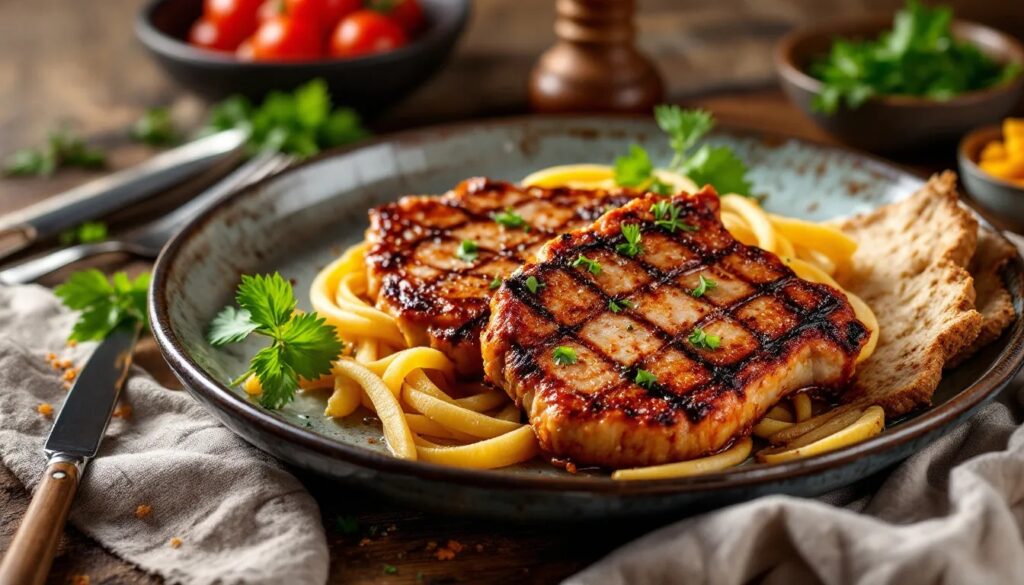
At its heart, this recipe is a testament to the confluence of global ingredients that have found a welcoming sanctuary in American pantries. Take the humble pork chop, a ubiquitous cut across many cultures, but here rendered distinctly American through its preparation. The genius lies in the glaze: a vibrant, tangy, and subtly sweet concoction born from the unlikely yet iconic pairing of ketchup and brown sugar. Ketchup, itself a fascinating global traveler, began its journey as a fermented fish sauce in ancient China, evolving through European adaptations before finding its quintessential tomato-based form in 19th-century America. Paired with brown sugar, a staple of both colonial sweetening and later American barbecue, it forms the bedrock of countless beloved American glazes, from ham to meatloaf, and now, to these succulent pork chops.
But the story doesn’t end there. The supporting cast of spices paints an even richer picture of global migration. Paprika, with its warm hue and gentle heat, harks back to the New World chili peppers, a gift from the Americas to the Old World via the Columbian Exchange, later becoming a cornerstone in Hungarian and Spanish cuisines before making its way to American spice racks. Ginger, a spice whose fragrant roots lie deep in Southeast Asia, traversed ancient trade routes, bringing its distinctive warmth to dishes across continents. And then there are the Mediterranean whispers of dried oregano and basil, staples of Italian and Greek cooking, whose aromatic presence here speaks to the waves of European immigrants who enriched America’s culinary landscape.
The inclusion of celery salt is a particularly telling detail, a seasoning that, while seemingly minor, is deeply embedded in American culinary history, particularly associated with hot dogs, Bloody Marys, and regional comfort foods. It adds an earthy, savory counterpoint to the sweetness, grounding the dish firmly in a North American context.
Traditionally, such pork chops would have been pan-fried or baked, offering a beautiful crust on the outside and tender succulence within. For home cooks, this method remains king: dredging the chops in flour and spices creates a protective, flavor-rich coating, allowing them to achieve a golden-brown perfection before being bathed in the delectable glaze. Modern kitchens might opt for oven-baking after a quick sear for convenience, or even grilling for a smoky twist, but the essence remains a hearty protein caramelized in a sticky, savory-sweet sauce.
For kitchen tips, ensure your pork chops are at room temperature before cooking for even doneness. Don’t overcrowd the pan when searing, as this will steam rather than brown the meat. A good sear is crucial for developing flavor and creating a crust that will hold up to the glaze. When making the glaze, a gentle simmer will allow the flavors to meld and the sauce to thicken perfectly. And remember, the beauty of this dish lies in its adaptability – feel free to adjust the spice levels or the sweetness of the glaze to suit your palate. This ‘Spiced Pork Chops’ recipe is more than just a meal; it’s a culinary journey, a testament to how flavors travel, evolve, and ultimately find a cherished place on our plates, reflecting the rich mosaic of human history and migration.
SPICED PORK CHOPS
Discover an enduring classic with these exquisitely spiced pork chops, a dish designed to captivate the palate. Each chop is first expertly seared to develop a rich, golden crust, then gently baked, bathed in a vibrant, balanced sauce boasting notes of sweet tomato and subtle tang. The result is a supremely tender, deeply flavorful main course that promises both comforting familiarity and gourmet satisfaction.
Ingredients
-
4
None
pork loin chops
about ¾-inch thick -
1½
tsp.
ground mustard
None -
1½
tsp.
garlic powder
None -
1/2
tsp.
celery salt
None -
1/8
tsp.
dried oregano
None -
pinch
None
pepper
None -
1/2
cup
flour
None -
1½
tsp.
paprika
None -
1/4
tsp.
ginger
None -
1/8
tsp.
dried basil
None -
1/8
tsp.
salt
None -
1 to 2
tbsp.
cooking oil
for browning -
1
cup
ketchup
None -
1
cup
water
None -
1/4
cup
packed brown sugar
None -
1 to 2
tbsp.
cooking oil
for sauce mixture; as written in original recipe
Instructions
-
In a shallow dish, thoroughly whisk together the flour, ground mustard, garlic powder, celery salt, dried oregano, a delicate pinch of pepper, vibrant paprika, pungent ginger, aromatic dried basil, and fine salt to create your dry seasoning blend.
-
Generously press each pork chop into the prepared dry mixture, ensuring a complete and even coating on both sides.
-
Heat 1 to 2 tablespoons of cooking oil in a large skillet over medium-high heat. Once shimmering, carefully place the coated chops into the hot pan and sear them until a beautiful golden-brown crust forms on both sides.
-
Carefully transfer the seared chops from the skillet and arrange them snugly within a greased 13 x 9 x 2-inch baking dish.
-
In a separate bowl, combine 1 to 2 tablespoons of cooking oil, 1 cup of rich ketchup, 1 cup of water, and ¼ cup of packed brown sugar. Whisk vigorously until the mixture is smoothly integrated, forming your delectable sauce.
-
Pour the prepared sauce generously over the chops in the baking dish, ensuring each piece is thoroughly enveloped.
-
Bake the chops, uncovered, for approximately one hour, or until they yield effortlessly to a fork, indicating perfect tenderness.
Recipe Notes
This beloved recipe, a testament to timeless home cooking, originates from the kitchen of Char Hall, and its original proponents described it as nothing short of ‘exceptional.’ A distinctive element of this preparation is the specified inclusion of 1-2 tablespoons of cooking oil directly into the sauce mixture; this is an intentional instruction from the original recipe and is believed to contribute a luxurious richness and improved mouthfeel to the finished glaze.
Global Heritage Archive
Anthropological & Spice Migration Record
“A culinary culture emphasizing accessible pantry ingredients, hearty sweet-and-savory flavors, and convenience, deeply rooted in American home cooking traditions.”
🌿 Spice & Botanical Migration
Black pepper, originating from India’s Malabar Coast, reached global tables via the ancient Spice Routes. Ginger, native to Southeast Asia, followed similar trade paths across continents. Paprika, derived from New World chili peppers, traveled from the Americas to Europe with explorers, while oregano and basil, rooted in the Mediterranean, spread through Roman influence and later global trade.
🏺 Historical & Archaeological Record
The domestication of pigs for pork consumption dates back to approximately 9000 BCE in Çayönü, southeastern Turkey. Evidence of frying and cooking with oils, a key technique for preparing chops, is found in ancient civilizations, with written recipes detailing such methods appearing in Roman texts like Apicius’s ‘De re coquinaria’ around the 4th century CE. The specific sweet-savory glaze style, however, is a much more recent development, primarily emerging in American cuisine in the 18th-19th centuries.
💡 Little Known Facts
- Ketchup, a core ingredient in this dish’s glaze, traces its origins not to tomatoes, but to a fermented fish sauce called ‘kê-tsiap’ from Fujian, China, introduced to Europeans in the 17th century.
- Celery salt, a distinctly American spice blend, became popular in the early 20th century, notably gaining fame as a key ingredient in the Bloody Mary cocktail and hot dog condiments.
- While paprika is a staple in Hungarian and Spanish cuisines, its source, the chili pepper, is indigenous to the Americas and was introduced to Europe via the Columbian Exchange.
📸 Made This Heritage Recipe?
We would love to see how your dish turned out! Send a photo of your culinary creation to [email protected] to be featured in our community gallery.
Leave a review and rate this recipe below!
Curated Literature & Washington DC Downtown Calendar
The Culinary Alchemist: Modern Gastronomy & Flavor Pairing
By LDN Gastronomy Series
Artisanal technique, seasonal sourcing, and kitchen mastery.
Upcoming Downtown Happenings
Live acoustic sessions, gallery receptions, literary salons, and independent trade shows across Washington DC.
