
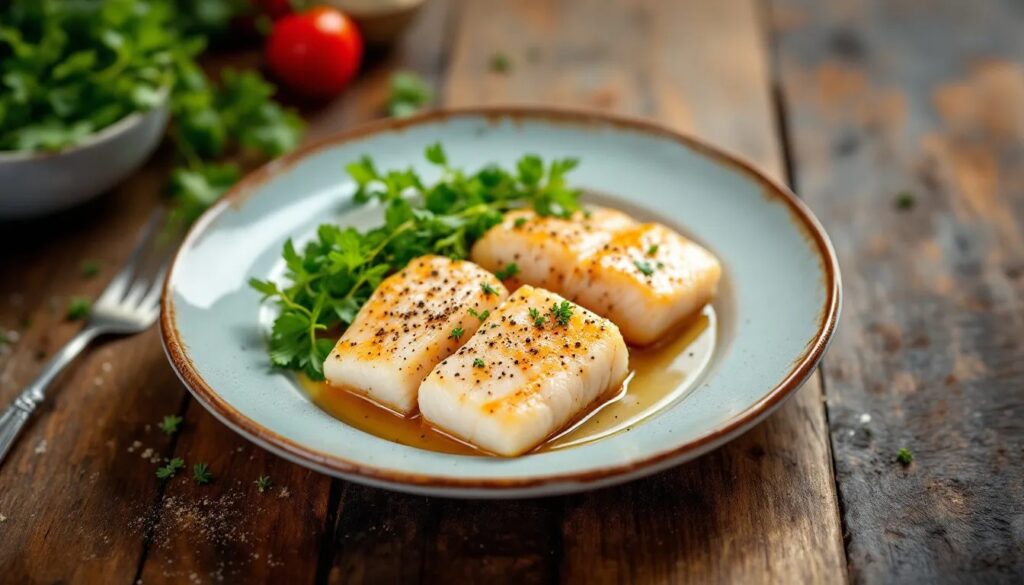
At its heart lies the sole, a fish revered across European tables for its delicate, mild flavor and firm, flaky texture. Often referred to as the ‘queen of the ocean,’ sole has historically graced the plates of aristocracy and gourmands, prized for its sheer elegance and versatility. Its understated character makes it a perfect canvas, allowing other ingredients to sing without being overshadowed. The preparation here, a quick sauté, honors its natural tenderness, ensuring a moist, succulent result.
Providing the aromatic soul of the dish are shallots, or perhaps their more robust cousin, scallions. These gentle alliums, with their milder, sweeter, and more nuanced flavor profile compared to onions, have a fascinating migratory tale. Believed to originate in Central Asia, shallots traveled westward, becoming indispensable in Middle Eastern and European cuisines by the Middle Ages. In France, they are a cornerstone, forming the aromatic base for countless sauces and preparations, valued for their ability to add depth without aggression.
Then enters Cognac, the distinguished spirit from the eponymous region of France. More than just a drink, Cognac is a culinary powerhouse. Its historical journey from a local wine to a world-renowned distilled spirit is intrinsically linked to its terroir and the meticulous craft of distillation. In the kitchen, its role is transformative: it deglazes the pan, lifting the savory browned bits left by the fish, and its complex notes of fruit, floral, and subtle oak infuse the resulting sauce with warmth and sophistication. The alcohol evaporates, leaving behind only concentrated flavor, a testament to the French art of sauce-making.
Finally, the fundamental pillars: salt and pepper. These ancient seasonings, seemingly commonplace today, were once highly coveted commodities that drove empires and shaped global trade. Salt, essential for life and preservation, has been a cornerstone of human civilization since antiquity. Black pepper, originating from the humid Malabar Coast of India, was once known as ‘black gold,’ its journey along the fabled Spice Routes making it a luxury item that transformed European cuisine. Together, they provide the essential balance, enhancing and unifying the delicate flavors.
For the home cook, the beauty of this dish lies in its approachable sophistication. The key is in the details: pat the sole fillets thoroughly dry to ensure a beautiful sear; don’t overcrowd the pan, allowing the fish to brown evenly; and most importantly, treat the deglazing process with reverence, scraping up every flavorful morsel. A quick reduction of the Cognac-infused shallot mixture creates a light yet intensely flavorful sauce, transforming simple fish into an exquisite meal. This dish is not just food; it is a narrative on a plate, an embodiment of history, migration, and the timeless joy of refined taste.
Seasoning The Fish Fillets
Unlocking the delicate essence of sole, this refined technique orchestrates a symphony of subtle flavors. By harmonizing the gentle, aromatic sweetness of shallots with the elegant warmth of Cognac, this foundational preparation promises to imbue your fish with a sophisticated depth, setting the stage for a truly exquisite Choulibiac.
Ingredients
-
16
None
skinless and boneless sole fillets
about 2 pounds -
Several
None
shallots or scallions
to make 3 Tablespoons -
A little
None
Cognac
None -
None
None
Salt
to taste -
None
None
Pepper
to taste
Instructions
-
Begin by finely dicing the shallots. Designate and set aside precisely half of the minced shallots; these will be reserved for a subsequent mushroom preparation.
-
Select a suitable rectangular or oval baking dish. Evenly scatter approximately one teaspoon of the remaining finely diced shallots across the base of the vessel.
-
Carefully arrange the sole fillets in an overlapping fashion, forming a uniform layer atop the shallot bed.
-
Delicately season this initial layer with a whisper of fine sea salt and freshly cracked black pepper. Follow with a light scattering of additional minced shallots and a few judicious drops of Cognac. Repeat this layering and seasoning process until all sole fillets are utilized.
-
Encase the dish snugly with food-grade plastic wrap, then transfer it to the refrigerator to chill, allowing the flavors to meld.
Recipe Notes
This preliminary infusion is designed to establish the foundational flavor profile for the fish element within a sophisticated Choulibiac. The portion of shallots designated as ‘reserved’ is intended for a separate, yet complementary, mushroom preparation integral to the complete Choulibiac recipe, which is not elaborated upon in these instructions.
Global Heritage Archive
Anthropological & Spice Migration Record
“A refined culinary tradition that emphasizes high-quality, often locally sourced ingredients, delicate flavors, and sophisticated techniques, often originating from aristocratic kitchens and evolving into haute cuisine.”
🌿 Spice & Botanical Migration
Black pepper (Piper nigrum) originates from the Malabar Coast of India, traversing ancient trade routes like the Spice Route to become a highly coveted luxury in Europe from Roman times, eventually transitioning to a common seasoning. Shallots, believed to have originated in Central Asia, spread across the Middle East to Europe by the Middle Ages, becoming a cornerstone aromatic in French cuisine due to their milder, sweeter flavor than onions. Cognac, a specific type of brandy, is intrinsically tied to the Cognac region of France, its use reflecting a highly localized product integrated into a sophisticated regional culinary tradition.
🏺 Historical & Archaeological Record
The foundational techniques of sautéing fish and crafting a pan sauce with aromatics and an alcoholic liquid have ancient precedents. Roman texts like Apicius (4th-5th century CE) detail similar methods involving fish, herbs, and wine-based sauces. While the precise combination of sole and Cognac is a more refined development within French haute cuisine (emerging strongly from the 17th century onwards), the underlying culinary principles of delicate protein preparation, aromatic infusion, and deglazed sauce creation can be traced back to early European culinary traditions, with written records detailing sophisticated fish cookery appearing in medieval cookbooks.
💡 Little Known Facts
- Sole, particularly varieties like Dover sole, has long been considered a premium fish in French haute cuisine due to its delicate flavor and firm, white flesh, often commanding high prices historically.
- The use of Cognac in this dish serves not only as a flavor enhancer but also as a powerful deglazing agent, its high alcohol content effectively lifting the browned, caramelized bits (fond) from the pan, which are essential for building a rich, deep sauce.
📸 Made This Heritage Recipe?
We would love to see how your dish turned out! Send a photo of your culinary creation to [email protected] to be featured in our community gallery.
Leave a review and rate this recipe below!
Curated Literature & Washington DC Downtown Calendar
The Culinary Alchemist: Modern Gastronomy & Flavor Pairing
By LDN Gastronomy Series
Artisanal technique, seasonal sourcing, and kitchen mastery.
Upcoming Downtown Happenings
Live acoustic sessions, gallery receptions, literary salons, and independent trade shows across Washington DC.
