
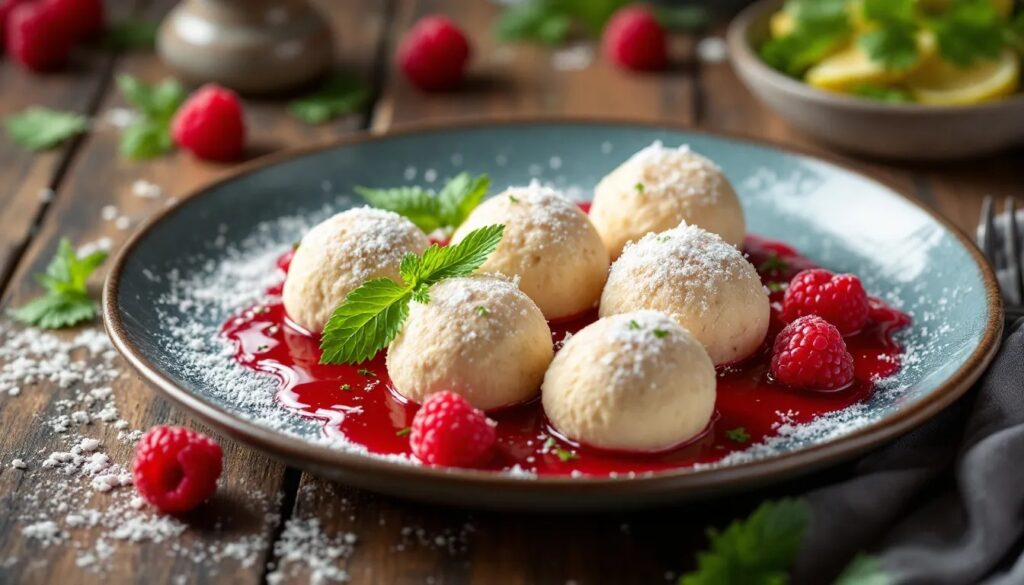
Our story begins, as many great culinary tales do, in France. The very word “truffle” is borrowed from the prized subterranean fungi, “la truffe,” a testament to the original confection’s rustic, lumpy appearance. Legend often credits Louis Dufour, a pâtissier in Chambéry, France, in 1895, with rolling a ball of chocolate ganache in cocoa powder to create the first bonbon resembling its earthy namesake. Others point to Auguste Escoffier in the 1920s, with an accidental pour of hot cream over chocolate scraps leading to the serendipitous discovery of ganache itself—a rich, smooth emulsion that would become the heart of countless desserts. This simple yet profound marriage of bittersweet chocolate and heavy cream forms the foundational elegance of French patisserie, a testament to its philosophy of elevating simple ingredients through meticulous technique and aesthetic presentation.
But the ingredients themselves tell a far grander narrative of global migration. The very soul of the truffle, *chocolate*, journeyed thousands of miles and across oceans. Its botanical origins lie deep in the rainforests of Mesoamerica, where the Olmec, Maya, and Aztec civilizations cultivated cacao for millennia, consuming it as a bitter, spiced beverage, often reserved for ritual and royalty. It was Hernán Cortés who introduced cacao to Spain in the 16th century, sparking its slow, deliberate transformation in Europe. Europeans, initially wary of its bitterness, gradually began to sweeten it, eventually transforming it from a drink to a solid confection – a process heavily reliant on the next crucial ingredient: *sugar*.
Sugar, too, has a complex and often bitter history. Originating in New Guinea and spreading through India and the Arab world, sugarcane cultivation exploded in the “New World” following the Columbian Exchange. Vast plantations in the Caribbean and Americas, fueled by the brutal institution of enslaved labor, made sugar widely available and affordable in Europe, fundamentally altering European palates and culinary landscapes. Without this influx of inexpensive sugar, the solid, palatable chocolate we know today, and by extension the truffle, might never have existed.
Adding the bright, fruity counterpoint to this rich history is the *raspberry*. Unlike chocolate and sugar, raspberries are native to the temperate climes of the Northern Hemisphere, including Europe. Their tart sweetness and vibrant color have long graced European gardens and tables, readily preserved in jams and jellies. In our truffle, raspberry jam offers a delightful burst of local flavor, a familiar comfort against the exotic complexity of chocolate and sugar, marrying local bounty with global imports.
Crafting these raspberry truffles is an exercise in mindful precision. Begin with high-quality bittersweet chocolate, its depth essential to balancing the sweetness. Gently heat the heavy cream, then pour it over the finely chopped chocolate, allowing the residual heat to melt it into a silken ganache. The raspberry jam is then folded in, infusing the mixture with its characteristic fruitiness. The careful cooling process is paramount—too warm, and it won’t hold its shape; too cold, and it will be unworkable. Once perfectly firm, scoop and roll the ganache into imperfect spheres, embracing their “truffe-like” irregularities before dusting them liberally with confectioners’ sugar. The resulting bonbon is not just a treat; it is a delicious artifact, a bite-sized chronicle of botanical journeys, trade routes, colonial legacies, and the enduring human desire for culinary artistry.
RASPBERRY TRUFFLES
Journey to a realm of exquisite indulgence with these peerless Raspberry Truffles, a timeless confection that whispers of artisanal craftsmanship and refined pleasure. Each meticulously crafted bite unveils a vibrant heart of concentrated raspberry essence, elegantly enrobed in a cloak of profound bittersweet chocolate. A symphony of textures and tastes, these truffles transcend the ordinary, making them an impeccable offering for momentous celebrations or a discreet luxury reserved for moments of personal bliss.
Ingredients
-
½
cup
heavy cream
None -
1½
cup
raspberry jam
strained -
14
ounces
bittersweet chocolate
None -
½
cup
granulated sugar
None -
None
None
Confectioners’ sugar
if necessary
Instructions
-
In a robust, heavy-bottomed saucepan, bring the heavy cream to a vigorous simmer over high heat, ensuring it reaches the point just before a full boil.
-
Immediately withdraw the saucepan from the heat source.
-
Incorporate 8 ounces of the bittersweet chocolate, precisely portioned into small pieces, into the hot cream. Stir continuously with a spatula or whisk until the chocolate has completely dissolved, yielding a velvety, homogenous ganache.
-
Gently fold in the meticulously strained raspberry jam. Cover the mixture securely and refrigerate for a minimum of 60 minutes, or until it achieves a firm, workable consistency.
-
Using impeccably clean hands, shape the chilled ganache into uniform spheres approximately the size of a walnut. Should the mixture prove excessively adherent, lightly dust your palms with confectioners’ sugar to facilitate handling.
-
Arrange the sculpted truffles onto a baking sheet thoughtfully lined with parchment or wax paper. Return them to refrigeration for at least an additional hour, or until they have fully firmed.
-
In a separate, small, heavy-bottomed saucepan, gently melt the remaining 6 ounces of chocolate over very low heat. Stir intermittently until the chocolate is utterly smooth and free of any lumps.
-
Remove the pan from the heat. With delicate precision, immerse each thoroughly chilled truffle into the molten chocolate, ensuring a uniformly thin, lustrous coating. Allow any excess to drip away.
-
Immediately after coating, gently roll the truffles in the granulated sugar to achieve a sparkling finish.
-
For an elevated presentation, nestle the finished truffles into individual candy papers, if desired. Chill for a minimum of one hour prior to serving to allow the chocolate to set perfectly.
Recipe Notes
These exquisite truffles are best enjoyed at cool room temperature, allowing their complex flavors to fully blossom. Store them in an airtight container in the refrigerator for up to one week. For an additional touch of sophistication, consider dusting with a fine cocoa powder instead of granulated sugar, or even a delicate swirl of melted white chocolate for a striking visual contrast. A pinch of sea salt added to the initial ganache can beautifully enhance the bittersweet chocolate notes.
Global Heritage Archive
Anthropological & Spice Migration Record
“A sophisticated culinary tradition emphasizing refined techniques, high-quality ingredients, and aesthetic presentation in confectionery.”
🌿 Spice & Botanical Migration
The primary flavoring, chocolate, originated from cacao beans in Mesoamerica and was brought to Europe by Spanish conquistadors in the 16th century via the Columbian Exchange. Sugar, vital for sweetening chocolate and forming confectionery, traces its botanical roots to New Guinea and spread globally via ancient trade routes to India and the Middle East, becoming a dominant crop in the Americas through colonial trade. Raspberries are native to the temperate Northern Hemisphere, widely cultivated in Europe for centuries.
🏺 Historical & Archaeological Record
The oldest archaeological evidence for *cacao* consumption (as a beverage) dates back to 1900-1500 BCE in Olmec sites in Mesoamerica. The earliest written records for a *solid chocolate confection* as distinct from a beverage, and the *ganache technique* fundamental to truffles, are found in European culinary texts from the 17th-19th centuries, specifically gaining prominence in French patisserie in the 19th century.
💡 Little Known Facts
- The term “ganache,” the rich chocolate and cream emulsion that forms the heart of a truffle, is said to have originated from a French apprentice’s mistake of spilling cream into chocolate, leading the master to exclaim “ganache!” (meaning “fool” or “idiot”).
- While modern chocolate truffles are associated with France in the late 19th century, the first solid chocolate bars, precursors to modern confectionery, were introduced in Europe in the 17th century, though they were often gritty and less refined than today’s chocolate.
📸 Made This Heritage Recipe?
We would love to see how your dish turned out! Send a photo of your culinary creation to [email protected] to be featured in our community gallery.
Leave a review and rate this recipe below!
Curated Literature & Washington DC Downtown Calendar
The Culinary Alchemist: Modern Gastronomy & Flavor Pairing
By LDN Gastronomy Series
Artisanal technique, seasonal sourcing, and kitchen mastery.
Upcoming Downtown Happenings
Live acoustic sessions, gallery receptions, literary salons, and independent trade shows across Washington DC.
