
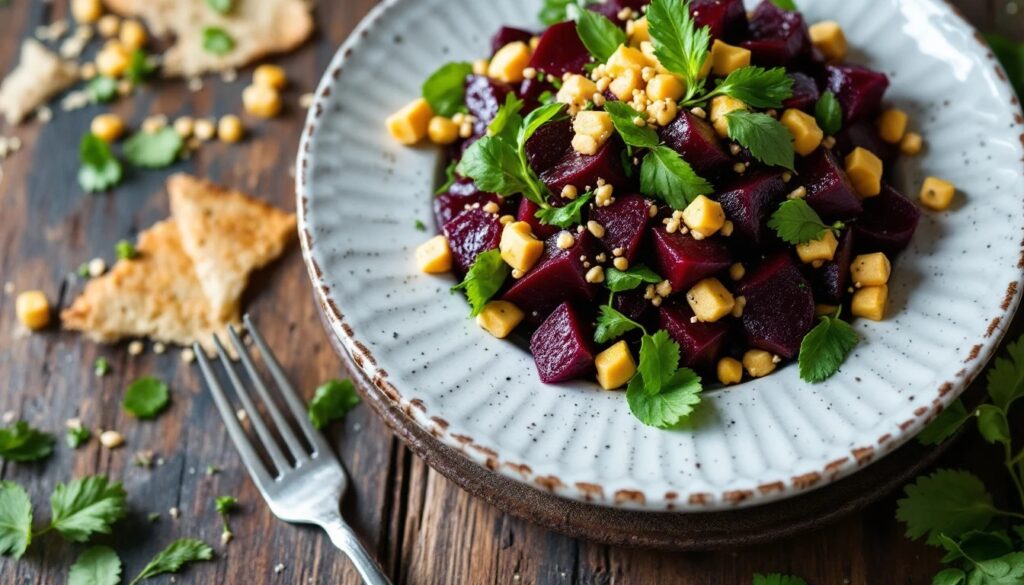

In the annals of American culinary history, few dishes capture the spirit of an era quite like the ‘Molded Beet Salad.’ More than just a collection of ingredients suspended in shimmering gelatin, this vibrant ruby creation is a gelatinous time capsule, whisking us back to the mid-20th century. It embodies an era defined by newfound domesticity, convenience foods, and a peculiar fascination with the aesthetic appeal of molded dishes, transforming everyday vegetables into a celebratory centerpiece.
The story of the molded salad truly blossoms in post-World War II America. With soldiers returning home, the baby boom in full swing, and suburban sprawl setting the stage for new household dynamics, the American kitchen underwent a revolution. Convenience became king, and processed foods, including the versatile Jell-O, soared in popularity. Homemakers, eager to present elegant yet accessible dishes for everything from Sunday dinners to church potlucks and bridge club luncheons, found an ideal canvas in gelatin. The ‘Molded Beet Salad’ perfectly exemplifies this trend: a dish that looked sophisticated and required minimal fuss.
Our humble ingredients tell tales of global migrations. Beets, with their earthy sweetness and stunning crimson hue, trace their origins to the Mediterranean region, cultivated for millennia before making their way across Europe and eventually to the Americas. Celery and onions, too, boast ancient Mediterranean and Central Asian roots respectively, becoming fundamental aromatics in diverse cuisines worldwide. Mustard seed, a pungent counterpoint in our salad, shares a similar journey from the Mediterranean and Asia Minor, its piquant charm traveling trade routes for centuries. White vinegar, an ancient preserving agent, and sugar, a luxury that became a staple through colonial expansion and global trade from its Southeast Asian origins, are equally vital. But it is the lemon Jell-O that truly grounds this recipe in its specific historical moment—a product of American industrial innovation and marketing genius.
Traditional preparation involved dissolving the flavored gelatin in hot beet juice (often augmented with water), then chilling it until partially set. Finely diced or julienned cooked beets, celery, and onion, along with a dash of white vinegar, sugar, and mustard seed, would then be folded into the semi-set gelatin. The mixture was then poured into an ornate mold, often a ring shape, and left to fully set in the refrigerator. The dramatic reveal, carefully unmolding the glistening salad onto a bed of lettuce, was a moment of culinary triumph.
For those venturing into this retro delight today, a few kitchen tips can ensure success. Ensure all vegetables are thoroughly drained to avoid watering down the gelatin. For an easier unmolding experience, lightly grease your mold with a neutral oil before pouring in the mixture, or briefly dip the mold in warm water before inverting. This salad, while a product of its time, offers a fascinating blend of sweet, sour, and savory, a testament to an era’s particular culinary sensibilities. It’s more than just a recipe; it’s a tangible piece of American history on a plate.
MOLDED BEET SALAD
Elevating the humble beet to an art form, this captivating molded salad is a celebration of contrasting textures and harmonious flavors. It masterfully marries the earthy sweetness inherent in garden-fresh beets with the spirited brightness of a citrus-infused gelatinous base. A testament to timeless elegance, it presents a visually stunning and delightfully wobbly centerpiece, offering a refreshing counterpoint to any sophisticated spread. Prepare to enchant your guests with a dish that is as unique in taste as it is in its shimmering presentation.
Ingredients
- 1 can julienne beets
- 1 cup beet juice add water to make 1 cup
- 1 cup celery chopped
- 1 onion grated
- ½ cup white vinegar
- 1/2 cup sugar
- 1 ½ tbsp. mustard seed
- 1-3 oz. pkg. lemon Jell-O
Instructions
-
Carefully drain the julienned beets, ensuring to collect and reserve their vibrant crimson liquid. Supplement this reserved juice with water until precisely one cup of total liquid is achieved.
-
Finely dice the crisp celery stalks and grate the pungent onion, preparing them for incorporation.
-
In a small saucepan, combine the measured beet juice mixture, white vinegar, granulated sugar, and mustard seeds. Bring this mixture to a rolling boil over medium-high heat.
-
Immediately pour the scalding hot liquid over the lemon-flavored gelatin granules in a heatproof bowl. Whisk continuously until the gelatin is completely dissolved and no solids remain.
-
Gently fold in the prepared, drained julienned beets, the finely diced celery, and the grated onion, ensuring even distribution throughout the liquid mixture.
-
Transfer the complete mixture into your chosen decorative mold. Refrigerate for several hours, or until the salad has completely set and holds its elegant form.
Recipe Notes
This exquisite molded creation, a testament to culinary ingenuity, offers a delightful interplay of sweet and savory notes. Its vibrant hue and unique, shimmering texture make it an unexpected showstopper, perfect for a sophisticated brunch or as a refreshing accompaniment to roasted meats. While reminiscent of classic aspics, its bright, piquant profile ensures a contemporary appeal. For an elevated presentation, consider garnishing with fresh herbs like dill or a dollop of crème fraîche before serving. A truly captivating dish that promises to spark conversation.
Global Heritage Archive
Anthropological & Spice Migration Record
“This dish is emblematic of mid-20th century American ingenuity in creating aesthetically pleasing, convenient, and often sweet-savory molded dishes for communal gatherings and family meals.”
🌿 Spice & Botanical Migration
Mustard seed, native to the Mediterranean region and parts of Asia, journeyed westward through ancient trade routes across Europe, becoming a staple spice that later migrated to the Americas with European colonization. Sugar, originally derived from sugarcane in Southeast Asia and New Guinea, traveled via the Silk Road to the Middle East, then to Europe, eventually becoming widely accessible in the Americas through colonial plantations and global trade networks, fundamentally altering global cuisine.
🏺 Historical & Archaeological Record
While the specific ‘molded salad’ using commercial fruit-flavored gelatin is a 20th-century American innovation, the broader concept of gelatinous, molded savory dishes (aspics) dates back much further. The oldest written records of aspic-like preparations can be found in medieval European cookbooks, such as ‘Le Viandier’ from 14th-century France, detailing methods to clarify and set meat broths into shimmering molds.
💡 Little Known Facts
- Jell-O was declared ‘America’s Most Famous Dessert’ in 1904, though savory Jell-O molds like this beet salad gained peak popularity decades later, particularly in the post-WWII era.
- Molded salads were often served at church potlucks, bridge club gatherings, and family dinners, symbolizing a hostess’s ability to present an elegant, yet often simple-to-make, dish.
Historical Locality Cartographic Map — Mestizo Media Archive
📸 Made This Heritage Recipe?
We would love to see how your dish turned out! Send a photo of your culinary creation to [email protected] to be featured in our community gallery.
Leave a review and rate this recipe below!
Curated Literature & Washington DC Downtown Calendar
The Culinary Alchemist: Modern Gastronomy & Flavor Pairing
By LDN Gastronomy Series
Artisanal technique, seasonal sourcing, and kitchen mastery.
Upcoming Downtown Happenings
Live acoustic sessions, gallery receptions, literary salons, and independent trade shows across Washington DC.
