
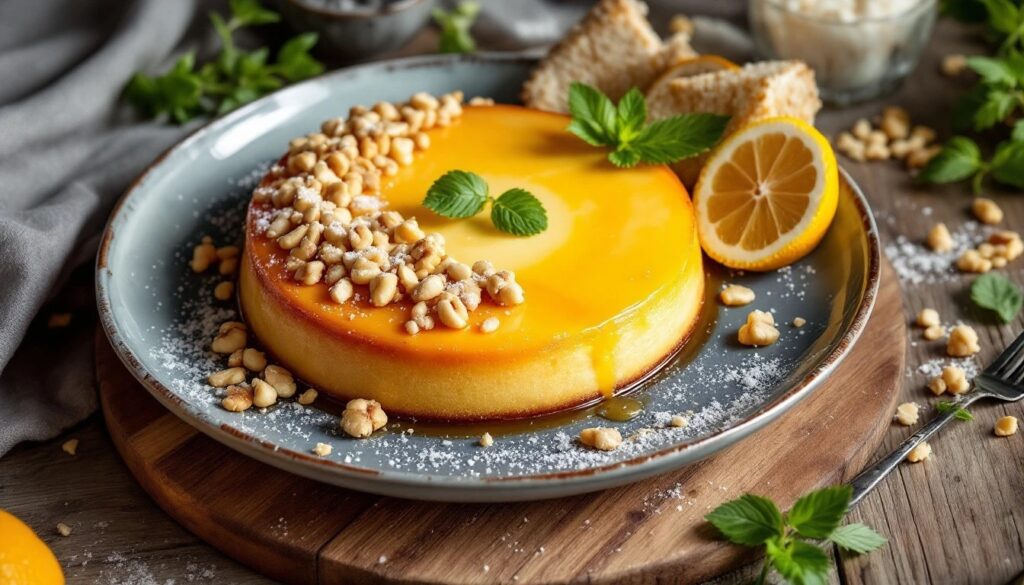
The foundation of this dish, the flan itself, boasts an ancient lineage. Its ancestors can be traced back to the kitchens of ancient Rome, where dishes like *tyropatinam* showcased the simple elegance of baked custards made with eggs and milk. Over centuries, this concept traveled, evolving significantly in medieval Europe, particularly in Spain, where it embraced the name “flan” and often took on a savory character before transforming into the sweet, caramel-topped delicacy we recognize today. Spanish colonizers then carried this culinary tradition across the Atlantic, embedding flan deeply into the vibrant dessert repertoires of Latin America, where it became a beloved staple, synonymous with celebration and comfort.
Yet, this particular flan bears a distinctly American twist: the inclusion of cream cheese. This ubiquitous ingredient, so fundamental to modern baking, was a relatively recent innovation, born not in the Old World, but in upstate New York in 1872. Dairyman William Lawrence, in an attempt to recreate a popular French cheese, inadvertently created something entirely new and destined for culinary stardom. Cream cheese quickly became a cornerstone of American desserts, most famously giving rise to the iconic New York cheesecake. Its appearance in a flan recipe marks a fascinating point of intersection, a deliberate or organic fusion where two distinct culinary traditions meet and meld.
This hybrid dessert likely blossomed in the fertile ground of Mexican-American communities, where traditional Latin American cooking converged with readily available American ingredients and evolving tastes. The flan format, deeply ingrained, was ingeniously adapted to incorporate the luscious richness of cream cheese, creating a dessert that resonated with both cultural palates. The addition of a pastry crust, while not traditional for classic flan, further nods to American baking traditions, bridging the gap between a standalone custard and a more substantial pie or tart.
The supporting cast of flavors further illustrates this global exchange. Vanilla, with its intoxicating aroma, is a true native of Mesoamerica, cultivated for centuries by the Totonac people before being introduced to the world by Spanish explorers. Nutmeg, that warm and comforting spice, traveled epic distances from the remote Banda Islands of Indonesia, a prized commodity on ancient spice routes. Lemon, providing its essential zest and brightness, began its journey in ancient India, spreading westward through the Middle East and Mediterranean, eventually gracing dishes across the globe. These ingredients, each with their own migratory tale, converge to define the unique character of this flan.
Preparing this Lemon Cream Cheese Flan is an act of culinary archaeology and innovation. To achieve that coveted smooth, creamy texture, ensure all dairy and cream cheese are at room temperature before blending. A water bath (bain-marie) during baking is crucial for even cooking and preventing cracks. Don’t rush the cooling process; patience is key for the flan to set perfectly. The sugar-walnut topping, a crunchy counterpoint to the silky custard, adds a final layer of indulgence. More than just a dessert, this flan is a celebration of culinary adaptation, a delicious reminder that food is a living, breathing testament to human connection and the continuous beautiful journey of culture.
Lemon Cream Cheese Flan with Sugar-Walnut Topping
Embark on a culinary journey to an era of refined indulgence with this exquisite Lemon Cream Cheese Flan. A testament to timeless dessert artistry, this creation gracefully marries a delicate, golden-hued pastry base with a sumptuously smooth, intensely zesty lemon and cream cheese core. Each slice is crowned with an irresistible, candied sugar-walnut crunch, orchestrating a symphony of textures and vibrant flavors. Whether gracing an elegant dinner party or savored as a comforting, personal treat, this flan promises pure delight, equally captivating when served warm from the oven or beautifully chilled.
Ingredients
- 1½ cups all-purpose flour
- 1½ sticks unsalted butter chilled
- 2 Tablespoons chilled lard or shortening
- 5 to 8 Tablespoons iced water
- 4 large eggs
- 1½ cups heavy cream
- 4 Tablespoons lemon juice or more
- 8 ounces cream cheese
- 1 teaspoon vanilla
- 1½ teaspoon salt
- The grated rind of 1 lemon zest
- 4 Tablespoons sugar
- A pinch of nutmeg
- 4 to 5 Tablespoons sugar for topping
- 4 to 5 Tablespoons walnuts chopped, for topping
Instructions
-
For the Pastry Dough: Into a spacious mixing bowl, introduce the flour, a whisper of salt, the cold, diced unsalted butter, and the chilled lard or shortening. Employ a pastry blender or your fingertips to work the ingredients together until the mixture achieves the consistency of coarse crumbs.
-
Incorporate the iced water, spoonful by spoonful, continuing to mix until the dough just begins to cohere. Gently press the nascent dough against the bowl's interior to encourage it to gather into a unified mass. Transfer this mass to a lightly floured surface and gently work it only two or three times. Envelop the dough securely in plastic wrap and allow it to rest in the refrigerator.
-
Once adequately chilled, roll out the dough on a lightly floured surface to fit your chosen flan ring. Carefully settle the pastry into the ring, trimming any excess. Return the prepared crust to the refrigerator for a further 20 minutes to firm up.
-
To Blind Bake the Shell: Position an oven rack in the middle and preheat your oven to 400°F (200°C). Line the chilled pastry shell with parchment paper, then fill it with ceramic baking weights, dried beans, or rice. Bake for 10 minutes. Carefully lift out the parchment and weights, then gently prick the base of the pastry with a fork. Continue baking for an additional 5 minutes, or until the crust just begins to take on a delicate golden hue.
-
For the Velvety Filling: Into the vessel of a blender or food processor, introduce the large eggs, rich heavy cream, vibrant lemon juice, softened cream cheese, fragrant vanilla extract, fine salt, grated lemon rind, granulated sugar, and a mere whisper of nutmeg. Process until the mixture is utterly smooth and homogenous. As an alternative, you may choose to push the cream cheese through a fine-mesh sieve, then incorporate the remaining ingredients using a whisk until a silken texture is achieved.
-
For the Candied Walnut Topping: In a small preparatory bowl, delicately combine the granulated sugar and chopped walnuts. Set this mixture aside for later use.
-
Assembly and Initial Bake: Elevate the oven temperature to 425°F (220°C). Carefully decant the prepared lemon cream cheese filling into the blind-baked pastry shell, ensuring it reaches approximately 1/8-inch shy of the rim. Transfer to the preheated oven and bake for 10 minutes, or until the filling just begins to set at the edges.
-
Gently disperse the reserved candied walnut topping evenly across the partially set surface of the flan. Return to the oven and continue baking for another 10 minutes. Following this, reduce the oven temperature to 350°F (175°C).
-
Continue baking until the flan has gracefully puffed and taken on a light golden-brown hue, and the base pastry is fully browned. The comprehensive baking duration for the filled flan (subsequent to the initial blind bake) should span approximately 30 to 35 minutes.
-
Upon removal from the oven, permit the flan to rest undisturbed for 5 minutes. Then, with care, slide it from its ring onto a wire cooling rack, allowing it to reach a tepid temperature prior to serving. This exquisite dessert is equally delightful when thoroughly chilled.
Recipe Notes
A Note on Seasoning: You may observe that the specified quantity of salt for the sweet filling—1½ teaspoons—is rather generous for a dessert. This is intentional, designed to enhance and balance the rich flavors, but we encourage you to tailor this to your personal preference. For the pastry dough, the instructions call for a 'whisper of salt' (a pinch), which is sufficient to bring out the butter's richness without imparting a distinct salty taste. This versatile flan presents beautifully whether savored gently warmed or elegantly chilled.
Global Heritage Archive
Anthropological & Spice Migration Record
“The culinary culture surrounding this dish is a vibrant synthesis of traditional Latin American flan artistry with American dairy innovation and baking techniques, embodying a cross-cultural culinary dialogue within immigrant communities.”
🌿 Spice & Botanical Migration
Nutmeg, imparting its warm, earthy notes, originates from the Banda Islands of Indonesia, an ancient hub of the Spice Route that connected Asia, the Middle East, and Europe through millennia of trade. Vanilla, lending its sweet, aromatic essence, is native to Mesoamerica, specifically ancient Totonac lands in what is now Mexico, and was introduced to the rest of the world by Spanish conquistadors during the Columbian Exchange. Lemon, a key citrus element, traces its lineage to Northeast India, spreading west via the Middle East and Mediterranean, brought to the Americas by European explorers.
🏺 Historical & Archaeological Record
The earliest archaeological evidence and written records of baked custards, the precursor to modern flan, can be found in ancient Roman cookery texts, such as Apicius’ *De re coquinaria*, dating to the 4th-5th century CE, which describes dishes like *tyropatinam*—an egg and milk custard often flavored with honey and pepper.
💡 Little Known Facts
- While “flan” is a term commonly associated with Spain and Latin America, the modern dessert of flan as a sweet custard with caramel sauce actually evolved significantly in Europe long after its Roman predecessors, before migrating to the Americas.
- Cream cheese, a quintessential ingredient in this recipe, was serendipitously invented in New York in 1872 by dairyman William Lawrence when he attempted to replicate a French cheese.

Historical Locality Cartographic Map — Mestizo Media Archive
📸 Made This Heritage Recipe?
We would love to see how your dish turned out! Send a photo of your culinary creation to [email protected] to be featured in our community gallery.
Leave a review and rate this recipe below!
Curated Literature & Washington DC Downtown Calendar
The Culinary Alchemist: Modern Gastronomy & Flavor Pairing
By LDN Gastronomy Series
Artisanal technique, seasonal sourcing, and kitchen mastery.
Upcoming Downtown Happenings
Live acoustic sessions, gallery receptions, literary salons, and independent trade shows across Washington DC.
