
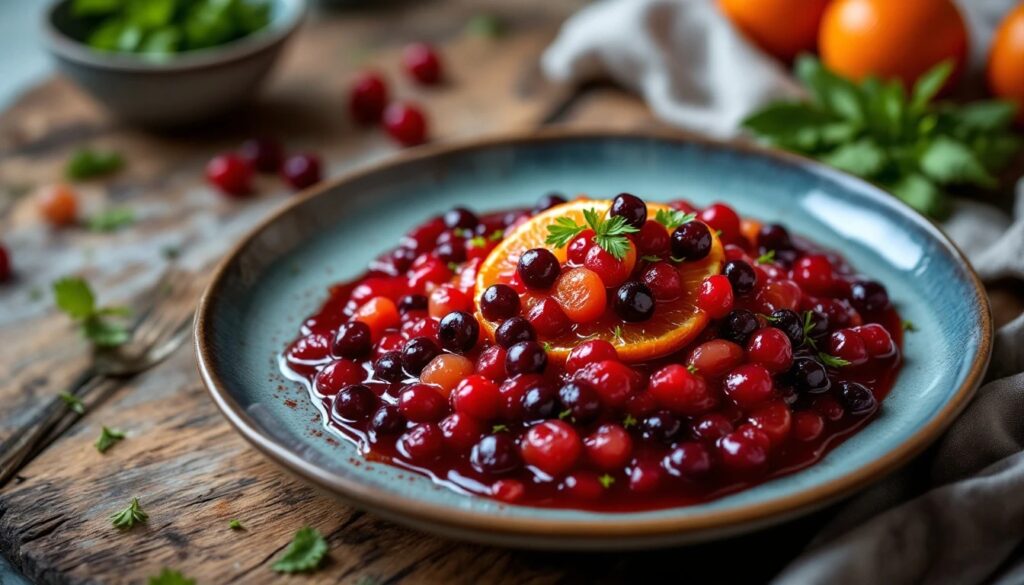
Our journey begins, as it must, with the cranberry itself. Indigenous to the bogs and wetlands of North America, *Vaccinium macrocarpon* — known as “sassamanash” by the Wampanoag people — was a vital resource long before European feet touched these shores. Native Americans harvested these tart berries, using them not just for food, but also as a natural dye, a potent medicine for wounds, and a scurvy preventative. They ingeniously mixed them with deer meat and fat to create “pemmican,” a high-energy, long-lasting travel food. When the Pilgrims arrived, they were introduced to this robust berry, which would eventually become inextricably linked with their harvest feasts, cementing its iconic status in what would become the quintessential American holiday: Thanksgiving.
But the transformation from a wild, native berry to a glistening jellied sauce required the intervention of two other globetrotting ingredients: the orange and sugar. The orange, with its vibrant hue and intoxicating aroma, hails from the verdant forests of Southeast Asia, a botanical ambassador that journeyed westward along the ancient Silk Road, gracing the tables of emperors and caliphs before finding its way to the Mediterranean. From there, it crossed the Atlantic during the Columbian Exchange, forever altering the culinary landscapes of the New World. Its zest and juice, bright and fragrant, perfectly complement the cranberry’s sharp tang, balancing its acidity with a sweet, citrusy lift.
Sugar, the third cornerstone of this recipe, tells an equally epic tale. Originating from sugarcane in New Guinea and Southeast Asia, its cultivation spread across India, Persia, and the Arab world, eventually reaching Europe. The demand for sugar fueled vast plantation economies and, tragically, the transatlantic slave trade, irrevocably shaping global demographics and economies. It is sugar that allows the cranberry to transmute from a tart berry into a luscious sauce, enabling its “jellied” consistency and providing the necessary sweetness to elevate its flavor profile.
The modern jellied sauce truly came into its own with the advent of food preservation techniques. Early American cookbooks from the late 18th and early 19th centuries featured recipes for cranberry sauce, but it was the 20th century and the rise of commercial canning that made it a year-round staple. Marcus L. Urann, founder of Ocean Spray, introduced the first commercially canned cranberry sauce in 1912, democratizing access and solidifying its omnipresence on the American holiday table. The convenience of a can meant that even those far from cranberry bogs could partake in this tradition, albeit often in a pre-molded, gelatinous form.
For those venturing beyond the can, crafting your own jellied orange cranberry sauce is a deeply rewarding experience. The secret lies in fresh ingredients: plump, ripe cranberries (whether fresh or frozen, they cook beautifully) and the zest and juice of a truly fragrant orange. The natural pectin in cranberries, activated by heat and sugar, does most of the work to create that coveted wobbly set. Gently simmering the berries with sugar, orange juice, and a generous grating of rind unlocks a symphony of flavors and aromas. A little tip: don’t overcook it; the sauce will thicken further as it cools. For an extra layer of complexity, consider adding a touch of cinnamon stick, a star anise pod, or a splash of orange liqueur during the cooking process.
In every spoonful of Jellied Orange Cranberry Sauce, we taste not just the tartness of the berry or the sweetness of the sugar, but a living history. It’s a testament to the resourcefulness of indigenous peoples, the ambition of explorers, the ingenuity of traders, and the enduring human desire to transform nature’s bounty into something celebratory and enduring. It’s a humble dish with a grand story, forever uniting continents and cultures on our holiday plates.
JELLIED ORANGE CRANBERRY SAUCE
Embark on a culinary journey with our exquisite Jellied Orange Cranberry Sauce, a showstopping condiment that effortlessly elevates any table setting. This vibrant, meticulously crafted creation harmonizes the sun-kissed brightness of citrus with the profound, ruby-red tartness of cranberries. The result is a stunningly clear, firm-set jewel, destined to become a beloved cornerstone of your festive feasts or a refreshing counterpoint to everyday fare, promising a burst of seasonal delight with every spoonful.
Ingredients
- 1 1/2 cups fresh orange juice None
- 1 1/2 cups sugar None
- 1 12 oz. bag cranberries picked over and rinsed (approximately 3 1/2 cups)
- 1 Tablespoon freshly grated orange rind None
Instructions
-
Into a robust saucepan, introduce the vibrant fresh orange juice and granulated sugar. Gently bring this elixir to a rolling boil over medium-high heat, continuously stirring until every granule of sugar has gracefully dissolved, yielding a clear syrup.
-
Carefully incorporate the meticulously sorted and thoroughly rinsed cranberries into the simmering liquid, ensuring an even distribution.
-
Return the mixture to a vigorous boil, then immediately reduce the heat to a gentle simmer. Allow it to cook, stirring occasionally to prevent sticking, for 20 to 30 minutes, or until the sauce has beautifully thickened and reduced to a volume of approximately 2 cups, indicating perfect concentration.
-
Withdraw the saucepan from the heat source and, with a final flourish, fold in the aromatic, freshly grated orange rind, infusing the sauce with its bright essence.
-
With precision, pour the still-warm, luscious sauce into a meticulously oiled 2-cup mold, ensuring an even fill and smooth surface.
-
Grant the sauce ample time to cool to room temperature, then transfer it to the refrigerator to fully firm and set. Once perfectly chilled and gelled, carefully unmold and present this culinary jewel.
Recipe Notes
For an impeccable unmolding experience, lightly grease your mold with a neutral oil or non-stick spray, then wipe away any excess with a paper towel. This sauce is not only a sublime accompaniment to roasted poultry and pork but also shines as an elegant topping for panna cotta or a vibrant spread for toast. It can be prepared several days in advance and stored, covered, in the refrigerator, allowing its flavors to deepen beautifully.
Global Heritage Archive
Anthropological & Spice Migration Record
“A staple of American celebratory meals, particularly Thanksgiving, embodying a blend of indigenous ingredients and European culinary techniques for communal harvest feasts.”
🌿 Spice & Botanical Migration
Cranberries are indigenous to North America, cultivated and used by Native American tribes for centuries before European arrival. Oranges, however, trace their botanical origins to Southeast Asia, migrating westward along ancient trade routes like the Silk Road to the Middle East and Mediterranean, before being introduced to the Americas during the Columbian Exchange. Sugar, derived from sugarcane, similarly originated in New Guinea and Southeast Asia, eventually spreading globally through Arab trade and European colonialism, creating a culinary bridge between continents in this sauce.
🏺 Historical & Archaeological Record
While cranberries have been consumed by indigenous North Americans for millennia, the specific combination of cranberries with sugar and citrus to form a ‘sauce’ or ‘jelly’ is a post-Columbian Exchange development. The earliest written records of recipes resembling cranberry sauce with sugar appear in American cookbooks from the late 18th to early 19th century, solidifying its place in holiday traditions, particularly after the widespread availability of processed sugar and canning techniques.
💡 Little Known Facts
- Native Americans used cranberries not only as food but also as dye for textiles and body paint, and as a medicine for wounds and scurvy.
- The first commercially canned cranberry sauce was introduced in 1912 by Marcus L. Urann, founder of Ocean Spray, making it accessible year-round and cementing its place on the American table.
Historical Locality Cartographic Map — Mestizo Media Archive
📸 Made This Heritage Recipe?
We would love to see how your dish turned out! Send a photo of your culinary creation to [email protected] to be featured in our community gallery.
Leave a review and rate this recipe below!
Curated Literature & Washington DC Downtown Calendar
The Culinary Alchemist: Modern Gastronomy & Flavor Pairing
By LDN Gastronomy Series
Artisanal technique, seasonal sourcing, and kitchen mastery.
Upcoming Downtown Happenings
Live acoustic sessions, gallery receptions, literary salons, and independent trade shows across Washington DC.
