

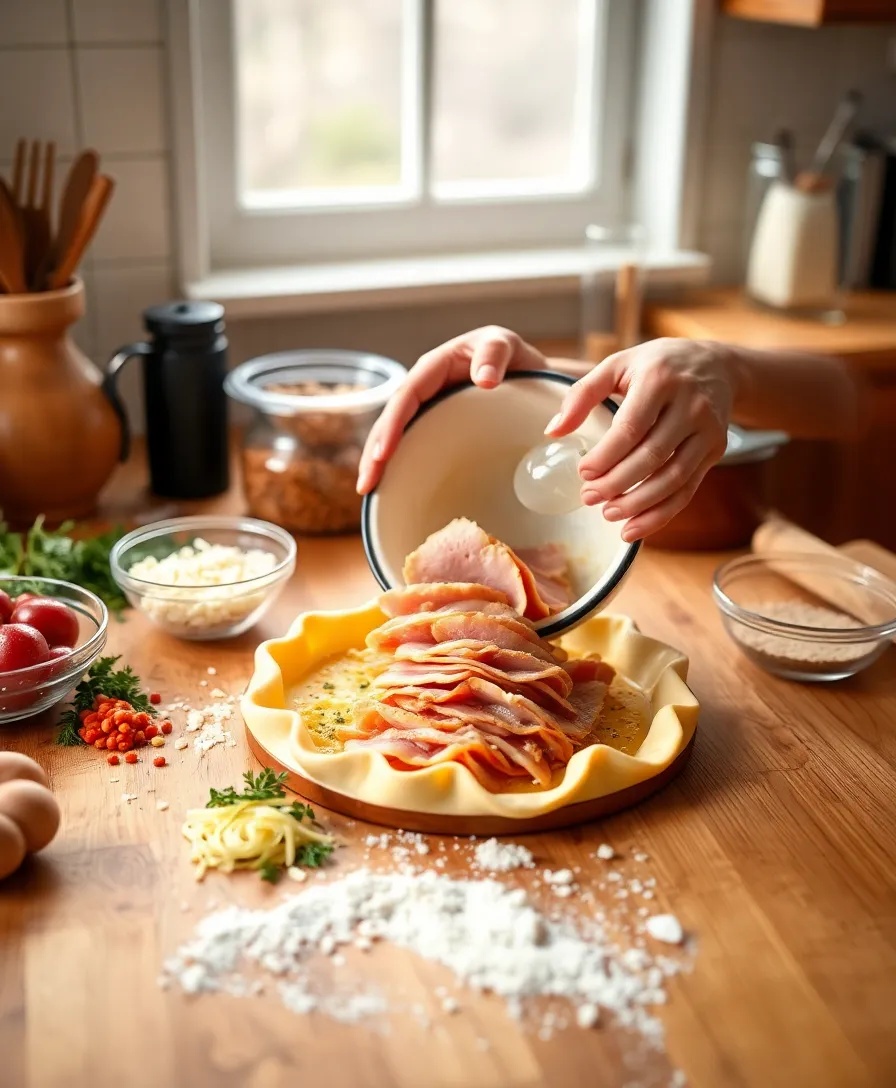
In the grand tapestry of culinary history, few dishes speak of both rustic ingenuity and refined elegance quite like ‘Decorative Ham in Pastry.’ This magnificent centerpiece, with its golden crust cradling succulent ham glazed with a piquant sweet-savory blend, is more than just a meal; it’s a narrative woven from centuries of tradition, trade, and transformation.
The concept of encasing meat in pastry is ancient, a testament to humanity’s enduring quest for both preservation and culinary artistry. From the simple, dough-wrapped provisions of Roman legionnaires to the elaborate ‘soteltys’ of medieval European feasts, pastry served as a protective barrier, locking in moisture and flavor, while simultaneously elevating the dish to a spectacle. ‘Decorative Ham in Pastry’ is a direct descendant of these traditions, emphasizing both substance and showmanship. The ‘unsifted flour’ in the recipe hints at an older, more robust baking tradition, perhaps from a time before industrial milling made finely sifted flours ubiquitous, lending a heartier texture to the crust that would withstand long cooking and rich fillings.
The ham itself is a symbol of European culinary heritage. Pork, especially cured ham, has been a staple across Europe for millennia, prized for its versatility and its ability to be preserved through salting and smoking. This made it a vital food source, particularly during lean months. Its prominence in celebratory dishes reflects its historical significance as a valuable protein. The preparation, which often involves a long bake, ensures that the ham becomes meltingly tender, a perfect counterpoint to the crisp pastry.
The unique glaze – a fusion of jam, mustard, and sugar – is a fascinating crossroads of global migration. Mustard, with its ancient roots in the Mediterranean and Asia, was spread throughout Europe by the Romans, becoming an indispensable condiment and flavor enhancer. Its sharp, earthy notes are a classic pairing with rich pork. Sugar, on the other hand, embarked on a much longer journey, originating in New Guinea and traveling through Southeast Asia to India, eventually making its way to Europe via Arab trade routes during the Middle Ages. Initially a luxury spice, its widespread availability post-Columbian Exchange, fueled by colonial expansion and the tragic realities of the transatlantic slave trade, transformed it into a common ingredient. The marriage of mustard’s piquancy with jam’s fruity sweetness and sugar’s caramelizing power creates a glaze that is quintessentially Anglo-American, often gracing holiday hams with its irresistible sheen and depth of flavor.
Preparing a ‘Decorative Ham in Pastry’ is a delightful culinary endeavor. Begin with a high-quality bone-in ham, as the bone imparts extra flavor. Scoring the fat in a diamond pattern before baking allows the glaze to penetrate and creates a beautiful presentation. When making the pastry, ensure your butter is cold for maximum flakiness. The ‘decorative’ aspect is where creativity truly shines; use pastry scraps to cut out leaves, braids, or other motifs to adorn the top. A final egg wash will give it that signature golden-brown luster. Rest the ham after baking to allow the juices to redistribute, ensuring every slice is moist and flavorful. This dish isn’t just a meal; it’s a celebration of history, a symphony of flavors, and a testament to the enduring power of food to bring people together.
Decorative Ham in Pastry
Elevate your holiday table or grand celebration with this magnificent culinary spectacle: a Decorative Ham in Pastry. A truly impressive centerpiece, it begins with a tender, succulent ham, first brushed with a distinctive savory-sweet glaze—a harmonious fusion of fruit jam, piquant mustard, and fine sugar. This masterpiece is then meticulously carved into elegant slices, only to be artfully reconstructed to its original form. Finally, it’s tenderly encased within a rich, homemade buttery pastry, adorned with exquisite, handcrafted embellishments. The result is a breathtaking presentation that promises not only visual grandeur but an unforgettable symphony of flavors.
Ingredients
-
Unspecified
Jam
Any type, for ham glaze -
Unspecified
Mustard
Any type, for ham glaze -
Unspecified
Sugar
For ham glaze -
1
whole
Bone-in ham
Type and size unspecified, implied large enough to carve -
1
pound
unsifted flour
approximately 3½ cups -
¼
cup
unsalted butter
softened and cut into pieces -
2
tablespoons
oil
vegetable, peanut, grape-seed or almond -
½
teaspoon
salt -
1
teaspoon
sugar
for dough -
3
egg yolks
egg yolks
mixed with 1 1/3 cup cold water -
1
egg
egg
for egg wash -
1
egg yolk
egg yolk
for egg wash
Instructions
-
Set your oven to a robust 425°F (220°C) to begin the culinary journey.
-
Forge the exquisite glaze by harmonizing the fruit jam, piquant mustard, and granulated sugar. Combine these elements until a smooth, cohesive mixture is achieved; tailor the proportions to your discerning taste.
-
Position the whole ham gracefully onto a baking sheet. Lavishly brush the entire surface with your freshly prepared glaze. Transfer to the preheated oven and roast for an initial period of 30 minutes.
-
Following its initial roast, allow the ham to rest and cool thoroughly to ambient temperature before proceeding.
-
Employing a long, slender carving knife, meticulously slice the ham into thin, elegant pieces, working at a slight angle. Arrange these slices with precision on your work surface as you progress. Continue this careful process until the central bone is fully revealed. Exercise discretion by avoiding overly large cuts from the ham’s core; instead, focus on consistent, manageable portions. Proceed by carving slices from one side of the bone, then mirroring the action on the other. (Should you desire, the ham is now perfect to serve unadorned by pastry.)
-
Gently reconstruct the ham’s original form by meticulously reassembling the carved slices in their approximate sequence. A perfect alignment is not paramount, as the artisanal pastry will ultimately envelop and unify the structure.
-
In the bowl of a stand mixer fitted with a flat beater attachment, combine the 1 pound (approximately 3½ cups) of unsifted flour, ¼ cup of softened unsalted butter (cubed), 2 tablespoons of oil, ½ teaspoon of salt, 1 teaspoon of sugar, and the pre-whisked mixture of 3 egg yolks and 1 1/3 cups of cold water. Mix on medium speed for approximately 1 minute, until all ingredients are thoroughly incorporated and a cohesive dough forms.
-
On a lightly floured surface, expertly roll out the freshly prepared dough into an expansive, circular form, aiming for a consistent thickness of about ½ inch.
-
In a modest bowl, whisk together the final whole egg with one additional egg yolk to create a rich, luminous egg wash.
-
Lavishly brush one side of the rolled dough with a generous amount of your prepared egg wash. This moistened surface will serve as the crucial adhesive layer.
-
Prepare a clean baking sheet by lining it with parchment paper. Gently transfer the reconstructed ham to the center of the parchment. With utmost care, drape the egg-washed dough over the ham, ensuring the “wet-side” faces downwards for optimal adhesion. Firmly press the pastry to conform to the ham’s contours, meticulously encasing the top and sides, paying particular attention to securing it around the shank. (Note: The base of the ham should remain exposed, a technique that facilitates handling and prevents the pastry from becoming unpleasantly soggy by allowing steam to escape during baking.) Neatly trim away any superfluous dough.
-
Bestow a final, opulent sheen upon the pastry-clad ham by generously brushing it with the remainder of the egg wash. Artfully arrange two slender strips of dough, spaced approximately ½ inch apart, to create elegant concentric circles atop the ham – this will define the “lid” for post-baking presentation and serving. Unleash your creativity by fashioning delicate dough flowers: form a long, thin strip and intricately fold it to evoke petals and a graceful stem. Cut complementary stems, leaves, and other imaginative patterns, positioning them with flair upon this central “lid.” Extend the artistic flourish to the perimeter of the lid by crafting a charming relief of cherries: use a pastry tube to excise small, perfect rounds, then arrange them with tiny dough stems. Complete the tableau with sculpted leaves placed artfully around the cherries. Gently, but firmly, press all decorative elements into the dough to secure their placement.
Recipe Notes
Editor’s Insights: While the recipe, in its original form, did not present a formal title, ‘Decorative Ham in Pastry’ has been thoughtfully assigned to encapsulate its essence. It is imperative to note a significant omission within the original instructions: the crucial final baking temperature and duration once the ham is enveloped in its decorative pastry. For optimal results and food safety when preparing a ham en croûte of this nature, we recommend baking at a moderate temperature, typically between 350-375°F (175-190°C), for an additional 60-90 minutes. The pastry should achieve a glorious golden-brown hue and be thoroughly cooked, and the internal temperature of the reheated ham should register a safe 140°F (60°C) when checked with a meat thermometer. Furthermore, the precise quantities for the fruit jam, mustard, and sugar in the initial ham glaze are left to the chef’s discretion, allowing for personalized flavor balance.
Global Heritage Archive
Anthropological & Spice Migration Record
“A culinary tradition rooted in elaborate presentation, rich ingredients, and celebratory meals, often associated with festive periods or formal gatherings.”
🌿 Spice & Botanical Migration
Mustard, a fundamental flavoring here, boasts ancient origins in the Mediterranean and parts of Asia (Brassica and Sinapis species). It was cultivated and spread across Europe by the Romans, becoming a staple condiment and spice in various forms. Sugar, another key component of the glaze, originated in New Guinea and was domesticated in Southeast Asia, traveling along ancient trade routes through India, Persia, and the Arab world before being introduced to Europe during the Crusades. Its widespread availability and affordability were later driven by the transatlantic slave trade and colonial sugar plantations in the Americas, transforming it from a luxury spice to a common ingredient.
🏺 Historical & Archaeological Record
The oldest archaeological evidence or written record of encasing meat in pastry, a precursor to dishes like ‘Decorative Ham in Pastry,’ can be found in Roman culinary texts like Apicius (4th-5th century CE), which describes various ‘patina’ preparations. Later, medieval European cookbooks, such as ‘The Forme of Cury’ (14th century, England), feature numerous ‘pies’ and ‘tarts’ where meat, fowl, or fish were baked within robust pastry crusts, serving both as a cooking method and a way to preserve and present food for banquets.
💡 Little Known Facts
- The practice of encasing meat in pastry dates back to Roman times, where dishes like ‘patina’ utilized crusts not just for cooking but also as edible serving vessels or for preservation.
- During the medieval period, European feast tables often featured ‘soteltys’ – elaborate, often non-edible, food sculptures that sometimes incorporated roasted meats encased in highly decorative crusts to impress guests.
📸 Made This Heritage Recipe?
We would love to see how your dish turned out! Send a photo of your culinary creation to [email protected] to be featured in our community gallery.
Leave a review and rate this recipe below!
Curated Literature & Washington DC Downtown Calendar
The Culinary Alchemist: Modern Gastronomy & Flavor Pairing
By LDN Gastronomy Series
Artisanal technique, seasonal sourcing, and kitchen mastery.
Upcoming Downtown Happenings
Live acoustic sessions, gallery receptions, literary salons, and independent trade shows across Washington DC.
