
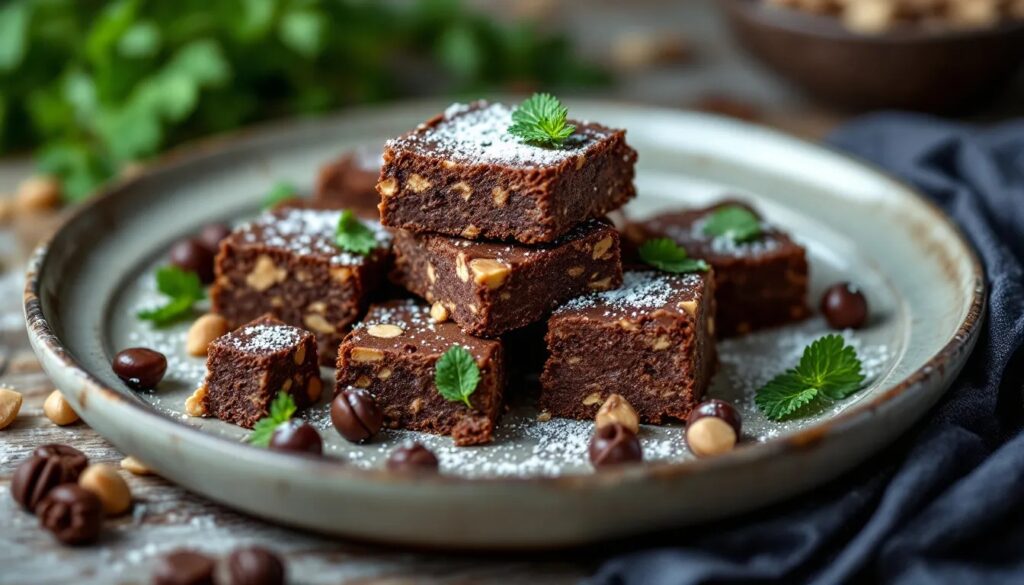
The genesis of the ‘bar’ dessert, a distinct American invention, can be traced back to the late 19th and early 20th centuries. As kitchens became increasingly efficient and women’s magazines proliferated, a demand grew for recipes that were delicious yet easy to prepare and serve. No longer confined to individual servings that required precise shaping, these sheet pan wonders offered a convenient solution: bake once, cut into squares, and share. The ‘mellow’ in our recipe title speaks to a desired texture – soft, chewy, and rich – a hallmark of these early American chocolate creations, often reminiscent of the burgeoning brownie.
At the heart of these bars lie ingredients whose journeys span continents and millennia. Unsweetened chocolate, the very soul of this dessert, originates from the cacao trees of ancient Mesoamerica. For thousands of years, the Olmec, Maya, and Aztec civilizations revered cacao, primarily consuming it as a bitter, frothy beverage. It was the Columbian Exchange that carried this precious bean to Europe, where it underwent a remarkable transformation. By the 19th century, industrial processing techniques in Europe and America rendered solid baking chocolate widely available, transitioning it from an aristocratic drink ingredient to an accessible staple for the home baker. Vanilla, the other aromatic star, followed a similar trans-Atlantic trajectory from its indigenous Mexican orchids, its delicate perfume becoming indispensable to global dessert cultures.
Sugar, in both its white and brown forms, tells an equally complex story, originating as sugarcane in Southeast Asia before traversing the globe via ancient trade routes and, later, colonial plantations in the Americas, inextricably linked with profound human migration. Flour, the foundational structure, is a testament to humanity’s oldest agricultural triumphs, with its wheat origins in the Fertile Crescent. The inclusion of baking powder, a mid-19th-century marvel, revolutionized home baking, offering a reliable and convenient leavening agent that freed bakers from the inconsistencies of yeast or the labor of whipping eggs.
Crafting these Chocolate Mellow Bars is a delightful exercise in culinary simplicity. The key to their signature ‘mellow’ texture lies in careful baking: avoid overbaking, as even a few extra minutes can turn them dry. A perfectly baked bar will still appear slightly unset in the very center. Let them cool completely in the pan before cutting to ensure clean squares and to allow the flavors to fully meld. While chopped nuts (walnuts or pecans being popular choices) add a delightful crunch and richness, feel free to experiment with add-ins like chocolate chips or even a sprinkle of sea salt to elevate their flavor profile. These bars are more than just a dessert; they are a slice of history, a warm embrace from generations past, and a reminder of the enduring power of simple ingredients to create profound joy.
CHOCOLATE MELLOW BARS
Embark on a culinary journey with our exquisite Chocolate Mellow Bars, a confection that beautifully marries the warmth of tradition with an elevated elegance. This timeless American classic features a decadent, velvety cocoa foundation, a deep and satisfying canvas of chocolate richness. Crowned with an ethereal, cloud-like meringue — delicately sweet and impeccably airy — each square promises a symphony of contrasting textures and harmonious flavors. These bars are more than just a dessert; they are a cherished indulgence, destined to be the star of intimate gatherings and a luxurious addition to any spread, evoking a sense of refined comfort with every perfect bite.
Ingredients
-
1/3
cup
butter or margarine
None -
2
eggs
separated -
1/2
teaspoon
baking powder
None -
1/2
teaspoon
vanilla
None -
1
ounce
unsweetened chocolate
melted -
1/2
cup
chopped nuts
None -
1
cup
brown sugar
well packed -
1/3
cup
sugar
None -
1
cup
flour
None -
1/2
teaspoon
salt
None
Instructions
-
Into a substantial mixing vessel, introduce the softened butter (or margarine) and the measured granulated sugar. Employ an electric mixer to thoroughly cream the duo until the mixture achieves a pale, aerated, and visibly fluffy consistency.
-
Subsequently, incorporate the egg yolks, continuing to beat vigorously for a full two minutes, ensuring complete integration and further aeration.
-
Methodically fold in the sifted flour, baking powder, and a pinch of salt. Mix with precision until the dry ingredients are just incorporated into the wet, avoiding overworking the mixture.
-
Gently stir in the fragrant vanilla extract, the lusciously melted unsweetened chocolate, and the finely chopped nuts, distributing them evenly throughout the dough.
-
Carefully transfer this rich dough into a pre-greased 9x9x2-inch baking pan, using an offset spatula to spread it into a uniform layer that reaches all edges.
-
In a meticulously clean, separate mixing bowl, whip the reserved egg whites until they achieve firm, glossy peaks that hold their shape impeccably when the beaters are lifted.
-
With the mixer still running, incrementally introduce the well-packed cup of brown sugar into the stiffened egg whites. Continue beating until the mixture transforms into a lustrous, voluminous, and stable meringue.
-
Delicately spoon and spread the exquisite meringue topping over the prepared chocolate dough base, ensuring an even and elegant blanket.
-
Place the pan into a convection oven, preheated to a precise 350°F (175°C), and bake for approximately 30 minutes, or until the meringue is golden and set.
-
Allow the baked confection to cool entirely within the pan on a wire rack before meticulously slicing into desired individual squares, ensuring clean edges.
Recipe Notes
For an impeccably clean cut, ensure the bars are completely chilled before slicing; refrigeration for at least an hour can yield pristine squares. Store these delightful treats in an airtight container at room temperature for up to 3 days, or refrigerate for extended freshness. A small sprinkle of sea salt flakes over the meringue before baking can elevate the chocolate notes beautifully.
Global Heritage Archive
Anthropological & Spice Migration Record
“A culture valuing comfort food, convenience in preparation, and desserts that can be easily shared and transported, deeply influenced by industrial advancements in ingredients like baking powder and processed chocolate.”
🌿 Spice & Botanical Migration
The recipe features vanilla, a treasured spice derived from the fruit of the Vanilla planifolia orchid, native to Mesoamerica, specifically Mexico. It journeyed to Europe following the Columbian Exchange, later becoming widely cultivated globally, profoundly impacting dessert cultures. While not a spice, unsweetened chocolate, made from the cacao bean, also originated in Mesoamerica and followed a similar trans-Atlantic path, transforming from a bitter ceremonial drink into a beloved baking ingredient thanks to 19th-century processing innovations.
🏺 Historical & Archaeological Record
The earliest archaeological evidence of chocolate (cacao) consumption dates back to the Olmec civilization in Mesoamerica, circa 1900-1500 BCE. While recipes for baked goods using flour and early leavening agents trace back to ancient Egypt and Mesopotamia (ca. 4000 BCE), the specific ‘bar’ dessert format, incorporating modern baking powder (mid-19th century invention) and solid baking chocolate, originated in the United States in the late 19th and early 20th centuries, with early recipes for brownies appearing around 1897-1906.
💡 Little Known Facts
- The ‘bar’ dessert format, where a cake-like batter is baked in a single pan and cut into squares, gained significant popularity in America during the late 19th and early 20th centuries, largely due to cook books and women’s magazines promoting easy, shareable treats.
- Unsweetened chocolate, crucial for these ‘mellow’ bars, became widely available in consistent, solid bar form for baking after processing innovations in the 19th century, particularly from companies like Baker’s Chocolate and Hershey’s, democratizing chocolate desserts for home bakers.
📸 Made This Heritage Recipe?
We would love to see how your dish turned out! Send a photo of your culinary creation to [email protected] to be featured in our community gallery.
Leave a review and rate this recipe below!
Curated Literature & Washington DC Downtown Calendar
The Culinary Alchemist: Modern Gastronomy & Flavor Pairing
By LDN Gastronomy Series
Artisanal technique, seasonal sourcing, and kitchen mastery.
Upcoming Downtown Happenings
Live acoustic sessions, gallery receptions, literary salons, and independent trade shows across Washington DC.
