
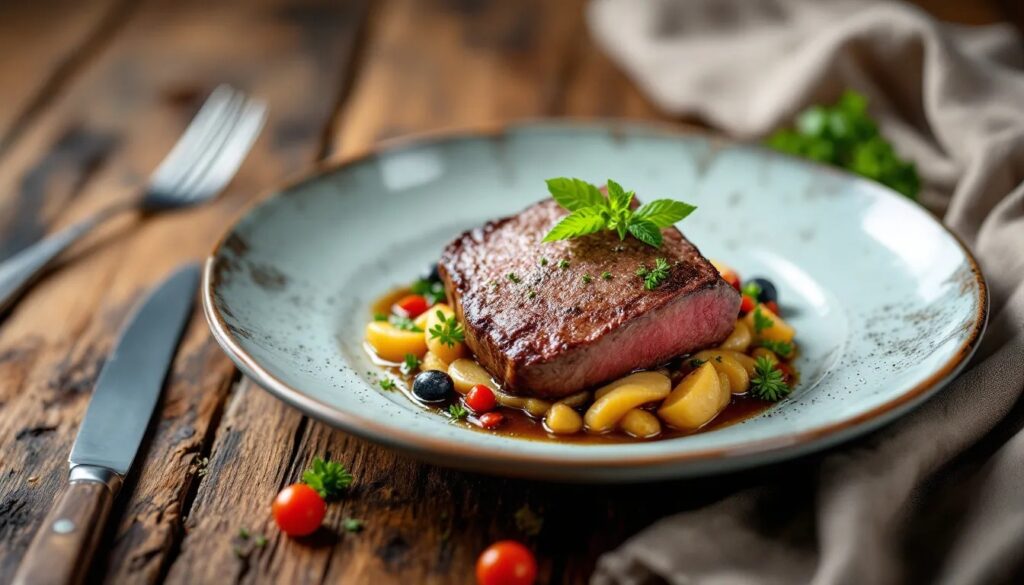
Its origins are as humble as the very earth from which its ingredients spring. For centuries, Burgundian farmers, resourceful and resilient, transformed tough, inexpensive cuts of beef – often from older, working cattle – into something extraordinary. The secret lay in time and the region’s most prized liquid asset: its robust red wine. A long, slow braise allowed the meat to surrender its sinewy resistance, yielding to an unparalleled tenderness, each fiber infused with the deep, savory notes of the surrounding terroir. Onions, garlic, and wild mushrooms foraged from the local forests joined the symphony, creating a dish that was both nourishing and deeply satisfying for a hard day’s work.
Over time, this rustic staple found its way from farmhouse tables to the hallowed halls of haute cuisine, thanks to culinary masters who recognized its inherent elegance. While its fundamental character remained unchanged, its presentation and ingredient quality were refined. However, it was across the Atlantic, in the mid-20th century, that Boeuf Bourguignon truly captured the world’s imagination. Julia Child, with her infectious enthusiasm and groundbreaking ‘Mastering the Art of French Cooking’ (1961), demystified this seemingly complex dish for a generation of home cooks, proving that French culinary excellence was within reach. Her meticulously detailed recipe became the definitive standard, a culinary touchstone that continues to inspire.
The very ingredients in this seemingly simple stew speak volumes about global migration and exchange. While the beef, onions, garlic, and local red wine are firmly rooted in European tradition, elements like black pepper traveled thousands of miles from the Spice Coast of India via ancient trade routes, a testament to humanity’s enduring quest for flavor. Even more tellingly, the subtle inclusion of tomato puree, now a staple in many versions, highlights the profound impact of the Columbian Exchange. Tomatoes, originally from the Andes, journeyed to Europe in the 16th century, slowly overcoming initial suspicion to become an indispensable part of countless dishes, including this very French classic, signifying its evolution through centuries of culinary adaptation.
Preparing Boeuf Bourguignon is an act of patience and precision, but one that rewards handsomely. The key lies in the initial browning of the beef; do not rush this step, as it builds the foundational layers of flavor through the Maillard reaction. Deglaze the pan with a splash of that wonderful red wine to capture every caramelized bit. While a good Burgundy wine is traditional, select a dry, medium-bodied red that you enjoy drinking, as its character will permeate the entire dish. Don’t be tempted to use cooking wine! Allow the stew ample time to simmer gently, letting the flavors meld and deepen. Serve it with creamy mashed potatoes, crusty bread, or simple boiled potatoes to soak up every drop of that exquisite sauce. Boeuf Bourguignon isn’t just a meal; it’s a comforting embrace, a historical journey, and a celebration of robust flavors that have stood the test of time, inviting you to savor a piece of culinary heritage with every warming spoonful.
BOEUF BOURGUIGNON
Embark on a culinary journey to the heart of the French countryside with this quintessential Boeuf Bourguignon. A dish celebrated for its profound depth and soul-warming character, it showcases tender cuts of beef, patiently braised until fork-tender within a luxurious crimson wine sauce. Aromatic essences of sautéed onions, delicate garlic, and earthy mushrooms intertwine, creating a symphony of flavors that truly defines rustic elegance. Preparing this timeless classic in advance allows its intricate components to meld and deepen, promising an even more transcendent dining experience.
Ingredients
-
4
ounces
bacon
cut in thick strips, for rendering fat -
1
pound
stewing beef
cut in small cubes -
A few
small onions or large onions
quartered if large -
1
Tablespoon
flour -
1
crushed clove of garlic -
as needed
red wine
to cover meat (see instructions for liquid options) -
as needed
water
to combine with red wine (if using 50/50 liquid blend) -
1
Tablespoon
tomato puree - salt
- pepper
- bouquet garni
-
4
oz.
raw mushrooms -
chopped parsley
for garnish
Instructions
-
In a substantial skillet or Dutch oven, render 4 ounces of thickly sliced bacon until crisp and golden. Carefully remove the rendered bacon from the pan and set it aside, reserving the flavorful drippings.
-
Should more fat be needed, elevate the skillet’s temperature to a high heat and add a touch more lard or oil. Sear 1 pound of beef stewing cubes, ensuring each piece develops a rich, caramelized crust on all sides. Do this in batches if necessary to avoid overcrowding.
-
Reduce the heat slightly, then introduce a few small whole onions or quartered larger onions to the skillet. Sauté them gently until they achieve a deep golden hue and begin to sweeten.
-
Lightly dust the contents of the skillet with 1 tablespoon of all-purpose flour. Continue to cook, stirring occasionally, until the flour also develops a nutty, golden-brown color, creating a foundational roux.
-
Stir in a crushed clove of garlic, allowing its fragrance to bloom. Immediately deglaze the pan with enough robust red wine to just submerge the meat, or use a blend of half red wine and half water, ensuring the liquid covers the ingredients.
-
Incorporate 1 tablespoon of concentrated tomato purée, season generously with salt and freshly ground black pepper, and add your classic aromatic bundle (bouquet garni).
-
Bring the liquid to a gentle simmer, then cover the skillet and allow the stew to braise slowly for approximately 2 ½ hours, or until the beef is exquisitely tender. Periodically decant any accumulated fat from the surface of the sauce.
-
Integrate 4 ounces of fresh, raw mushrooms into the stew and continue to cook, uncovered, for an additional 15 minutes, allowing them to soften and impart their earthy depth.
-
Prior to serving, crown the rich stew with the reserved crisp bacon and a vibrant sprinkle of freshly chopped parsley, adding a fresh herbaceous note.
-
Present this magnificent Boeuf Bourguignon alongside your choice of delicate egg noodles or small, tender boiled potatoes for a hearty and satisfying accompaniment.
Recipe Notes
The complex flavors of this dish are significantly enhanced by resting. For optimal results, we highly recommend preparing Boeuf Bourguignon the day before serving. After its initial cooking, allow the stew to cool completely, then transfer it to the refrigerator. The following day, gently skim any solidified fat from the surface. Reheat the stew over medium heat until it comes to a gentle boil, then proceed to add the mushrooms and simmer for the final 15 minutes as directed in the main instructions. This advance preparation allows the ingredients to fully meld, deepening the overall taste profile.
Global Heritage Archive
Anthropological & Spice Migration Record
“A quintessential dish of French regional cuisine, embodying slow cooking, the judicious use of local wine, and robust flavors derived from humble ingredients.”
🌿 Spice & Botanical Migration
Black pepper, originating from Kerala, India, reached Europe via ancient trade routes like the Spice Road. Garlic, from Central Asia, spread globally thousands of years ago. The fresh herbs of the bouquet garni (thyme, bay leaf, parsley) are indigenous to the Mediterranean, while the tomato, a New World fruit from the Andes, was incorporated into European cooking following the Columbian Exchange, signifying a recipe codified post-16th century when tomatoes gained culinary acceptance in France.
🏺 Historical & Archaeological Record
The fundamental technique of braising meat in liquid, including wine, dates back to antiquity, with recipes in Roman texts like Apicius (4th century CE) describing similar preparations. While the specific ‘Boeuf Bourguignon’ formulation evolved over centuries, medieval European cookbooks such as ‘Le Viandier’ (14th century) feature numerous beef stews employing wine and thickening agents, establishing a clear lineage for this dish’s core method.
💡 Little Known Facts
- Julia Child’s inclusion of Boeuf Bourguignon in her 1961 cookbook, ‘Mastering the Art of French Cooking,’ is credited with popularizing the dish globally and elevating it to an iconic status in American households.
- Historically, Boeuf Bourguignon was a frugal peasant dish designed to tenderize tougher, less expensive cuts of beef from older, working animals, making it palatable through long, slow braising.
📸 Made This Heritage Recipe?
We would love to see how your dish turned out! Send a photo of your culinary creation to [email protected] to be featured in our community gallery.
Leave a review and rate this recipe below!
Curated Literature & Washington DC Downtown Calendar
The Culinary Alchemist: Modern Gastronomy & Flavor Pairing
By LDN Gastronomy Series
Artisanal technique, seasonal sourcing, and kitchen mastery.
Upcoming Downtown Happenings
Live acoustic sessions, gallery receptions, literary salons, and independent trade shows across Washington DC.
