
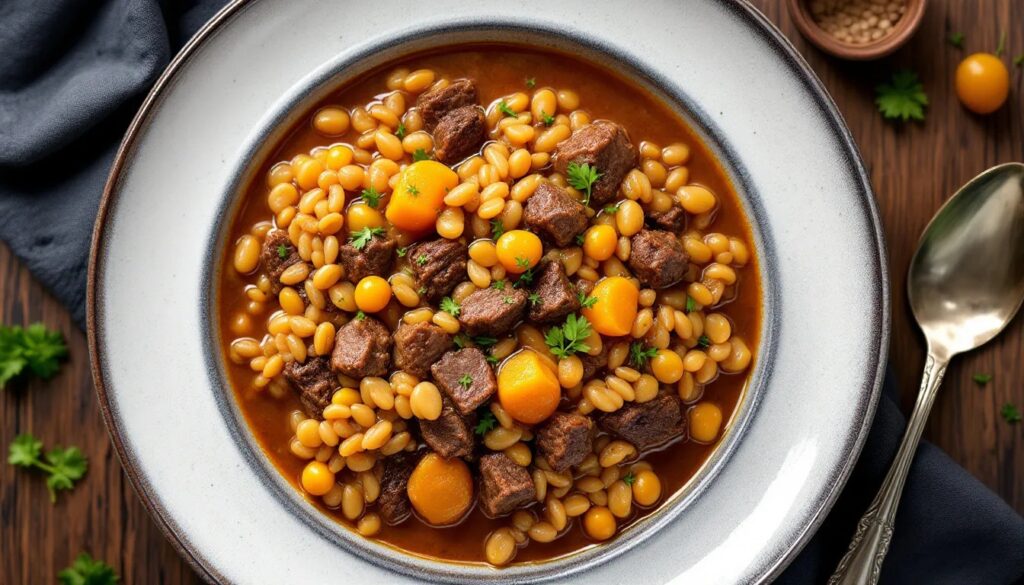
At its heart, this stew boasts ingredients with truly ancient pedigrees. Barley, one of humanity’s oldest cultivated grains, originates from the Fertile Crescent over 10,000 years ago. It sustained early civilizations and traversed continents, arriving in European cuisines where it became a staple thickener and filler in hearty stews. The chuck roast, a robust cut of beef, speaks to a history of agrarian societies and the clever culinary techniques developed to tenderize tougher meats through long, slow cooking – a practice refined over millennia across diverse cultures. Onions and carrots, foundational aromatics, trace their origins to Central Asia, while celery hails from the Mediterranean. These essential building blocks spread globally via ancient trade routes, proving their indispensable role in flavor development.
However, it’s the recipe’s more ‘modern’ components that truly anchor it in a specific time and place. The inclusion of ‘chili pods’ is a clear marker of the Columbian Exchange. These fiery fruits, native to the Americas, revolutionized global palates after their introduction in the 15th and 16th centuries. Their presence here suggests a cuisine that embraced new world flavors, using them not always for intense heat, but for a subtle warmth and earthy depth, common in adapted European-American stews. The ‘frozen green beans’ and ‘bouillon’ are unequivocal indicators of 20th-century culinary practices. The advent of freezing technology and convenience food products fundamentally reshaped home cooking, allowing busy cooks to incorporate seasonal vegetables year-round and simplify flavor bases. Green beans themselves are also native to the Americas, completing a full circle of transcontinental culinary exchange.
This particular Beef Barley Stew, therefore, tells a story of enduring culinary traditions meeting innovation. It embodies the Euro-American spirit of hearty, practical cooking, where time-honored methods are gracefully blended with ingredients made accessible through global trade and technological advancements. When you prepare this stew, you’re not just cooking a meal; you’re participating in a ritual that spans continents and centuries. To achieve its full potential, start by browning the chuck roast thoroughly – this crucial step builds foundational flavor through the Maillard reaction. Sauté your aromatics (onions, carrots, celery) until softened, then deglaze the pan to capture all those delicious browned bits. Add the pearl barley and liquids, along with the chili pods for their subtle contribution, and let it simmer low and slow. The patience of a long simmer allows the meat to become fork-tender and the barley to absorb the rich broth, while the frozen green beans are added towards the end to retain their vibrant color and texture. The result is more than just a stew; it’s a warm embrace, a testament to culinary ingenuity, and a delicious journey through history in every comforting spoonful.
BEEF BARLEY STEW
Embrace the profound comfort of this robust Beef Barley Stew, a timeless culinary creation that elevates even the chilliest evenings into moments of pure culinary bliss. Featuring succulent cuts of beef chuck, patiently slow-simmered alongside a medley of fragrant garden vegetables, and infused with an intriguing whisper of Southwestern warmth from dried chili pods, this stew delivers a complex, deeply savory profile. Each spoonful promises a delightful journey, evoking cherished memories of home-cooked excellence and comforting traditions.
Ingredients
-
2-3
lbs
chuck roast -
4
ribs
celery
chopped -
1
cup
pearl barley -
1
pkg.
frozen green beans -
1
medium
onion
chopped -
3
pods
chili pods
from faded ristra -
as needed
bouillon
for barley water -
4
carrots
sliced -
just enough
cooking oil
for searing -
as needed
water
to cover stew -
to taste
salt
Instructions
-
Carefully separate the prime cut of beef from any bones; meticulously trim away excess fat and dice the meat into uniform, bite-sized cubes.
-
In a heavy-bottomed cast iron skillet, brown the prepared beef cubes over medium-high heat with a minimal amount of cooking oil until a rich, golden-brown crust develops on all sides.
-
Transfer the seared beef to a slow cooker. Incorporate the finely chopped onion and celery.
-
Thoroughly rinse the dried chili pods, then remove their stems and seeds before nestling them amongst the beef and vegetables in the slow cooker.
-
Submerge all ingredients completely with fresh water. Set the slow cooker to its low setting and allow it to simmer gently for a duration of ten hours.
-
Prepare the barley by cooking one cup in simmering bouillon, strictly adhering to the package’s instructions. Once tender, set it aside.
-
Upon the completion of the slow-cooking process, carefully retrieve and discard the spent chili pods from the stew.
-
Blanch the sliced carrots and fresh green beans until they achieve a perfectly crisp-tender texture.
-
Integrate the reserved cooked barley, tender carrots, and vibrant green beans into the stew. Season generously with salt to taste, then gently warm all components together until thoroughly heated through and ready to serve.
Recipe Notes
Elevate this robust stew by accompanying it with crusty, warm artisanal sourdough bread, ideal for soaking up every last drop, and a vibrant, crisp garden salad to provide a refreshing counterpoint. This substantial dish truly shines on cooler evenings, offering unparalleled comfort and satiety with its deep, satisfying flavors.
Global Heritage Archive
Anthropological & Spice Migration Record
“A culinary culture focused on hearty, comforting home-cooked meals, blending traditional European stewing techniques with New World ingredients and 20th-century food conveniences.”
🌿 Spice & Botanical Migration
Chili pods, native to the Americas (specifically Mexico and Central/South America), were introduced globally via the Columbian Exchange in the 15th and 16th centuries, rapidly integrating into cuisines across Europe, Africa, and Asia. Onions, believed to originate in Central Asia, spread along ancient trade routes throughout the Mediterranean, Europe, and Asia, becoming a fundamental aromatic in nearly all global cuisines.
🏺 Historical & Archaeological Record
The earliest archaeological evidence of barley cultivation dates back over 10,000 years to the Fertile Crescent, making it one of the first domesticated grains. Traces of barley-based porridges or stews have been found in Neolithic sites in the Near East, dating back to c. 8000-6000 BCE.
💡 Little Known Facts
- Pearl barley, despite its name, is not a whole grain; it has been polished to remove its outer bran layers and often part of the germ, which speeds cooking time but reduces fiber content compared to hulled barley.
- The inclusion of ‘chili pods’ in this American-style beef barley stew often indicates a desire for subtle warmth and earthy depth rather than intense heat, reflecting a general adaptation of chili peppers into broader American palates.
📸 Made This Heritage Recipe?
We would love to see how your dish turned out! Send a photo of your culinary creation to [email protected] to be featured in our community gallery.
Leave a review and rate this recipe below!
Curated Literature & Washington DC Downtown Calendar
The Culinary Alchemist: Modern Gastronomy & Flavor Pairing
By LDN Gastronomy Series
Artisanal technique, seasonal sourcing, and kitchen mastery.
Upcoming Downtown Happenings
Live acoustic sessions, gallery receptions, literary salons, and independent trade shows across Washington DC.
