

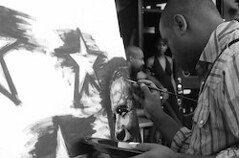
Immerse yourself in the profound artistry of Charles Philippe Jean Pierre, a visionary whose captivating collages and hand-painted works transcend the canvas. His art, as seen in pieces like “Tout Est Possible 1-20Collage,” invites viewers into a world of vibrant storytelling and intricate detail.
Experience the Vision: Charles Philippe Jean Pierre’s Art Continues to Inspire the DC Cultural Scene in 2026.
In 2026, as the pulse of urban culture beats stronger than ever, certain artists don’t just participate; they define it. Charles Philippe Jean Pierre, the acclaimed Haitian American multimedia artist, stands as an undeniable force, whose profound work continues to resonate throughout the Washington D.C. art scene and beyond. Long hailed by many as “DC’s own Basquiat” for his vibrant energy and profound social commentary, Jean Pierre masterfully blends folk art, graffiti aesthetics, graphic design, and diverse multimedia techniques to breathe a distinct and refreshing life into every canvas. His down-to-earth yet soulful approach crafts an experience that leaves you marveling at the pure passion and inspiration embedded in each piece. With a radiant palette and an unmistakable style, Charles Philippe Jean Pierre’s artwork has garnered sustained attention from major media outlets, including NBC, the Washington Post, and NKH TV. Hailing originally from Chicago, this influential urban contemporary artist’s public art installations are woven into the fabric of the nation’s capital, with his sought-after creations adorning collections of numerous prominent politicians and celebrities. Beyond his prolific artistic output, Jean Pierre remains deeply committed to art education and community engagement, having taught art at Macfarlane High for years, served as an artist-in-residence for DC nonprofit Bloom Bars, and as the National Arts Director for the Young and Powerful group. His involvement with esteemed organizations like the United Nations Association further solidifies his role as a community pillar, consistently reaching back to uplift and inspire. Charles Philippe Jean Pierre embodies the spirit of a highly acclaimed DC artist who, despite international recognition, remains humbly grounded in his roots and dedicated to his craft.
In the dynamic world of 2026, understanding one’s true calling feels more vital than ever. It’s clear that art has always been your path, Charles Philippe Jean Pierre. What drew you to art, and when did you realize this was your destiny?
Art was never what I wanted to do; it’s always been what I did. I vividly remember branding myself with a hot iron and a crayon, driven by a raw desire to experiment and mix my own colors. I’d create narratives to accompany the Haitian paintings on our walls, practicing by recreating those traditional pieces. Art is an intrinsically large part of our Haitian culture, a rich artistic tradition. The reason I began to view art as a plausible career path was because I had tangible examples within my family. Several relatives are respected artists in their fields. While my parents initially encouraged a more traditional career, their appreciation for art—they are collectors themselves—made my journey into professional artistry pretty much inevitable.
 Considering all the options, why do you think your mother chose to enroll you in art classes, setting a foundation for your journey as a DC artist?

I don’t think my mother envisioned me as a professional artist at all. I believe she had aspirations for me to become a priest or a doctor, which is quite amusing. Initially, she enrolled me in piano lessons; the piano was a significant part of our family gatherings and holidays. To cut a long story short, the piano and I didn’t quite harmonize. My piano teacher, Mrs. Mims, eventually suggested I pursue art classes instead. I was actually too young for the program at the time, so it required some persistence, but they eventually allowed me to participate. It was in this pivotal class that I gained my foundational art education, learning essential techniques like acrylics, collage work, and carving, which are still central to my multimedia art today.
Beyond your mother, were there other individuals who recognized your immense talent and potential, guiding your artistic journey? What valuable lessons did they impart along the way?
If I had to single out one person, it would undoubtedly be my piano teacher, Ms. Mims. She never gave up on me. She recognized my potential and understood that while I wasn’t blessed with musical talents, I possessed other gifts. She constantly reminded me of my blessings and truly took me under her wing, helping to groom me and expose me to broader American culture. She’d take students from the Positive Youth Development program to dinners and plays downtown. She gave me my first job and even helped me launch my first business venture. She connected with the city to secure a contract for a group of us to cut grass on abandoned lots. Her dedication and belief in me are among the primary reasons I am so passionate about giving back to the community through art and education.
Rejection is an inherent part of pursuing one’s passion and bringing dreams to fruition, especially in the competitive art world. What advice would you offer aspiring artists about navigating rejection? How has any rejection you’ve faced shaped you as the innovative artist you are today?
When you’re not actively seeking acceptance, it becomes much harder to experience true rejection. I was, for example, wearing Chucks before they were considered fashionable (laughs). Authenticity—being truly who you are—is one of the most invaluable lessons I’ve learned in life, particularly when it comes to acceptance within the DC art community and beyond. Don’t misunderstand me; I have certainly been turned down for opportunities, but these instances were almost always accompanied by encouragement. In that aspect, I’ve been incredibly blessed. I will say, however, that my biggest critic has consistently been my mother. She has a stronger affinity for classical art and often found my early work “too urban.” This perspective keeps me grounded, as the people who love me most also offer the most honest critique. At home, I’m simply Philippe.
Well Philippe, in your journey as a respected artist, do you feel your talent has opened doors to unique experiences or imparted profound lessons and wisdom?
I learn something new every single day. My talent has definitely exposed me to diverse circles and allowed me to connect with many individuals I might not have otherwise encountered. Yet, at their core, they are all driven, like-minded individuals, whether they’re collectors, fellow artists, or community leaders. I’ve come to realize that many people often view their past achievements as the pinnacle of their lives. For me, however, I always look forward to the future. I am profoundly confident that I will be a better artist, a better person, tomorrow than I am today, continuing to evolve within the vibrant DC cultural landscape.
Your artwork, Charles Philippe Jean Pierre, reflects a rich tapestry of concepts, with influences from musicians like Run DMC and Michael Jackson. What is it about these influences that sparks your creative process, leading to the birth of these distinct concepts?
I paint what truly moves me, and music consistently provides that spark. I recall waking up the morning after the BET Honors and immediately beginning a painting inspired by the Tuskegee Airmen, who had been celebrated the night before, creating a 1942 Bomber piece. That’s often how it works. I maintain a detailed sketchbook filled with concepts and ideas that I draw from for whatever project I’m currently developing. The variety in my work stems directly from my diverse background. I simply cannot be confined to one box or a single label. My ultimate goal is simply to share my light and my unique perspective on urban contemporary art.
Originally from Chicago, how did you find your way to the culturally rich District of Columbia? Could you share more about your journey and how you established yourself as a prominent figure in the DC art scene?
After graduating college, I landed a manager-in-training program with a popular athletic shoe company—who shall remain nameless (laughs). I was deeply immersed in hip-hop culture and a true sneakerhead at the time. I quickly became a top seller and was transferred to the flagship store in Downtown Chicago, located in Oprah’s building. Even then, I was still painting consistently, about three days a week, and developing a significant buzz. I was creating portraits for high-profile individuals and actively participating in art shows across the city. One day, the regional manager visited my store and asked where I saw myself in five years. That question triggered a profound epiphany. I remember it like it was yesterday—a “Kanye & GLC Spaceship moment,” a real turning point. Long story short, I paid all my bills, put everything into storage, and drove straight to Washington D.C. I arrived with just $900 in my pocket, an acceptance letter from Howard University, and all my paintings packed in the back of my truck. It was a true “do or die” moment for my artistic career in DC.
You are an integral part of “Culture District.” For our Life Diverse Network readers in DC, could you elaborate on what Culture District is and its significance within the Washington D.C. art community?
When I arrived at Howard University, I connected with two other incredibly talented Howard art students, Johnnie Best and Brock Horne, and together we formed Culture District. We conceived the name at Brock’s house; Chicago is renowned for its African American culture, and DC is its own unique district, so “Culture District” felt perfectly apt. Our inaugural art show was in the spring of 2006 at Howard University’s Spring Black Artfest. The collaborative energy was immense; everyone fed off each other’s creativity, and we experienced great success. Today, Johnnie is making his mark in Miami, Brock is based out of Atlanta, and I continue to hold down the DC & New York art scenes. Culture District, with all its moving parts, could honestly be an entire interview in itself, but ultimately, it represents the family and collaborative spirit we forged here in Washington D.C.
We’ve seen your captivating art galleries and the numerous community-focused events you’ve championed, including live performances and open canvas initiatives. Your deep involvement with Bloom Bars, Culture District, and your extensive experience teaching art highlight your commitment. Looking ahead from 2026, can we anticipate Charles Philippe Jean Pierre venturing into new projects? What upcoming endeavors should our audience look forward to?
I am actively collaborating with the United Nations Association for their upcoming Black History celebration. For this significant event, I am creating three unique paintings that honor the extraordinary achievements of African American women, specifically celebrating Barbara Lee, Rosa Whitaker, and Ruby Bridges. It’s a profound honor to have my name associated with these regal women and their legacies. I’m also extremely enthusiastic about my upcoming teaching engagement at the Alvin Ailey Dance School this summer, where I will be developing the mental and cultural skills of students during their six-week camp. Furthermore, I’m working with Passport Carriers, a non-profit organization based out of Chicago. This program is dedicated to promoting exposure and international travel experiences for inner-city youth, and we will be taking a group to Germany in July. My commitment to art education, community empowerment, and cross-cultural dialogue remains central to my ongoing work as a DC artist and advocate.
Read More DC Life Magazine Art Stories
Curated Literature & Washington DC Downtown Calendar
The Architecture of Focus: Deep Work & Modern Mastery
By Founders Library Press
A structured framework for strategic clarity, productivity, and authentic execution.
Upcoming Downtown Happenings
Live acoustic sessions, gallery receptions, literary salons, and independent trade shows across Washington DC.
