
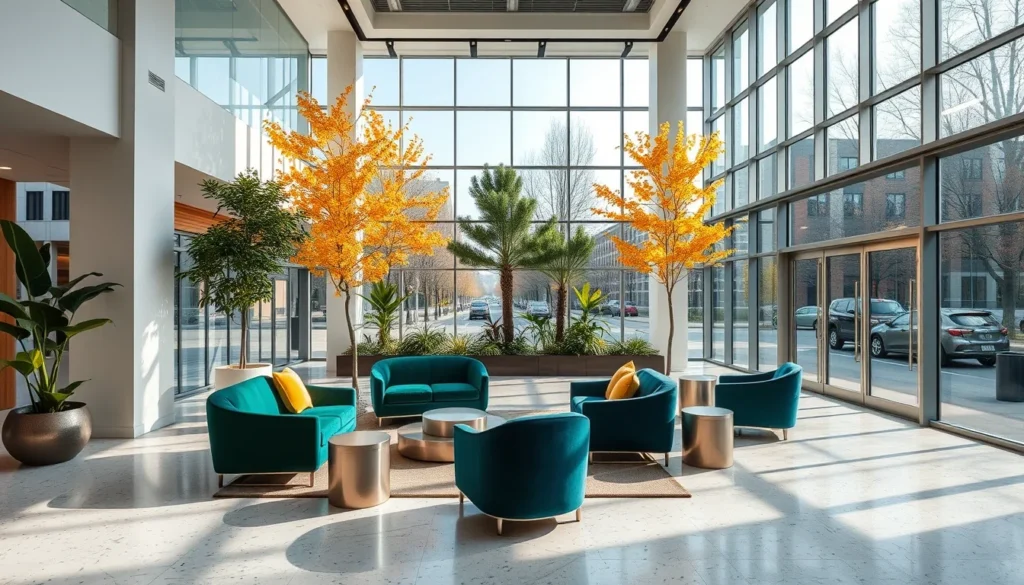
How federal workforce changes are reshaping the regional economy comes down to a measurable shift in commercial leases, procurement flows, and neighborhood spending across the DMV. As agencies trim headcounts and consolidate office footprints this autumn, capital allocation is moving out of downtown corridors and into residential neighborhoods.
Crisp 50-degree air along L Street NW frames a quieter weekday rush than Washington saw a decade ago. Underwriting the region’s private sector now requires tracking real foot traffic, household liquidity, and local business adaptation across District, Maryland, and Northern Virginia corridors.
How are downtown research groups measuring the shift in federal spending?
The D.C. Policy Center, headquartered at 1310 L Street NW in Downtown DC, tracks how federal workforce reductions, shutdown disruptions, and declining procurement contracts directly compress local gross domestic product and push commercial office vacancies higher.
Through its annual State of Business Report and Business Sentiments Survey, the non-partisan organization maps the structural link between agency payrolls and private-sector revenue. Property owners and commercial lenders rely on those metrics when pricing downtown lease renewals.
Fewer federal commuters on the Red and Orange lines translate into thinner weekday margins for dry cleaners, parking garages, and service contractors. Strategic diversification away from single-tenant government dependency has become the defining balance-sheet priority for District landlords.
What does household-level data reveal across DC, Maryland, and Virginia?
Household-level tracking by the Greater Washington Community Foundation at 1750 H Street NW in the Golden Triangle shows that federal job cuts and contracting losses ripple unevenly through savings accounts, mortgage stability, and family budgets across the DMV.
Working alongside Gallup on the VoicesDMV Community Insights report, the philanthropic institution documents how mid-career civil servants and suburban subcontractors absorb sudden income volatility. In Montgomery County and Northern Virginia, reduced contracting awards tighten discretionary spending almost immediately.
That financial pressure shifts how households evaluate housing, childcare, and long-term career planning. Local employers outside the federal sphere now compete for displaced policy analysts, project managers, and compliance specialists who bring disciplined operational experience to private firms.
How do Penn Quarter restaurants adapt when weekday office traffic drops?
Penn Quarter dining rooms survive federal disruptions by converting weekday lunch losses into local goodwill and evening neighborhood loyalty. At 480 7th Street NW, Jaleo countered recent shutdown slowdowns by serving complimentary weekday dine-in lunch sandwiches to federal employees holding valid government identification.
José Andrés built his flagship Spanish restaurant on brisk midday turnover from nearby agency headquarters and law firms. When federal desks sit empty, fixed kitchen overhead and perishable inventory force immediate operational adjustments without compromising culinary craftsmanship.
Cooler October evenings bring theatergoers and Capitol Hill residents back to 7th Street NW in wool coats for tapas and sherry. Still, restaurant operators across the District treat daytime office occupancy as a volatile variable rather than a guaranteed baseline. Explore how DC dining corridors are evolving this season.
Why are neighborhood bakeries and studios stepping in for displaced workers?
Independent neighborhood businesses across Woodley Park and Capitol Hill are absorbing the social shock of workforce instability through targeted local relief. At 3000 Connecticut Avenue NW, Baked by Yael supported furloughed federal employees and contractors with complimentary bagels and cakepops during federal shutdowns.
Across town at 410 H Street NE, Hot Yoga Capitol Hill extended up to five complimentary classes to federal workers and contractors affected by administration cuts. Residents used the promo code BREATHEFREE at registration to book sessions during high-stress transitions.
These small-scale interventions keep neighborhood storefronts visible and woven into daily civic life. While commercial banks underwrite debt covenants, independent owners build durable customer retention by showing up before household budgets fully recover.
Where are civil servants gathering to plan their next career move?
Suburban commercial strips just across the District line are emerging as daytime hubs for remote consultants and transitioning civil servants. At 7014-A Westmoreland Avenue in Takoma Park, Maryland, The People’s Book serves as an authentic gathering space and community resource hub.
Readers in layered autumn sweaters browse curated nonfiction shelves, attend evening author talks, and network over coffee steps from the Metro. Independent bookstores and neighborhood cafes now capture the daytime foot traffic that once belonged exclusively to Farragut Square.
As federal employment contracts, secondary commercial nodes in Takoma Park, Bethesda, and Alexandria gain steady weekday demand. Capital follows people, and the region’s economic center of gravity is visibly dispersing from marble federal triangles toward mixed-use neighborhoods.
Washington’s economy is not shrinking so much as it is decentralizing. By pairing disciplined private-sector underwriting with resilient neighborhood commerce, the DMV is building a less concentrated, more durable commercial foundation that thrives well beyond the next federal budget cycle.
Curated Literature & Washington DC Downtown Calendar
The Architecture of Focus: Deep Work & Modern Mastery
By Founders Library Press
A structured framework for strategic clarity, productivity, and authentic execution.
Upcoming Downtown Happenings
Live acoustic sessions, gallery receptions, literary salons, and independent trade shows across Washington DC.
