
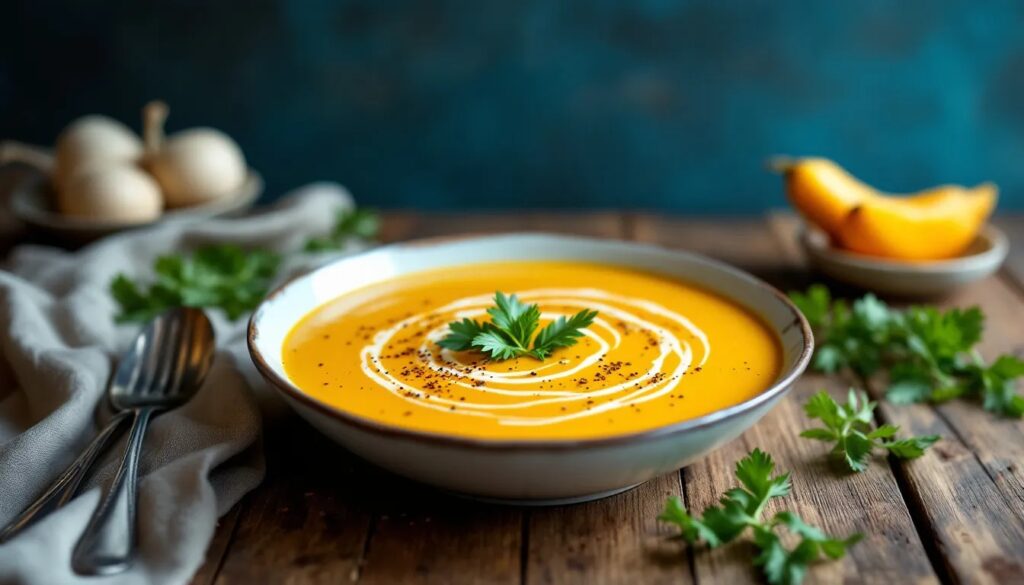

The chill of autumn air often brings with it a craving for warmth, comfort, and the golden embrace of seasonal produce. “Golden Mustard Squash Soup” is more than just a remedy for a crisp evening; it’s a meticulously crafted culinary journey, a testament to the confluence of global history, ingenious agricultural practices, and sophisticated European cooking techniques that coalesce into a single, sublime bowl. This soup, deceptively simple in its name, carries the echoes of continents and centuries, a rich tapestry woven from the bounty of the New World and the culinary artistry of the Old.
At its heart lie the humble yellow squash and the versatile white potato, ingredients that whisper tales of ancient civilizations across the Americas. For thousands of years before European contact, indigenous peoples across Mesoamerica and the Andes cultivated these staples, developing sophisticated agricultural systems that sustained vast populations. The squash, with its sunny disposition and gentle sweetness, and the potato, a remarkable tuber capable of nourishing millions, began their transatlantic voyage after the Columbian Exchange. They arrived in Europe not as immediate celebrities, but as curiosities that, over centuries, transformed diets and shaped agricultural landscapes, eventually becoming cornerstones of cuisines far from their ancestral homes.
Yet, it is the preparation methods and flavor profiles that firmly anchor this “Golden Mustard Squash Soup” in a distinctly European, particularly French, tradition. The initial sautéing of onion, carrot, and celery – the quintessential *mirepoix* – is the aromatic soul of countless French dishes, a foundation of flavor that builds depth and complexity. The generous use of butter and whipping cream speaks to the French inclination for richness and elegance, transforming a rustic vegetable into a luxurious velouté. And then there’s the star turn of Dijon mustard, a piquant flourish that cuts through the creaminess, offering a tangy counterpoint that brightens and invigorates the palate. Its origins trace back to the Burgundy region of France, where for centuries, mustard production has been an esteemed art, evolving from ancient Roman pastes to the refined, sharp condiment we know today.
Even the spices, seemingly minor players, tell grand tales of global trade. A pinch of nutmeg transports us to the distant Banda Islands of Indonesia, the fabled Spice Islands, whose control was once fiercely contested by colonial powers. Black pepper, universally loved, hails from the Malabar Coast of India, a testament to millennia of trade routes connecting East and West. These ingredients, spanning continents and epochs, arrive in our modern kitchens, allowing us to craft dishes that are both deeply familiar and subtly exotic.
To achieve the soup’s perfect silken texture and vibrant flavor, a few culinary considerations are key. Roasting the squash before adding it to the pot intensifies its sweetness and caramelizes its sugars, adding a layer of depth that boiling simply cannot achieve. Simmering with both chicken and beef broths provides a more complex umami base than a single broth alone. When incorporating the cream and mustard, temper them gently, stirring a small amount of hot soup into the cold dairy first to prevent curdling, ensuring a smooth, emulsified finish. Finally, a finishing sprinkle of fresh chives not only adds a delicate oniony freshness but also a visually appealing verdant contrast, completing this historical and delicious tableau. This soup is a celebration of interconnectedness, a bowl where the past and present merge in a symphony of flavor.
GOLDEN MUSTARD SQUASH SOUP
As autumn’s crisp embrace settles, surrender to the inviting allure of this Golden Mustard Squash Soup. A culinary refuge from the chill, this radiant creation marries the earthiness of seasonal vegetables with a whisper of piquant Dijon and the fragrant warmth of nutmeg. Swirled with a touch of silken cream, each spoonful offers a profoundly satisfying experience, transforming a simple meal into an occasion of elevated comfort.
Ingredients
-
0.25
cup
butter
½ stick -
1
cup
onion
chopped -
1
None
medium carrot
chopped -
1
None
celery stalk
chopped -
3
cups
rich chicken broth -
2
cups
rich beef broth -
1.5
pounds
yellow squash
diced -
0.25
cup
whipping cream -
1.5
Tablespoons
Dijon mustard -
to taste
None
salt and pepper -
0.5
teaspoon
nutmeg
freshly grated -
1
None
white potato
6-8 ounce, peeled and diced -
as needed
None
freshly grated carrot
for garnish -
as needed
None
snipped fresh chives
for garnish
Instructions
-
Commence by gently melting the unsalted butter in a substantial, heavy-bottomed saucepan over a delicate low heat.
-
Introduce the finely diced onion, carrot, and celery to the pan. Envelop the mixture, allowing it to tenderize until the onion achieves a diaphanous translucency, approximately ten minutes, stirring occasionally to ensure even cooking.
-
Pour in the rich chicken and beef broths, followed by the cubed squash and potato.
-
Elevate the heat, bringing the liquid to a gentle, sustained simmer.
-
Allow the concoction to cook unhurriedly until all the vegetables are exceedingly tender and easily pierced with a fork, a process typically requiring about thirty minutes.
-
Carefully transfer the cooked contents to a high-speed blender or a robust food processor. Process until the soup achieves an utterly smooth, homogeneous consistency. For an impeccably silken finish, consider passing the purée through a fine-mesh sieve.
-
Return the velvety liquid to the saucepan. Gently fold in the opulent heavy cream, the vibrant Dijon mustard, and the fragrant ground nutmeg. Season judiciously with flakes of sea salt and freshly cracked black pepper, tasting to perfect the symphony of flavors.
-
Present the radiant soup piping hot, beautifully adorned with a delicate scattering of freshly grated carrot and vibrant, finely snipped fresh chives.
Recipe Notes
This splendid soup offers versatility for the discerning palate. For a deeper, more nuanced flavor profile, consider roasting the squash pieces until caramelized before adding them to the pot. Should you desire a vegetarian rendition, simply substitute the chicken and beef broths with a premium vegetable stock. This soup also freezes beautifully; allow it to cool completely before transferring to airtight containers, where it will maintain its quality for up to three months. Reheat gently over low heat, adding a splash more broth or cream if needed to restore its perfect consistency.
Global Heritage Archive
Anthropological & Spice Migration Record
“A culinary culture that embraces seasonal American produce, often elevating it with sophisticated European (particularly French) culinary techniques to create comforting, rich, and flavorful dishes.”
🌿 Spice & Botanical Migration
Black pepper, originating from the Malabar Coast of India, embarked on millennia-long journeys along the ancient Spice Routes, becoming a global staple. Nutmeg, hailing from the remote Banda Islands of Indonesia, was a highly coveted commodity in the Age of Exploration, driving intense colonial competition for its control. Chives, native to Europe and Asia, have been cultivated for their delicate oniony flavor for centuries, making their way into various regional cuisines.
🏺 Historical & Archaeological Record
The earliest archaeological evidence of squash cultivation dates back approximately 10,000 years in regions spanning from Mesoamerica to Eastern North America. White potatoes were first domesticated in the Andes Mountains, roughly 7,000-10,000 years ago. However, the specific technique of a puréed, cream-enriched vegetable soup, characteristic of this recipe, finds its clearest written precursors in 17th to 18th-century French culinary texts, demonstrating the refinement of European cooking methods following the global exchange of ingredients.
💡 Little Known Facts
- The yellow squash and white potato in this soup are New World ingredients, first cultivated by indigenous peoples in the Americas thousands of years before making their way to Europe via the Columbian Exchange.
- Dijon mustard, a cornerstone of this soup’s distinctive tang, traces its fame back to a 17th-century regulation in Dijon, France, which granted exclusive rights to make mustard using verjuice, a pressed juice of unripe grapes.
📸 Made This Heritage Recipe?
We would love to see how your dish turned out! Send a photo of your culinary creation to [email protected] to be featured in our community gallery.
Leave a review and rate this recipe below!
Curated Literature & Washington DC Downtown Calendar
The Culinary Alchemist: Modern Gastronomy & Flavor Pairing
By LDN Gastronomy Series
Artisanal technique, seasonal sourcing, and kitchen mastery.
Upcoming Downtown Happenings
Live acoustic sessions, gallery receptions, literary salons, and independent trade shows across Washington DC.
