
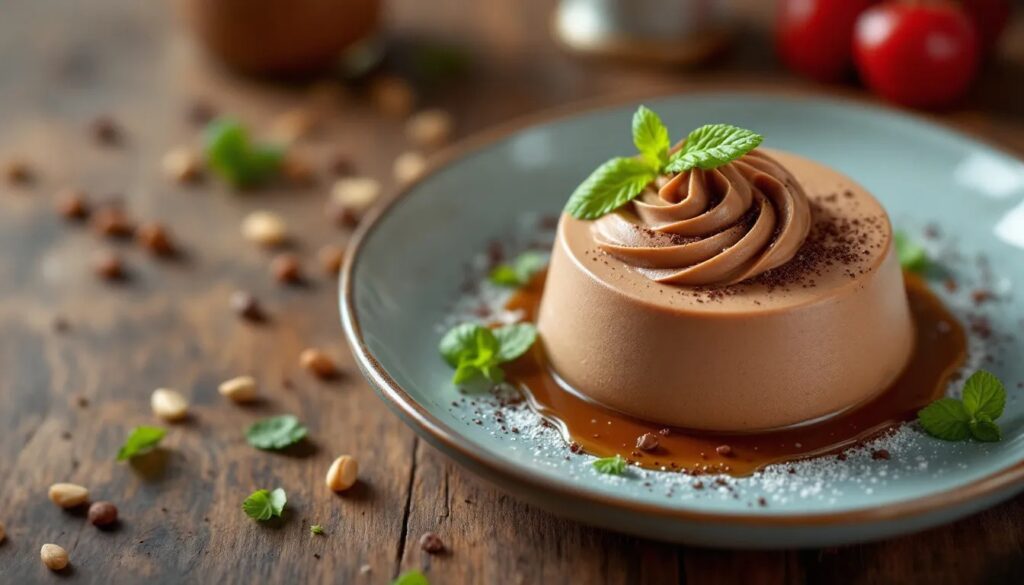

Imagine a dessert that whispers tales of ancient trade routes, echoes the bustling innovation of European cafés, and cradles the sun-drenched spirit of distant lands in every silken spoonful. The Coffee Mousse is precisely that – a culinary masterpiece whose deceptively simple appearance belies a rich, global history. While the term ‘mousse’ itself is distinctly French, derived from the word for ‘foam’ to describe its ethereal, airy texture perfected by 18th-century Parisian confectioners, this particular rendition, with its bold espresso heart, speaks volumes of Italian ingenuity and a broader European embrace of global flavors.
The journey of coffee, the very soul of this mousse, began centuries ago in the verdant highlands of Ethiopia. From there, it traveled across the Red Sea to the Arabian Peninsula, where Sufi mystics first harnessed its stimulating properties for long nights of prayer, before becoming the beloved social beverage of the Ottoman Empire. By the 17th century, coffee houses were flourishing across Europe, particularly in Italy, where the invention of the espresso machine in the late 19th century revolutionized coffee consumption, transforming it from a slow brew into a concentrated, aromatic shot – perfect for infusing desserts.
But the story doesn’t end with coffee. Look closer at the accompanying spices: the warm embrace of cinnamon, the pungent intrigue of cloves, and the sweet, woody whisper of nutmeg. These are not indigenous to Europe but are powerful migration indicators, each having traversed thousands of miles from their tropical homelands. Nutmeg and cloves hail from the remote Banda Islands in Indonesia, while cinnamon journeyed from Sri Lanka and Southeast Asia. Their arrival in European kitchens, facilitated by millennia of the legendary Spice Route, imbued desserts with exotic warmth, signifying status and a taste for the global. The inclusion of white chocolate, a relatively modern invention originating from Switzerland in the early 20th century, adds another layer of creamy indulgence, a testament to evolving culinary science and tastes.
Crafting this Coffee Mousse is a delightful exercise in balancing historical reverence with modern technique. The richness comes from diligently tempered egg yolks and unctuous butter, whipped into a sabayon-like base, while the lightness is achieved by carefully folding in peaks of whipped cream, ensuring every bubble of air contributes to that signature melt-in-your-mouth texture. The quality of your espresso is paramount; a freshly pulled shot with a good crema will provide the depth and aroma necessary to stand up to the dairy and sugar. A gentle infusion of the whole spices into the cream can extract their nuances without overpowering the star. Chill thoroughly, allowing the flavors to meld and the mousse to set into its perfect, voluptuous form. This dessert is more than just a sweet treat; it’s a confluence of cultures, a historical narrative on a spoon, inviting you to savor the interconnectedness of our culinary world.
Coffee Mousse
This delightful Coffee Mousse offers a sophisticated blend of robust espresso and rich chocolate, balanced by the warmth of cinnamon and nutmeg. A truly vintage dessert, it evokes cozy gatherings and elegant entertaining, perfect for coffee lovers seeking a unique sweet treat.
Ingredients
-
1 ½
cups
whipping cream -
2/3
cups
espresso coffee beans -
1/8
teaspoon
nutmeg -
2
large egg yolks -
2
Tablespoons
sugar -
2
cinnamon sticks
broken in half -
10
whole cloves -
6
ounces
white chocolate
finely chopped -
1/3
cup
chilled whipping cream -
3/4
stick
unsalted butter
room temperature (equivalent to 6 Tablespoons)
Instructions
-
Bring first 5 ingredients (1 ½ cups whipping cream, 2/3 cups espresso coffee beans, 1/8 teaspoon nutmeg, 2 large egg yolks, 2 Tablespoons sugar) to full boil in saucepan.
-
Remove from heat.
-
Cover and let steep one hour.
-
Bring coffee mixture to boil again.
-
Strain into measuring cup.
-
Return to saucepan and cook until reduced to ½ cup, stirring constantly.
-
Remove from heat; add white chocolate, stir until melted.
-
Whisk yolks and sugar in bowl until slightly thickened.
-
Whisk in chocolate mixture then butter.
-
Chill until cool and thick, stirring frequently, 20 minutes.
-
Meanwhile, whip 1/3 cup cream to peaks.
-
Fold into coffee mixture gently; do not over-mix.
-
Spoon mousse over caramel layer.
-
Cover and refrigerate.
Recipe Notes
The instruction ‘Spoon mousse over caramel layer’ suggests this mousse might be part of a multi-component dessert, possibly paired with another caramel element not detailed in this recipe, or even the Caramel Mousse recipe on the same page.
Global Heritage Archive
Anthropological & Spice Migration Record
“A sophisticated culinary culture valuing rich textures, aromatic spices, and coffee’s role beyond a beverage, often associated with post-meal indulgence and European café traditions.”
🌿 Spice & Botanical Migration
Nutmeg and cloves both trace their botanical origins to the remote Banda Islands (Moluccas) in Indonesia, becoming highly coveted commodities along the ancient Spice Route, reaching the Mediterranean and Europe by various intermediaries for millennia. Cinnamon, primarily from Sri Lanka (Ceylon cinnamon) or Southeast Asia (Cassia), similarly traveled westward. Coffee beans, originating in the Kaffa region of Ethiopia, spread through the Arabian Peninsula, across the Ottoman Empire, and eventually made their way to Europe by the 17th century, where Italian ingenuity later developed the espresso method.
🏺 Historical & Archaeological Record
The earliest documented mention of a dish resembling a ‘mousse’ (specifically chocolate mousse) is found in French cookbooks of the mid-18th century, such as *La Cuisinière bourgeoise* (1746). However, the technique of whipping cream and eggs to create a lighter texture has older roots in European pastry. Coffee’s use as a beverage is first reliably recorded in Sufi monasteries in Yemen in the mid-15th century, while the first patent for an espresso machine was granted to Angelo Moriondo of Turin, Italy, in 1884.
💡 Little Known Facts
- The word ‘mousse’ means ‘foam’ in French, reflecting its airy, light texture, a technique perfected by 18th-century Parisian confectioners.
- Coffee was initially consumed by Sufi mystics in Yemen in the 15th century to aid concentration during long hours of prayer before it became a popular social beverage.
- White chocolate isn’t technically ‘chocolate’ in the strictest sense as it contains no cocoa solids, only cocoa butter, milk, and sugar.
- The first patent for an espresso machine was granted in Turin, Italy, in 1884 to Angelo Moriondo, seeking to speed up coffee preparation for busy workers.
📸 Made This Heritage Recipe?
We would love to see how your dish turned out! Send a photo of your culinary creation to [email protected] to be featured in our community gallery.
Leave a review and rate this recipe below!
Curated Literature & Washington DC Downtown Calendar
The Culinary Alchemist: Modern Gastronomy & Flavor Pairing
By LDN Gastronomy Series
Artisanal technique, seasonal sourcing, and kitchen mastery.
Upcoming Downtown Happenings
Live acoustic sessions, gallery receptions, literary salons, and independent trade shows across Washington DC.
