
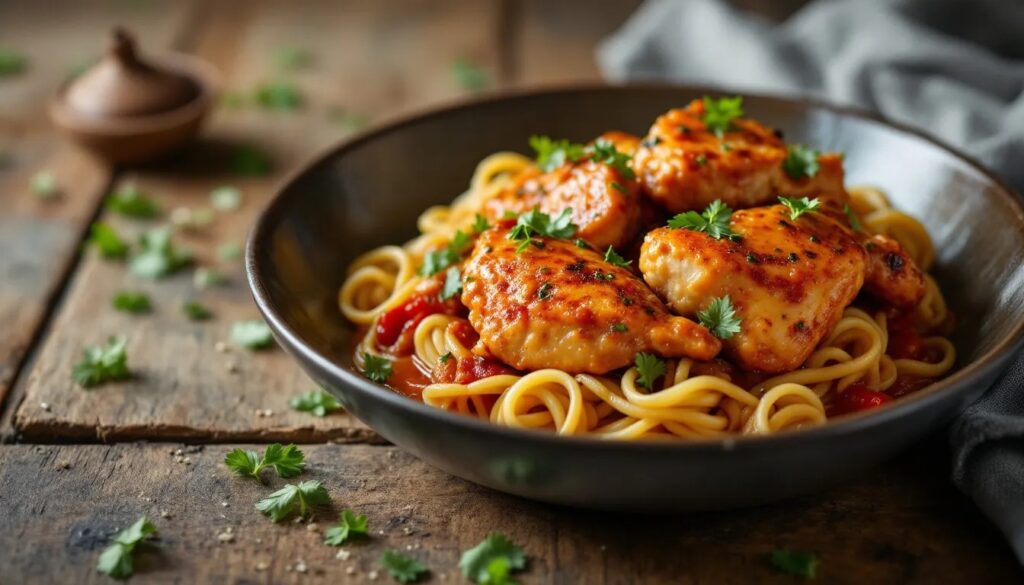
Picture the scene: The battle concluded, Napoleon, famished, demanded a meal. His chef, Dunand, found himself in a desolate landscape with scant provisions. Resourcefulness, the mother of culinary invention, took over. He scrounged up a chicken, some eggs, crayfish from a nearby stream, a splash of brandy, and perhaps some olive oil and garlic. What he created that evening was a hasty, yet fortifying, dish that Napoleon declared a triumph – not just of the palate, but of destiny. He believed this improvised meal brought him luck and demanded it be served after every future battle, prepared in precisely the same manner.
From a historian’s perspective, the narrative of Chicken Marengo is a fascinating study in culinary evolution and myth-making. The original Marengo, by many accounts, would have been simpler, perhaps even lacking the very ingredient that now defines it for many: the tomato. The tomato, a ‘new world’ fruit, was still gaining acceptance in European kitchens in 1800, and its widespread culinary integration into Italian and French cuisine largely occurred later in the 19th century. Its inclusion in later recipes of Chicken Marengo reflects a broader shift in European gastronomy, a beautiful testament to the Columbian Exchange’s profound impact.
Likewise, the original dish famously featured crayfish and fried eggs as garnish – elements often omitted in modern renditions but crucial to Napoleon’s superstitious decree. The inclusion of shrimp in our recipe is a modern adaptation, a nod to the original’s seafood component but with greater accessibility. The combination of French brandy and Italian tomatoes, along with Mediterranean herbs like thyme, bay leaf, and parsley (all indigenous to the region), makes Chicken Marengo a delicious culinary crossroads, a dish that absorbed and adapted new flavors and ingredients over time.
To prepare Chicken Marengo today is to participate in this rich history. Start with good quality chicken, sear it until golden, then build your flavors with aromatics like onion and garlic. Deglaze the pan with brandy and white wine, scraping up all those flavorful bits – a foundational French technique. The Italian tomatoes provide the dish’s essential acidity and sweetness, creating a robust, rustic sauce. Don’t be shy with the fresh herbs, and consider adding the traditional mushrooms and shrimp for textural variety and historical accuracy (with a modern twist). A final squeeze of lemon juice brightens the whole affair.
Chicken Marengo is more than just a recipe; it’s a living artifact, a testament to culinary improvisation, the ebb and flow of global trade, and the enduring power of a good story. Each bite connects us to a moment in history, to a hungry emperor, and to the eternal human need for sustenance, comfort, and perhaps, a little bit of luck.
CHICKEN MARENGO
Embark on a culinary journey steeped in history with Chicken Marengo, a magnificent classic rumored to have been conceived on the battlefield for Napoleon himself. This refined rendition elevates the experience, weaving together the sun-kissed sweetness of Italian tomatoes, the spirited warmth of aged brandy, the earthy depth of mushrooms, and a delicate medley of fresh herbs. The result is a profoundly satisfying and elegant stew, a testament to timeless European home cooking that promises to transport your palate to an era of distinguished flavors and comforting luxury.
Ingredients
-
2
frying chickens
chicken
3 pounds each -
1 1/4
cup
vegetable oil -
1
large
onion
thinly sliced -
3
Tablespoons
brandy -
2
cans
Italian tomatoes
1-pound each, drained -
1/4
cup
dry white wine -
2
cloves
garlic
pressed -
1/2
teaspoon
dried thyme -
1
bay leaf -
4
sprigs
fresh parsley -
1
cup
chicken stock -
1
teaspoon
salt -
1/2
teaspoon
ground pepper -
1
cup
shrimp
small, cleaned -
1/4
pound
fresh mushrooms
sliced -
1/4
cup
butter -
2
Tablespoons
lemon juice -
2
Tablespoons
freshly minced parsley
Instructions
-
Carefully remove the skin from each chicken, then deftly portion each bird into four substantial pieces.
-
In a generously sized skillet, warm the cooking oil over a moderate flame until it shimmers invitingly.
-
Introduce the finely sliced onions to the hot oil, then gently sauté, stirring with regularity, until they soften and achieve a delicate golden hue.
-
Carefully transfer the caramelized onions from the skillet and reserve them.
-
Place the chicken pieces into the skillet, searing them on all surfaces until beautifully bronzed.
-
With extreme care, gently warm the brandy (momentarily lifting the skillet from the heat source if prudent), then cascade it over the chicken and carefully ignite. Permit the flames to fully extinguish before proceeding.
-
Transfer the well-drained Italian tomatoes to a blender and process until a smooth purée is achieved. Incorporate this into the skillet with the chicken.
-
Stir in the dry white wine, freshly pressed garlic, fragrant dried thyme, the bay leaf, fresh parsley sprigs, robust chicken stock, a generous pinch of salt and freshly ground pepper, along with the previously reserved sautéed onions.
-
Cover the skillet securely and allow the mixture to gently simmer for approximately one hour, or until the chicken yields to tenderness.
-
Carefully extract the tender cooked chicken from the skillet and set it aside to maintain warmth.
-
Should you desire a more refined texture, pass the luscious sauce through a fine-mesh sieve to eliminate any remaining solids.
-
Introduce the shrimp to the sauce, allowing them to gently simmer until they are heated through and perfectly cooked.
-
Concurrently, in a separate pan, gently sauté the fresh sliced mushrooms in a knob of butter until they are exquisitely tender. Stir in a splash of fresh lemon juice.
-
Fold the prepared mushrooms and their zesty lemon essence into the simmering sauce, warming them through gently.
-
Artfully arrange the warmed chicken pieces on a preheated serving platter, spoon the magnificent sauce generously over them, and crown the dish with a vibrant sprinkling of freshly minced parsley just before presenting.
Recipe Notes
Exercise paramount diligence when igniting brandy. This crucial step must be undertaken in an environment that is both well-ventilated and entirely free from combustible materials. Confirm the complete dissipation of all flames before proceeding to the subsequent stages of preparation.
Global Heritage Archive
Anthropological & Spice Migration Record
“A dish born from exigency and battlefield improvisation, transformed into a staple of celebratory French cuisine, emblematic of a historical moment and evolving culinary tastes.”
🌿 Spice & Botanical Migration
The core herbs like thyme, bay leaf, and parsley are indigenous to the Mediterranean, spreading through ancient Roman cultivation. Garlic and onion trace their origins to Central Asia, migrating across continents millennia ago. Black pepper, a global staple, began its journey on India’s Malabar Coast, reaching Europe via the intricate Spice Routes. The most significant migration indicator here is the tomato, a New World fruit brought to Europe via the Columbian Exchange, which, though slow to be embraced culinarily, became central to dishes like Marengo in the 19th century.
🏺 Historical & Archaeological Record
The foundational technique of braising chicken with aromatic vegetables and herbs is ancient, with precedents in Roman culinary texts like Apicius’ *De Re Coquinaria* (4th century CE). However, the specific iteration of ‘Chicken Marengo,’ especially with tomatoes, places its earliest written records in 19th-century French cookbooks, evolving from its purported battlefield origin to a formalized recipe.
💡 Little Known Facts
- The original Chicken Marengo, reportedly improvised for Napoleon after the Battle of Marengo in 1800, likely did not contain tomatoes, as they were not yet widely adopted in Italian or French cuisine at that time. They became a staple addition later in the 19th century.
- Napoleon was reputedly highly superstitious about the dish, insisting it be prepared exactly the same way (including its original accompaniments of fried eggs and crayfish) before every battle, believing it brought him good fortune.
📸 Made This Heritage Recipe?
We would love to see how your dish turned out! Send a photo of your culinary creation to [email protected] to be featured in our community gallery.
Leave a review and rate this recipe below!
Curated Literature & Washington DC Downtown Calendar
The Culinary Alchemist: Modern Gastronomy & Flavor Pairing
By LDN Gastronomy Series
Artisanal technique, seasonal sourcing, and kitchen mastery.
Upcoming Downtown Happenings
Live acoustic sessions, gallery receptions, literary salons, and independent trade shows across Washington DC.
