
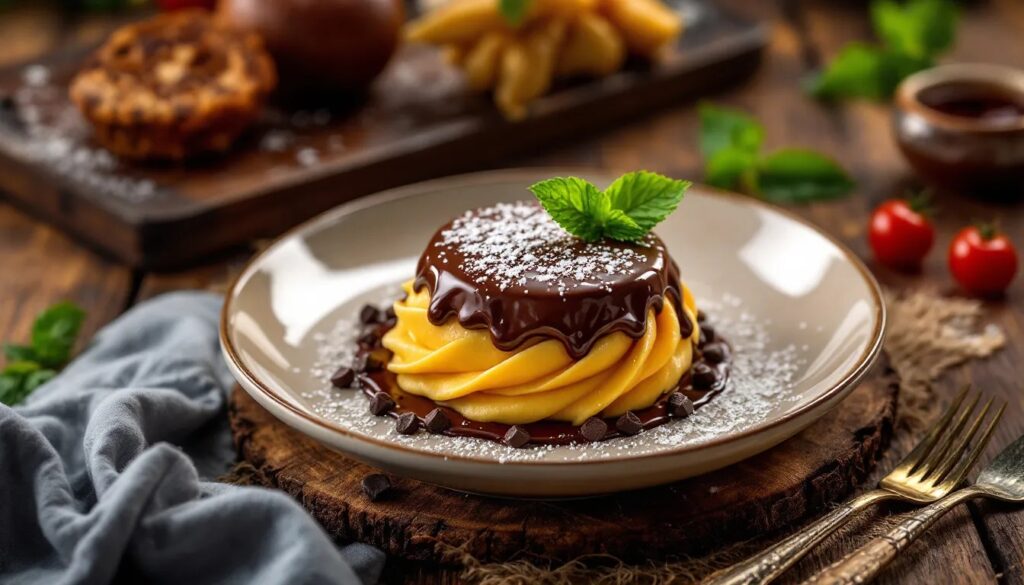
The very name ‘Charlotte’ whispers tales of European aristocracy. While some lore attributes it to Queen Charlotte, wife of England’s King George III, others suggest an older English root, ‘charlyt,’ for a dish of custard. Regardless of its namesake, the dessert evolved significantly. The earliest Charlottes were humble, warm, baked puddings, often made with fruit and lined with bread. It was the legendary French chef Marie-Antoine Carême, ‘the King of Chefs and the Chef of Kings,’ who transformed it in the early 19th century into the cold, molded masterpiece we recognize today. His ‘Charlotte Russe,’ lined with ladyfingers (known in French as ‘biscuits à la cuillère’) and filled with a Bavarian cream, set the stage for countless variations, including our decadent Charlotte au Chocolat.
The star of this particular Charlotte, chocolate, carries an epic narrative of its own. Cacao, the bean from which chocolate is derived, originated in Mesoamerica, where ancient Olmec, Mayan, and Aztec civilizations revered it as a bitter, sacred drink. Introduced to Europe by the Spanish conquistadors after the Columbian Exchange, cacao was initially an aristocratic indulgence, a sweetened beverage savored in royal courts. It wasn’t until the 17th and 18th centuries that chocolate transitioned from drink to a solid, edible ingredient, profoundly influencing European patisserie, especially in France, where it quickly became a symbol of luxury and refinement.
Other ingredients further paint this picture of global migration. The ladyfingers, with their light, airy texture, find their heritage in the Italian ‘Savoiardi,’ adopted and refined by French bakers. The dark rum, lending its complex, warm notes to the chocolate cream, speaks of the Caribbean’s colonial past and the transatlantic trade routes that brought sugarcane and its distilled byproducts to European palates. Even the seemingly simple sugar, essential for sweetness and structure, traces its botanical origins to New Guinea, its cultivation spreading across Asia, the Middle East, and eventually to the New World, becoming a global commodity through extensive trade. Candied violets, a delicate and distinctly French flourish, crown this global tapestry with a local touch of sophisticated confectionery.
Crafting a Charlotte au Chocolat is an act of culinary love and precision. Success hinges on a few crucial details: select high-quality dark chocolate for depth of flavor; ensure your egg yolks are tempered carefully to create a silky, rich cream; and whip your egg whites and cream to perfect, airy peaks for that ethereal mousse texture. The assembly, though seemingly straightforward, requires a steady hand—lining the mold meticulously with rum-soaked ladyfingers is key to its structural integrity and elegant presentation. The patience required for the chilling process is paramount, allowing the flavors to meld and the mousse to set firmly. This isn’t just a dessert; it’s a historical narrative, a celebration of ingenuity, and a beautifully layered indulgence, inviting you to savor each exquisite bite as a taste of history.
CHARLOTTE AU CHOCOLAT
Presenting the ‘Charlotte au Chocolat,’ a testament to classic French confectionery that transforms any occasion into an elegant affair. This dessert is a symphony of textures and profound cocoa depth, featuring delicate, crisp ladyfingers meticulously arranged to cradle a cloud-like, ethereal chocolate mousse. Each spoonful promises a luxurious melt-in-your-mouth experience, often uplifted by a subtle, resonant hint of aged rum, culminating in a culinary masterpiece designed to captivate and delight.
Ingredients
-
quantity not specified
package
Ladyfingers
both long and tear-shaped; typically 24-36 standard ladyfingers are needed for a 1-quart mold -
4
egg yolks
None -
½
cup
confectioners’ sugar
None -
1
Tablespoon
dark rum
None -
¼
cup
dark rum or cognac
optional, for sprinkling -
8
ounces
chocolate
4 ounces sweet, 4 ounces bitter -
1
Tablespoon
warm water
None -
8
egg whites
None -
for garnish
Whipped cream
None -
for garnish
Candied violets
optional -
2
sticks
unsalted butter
softened
Instructions
-
Begin by preparing both the elongated and tear-shaped ladyfingers. Gently trim the ends of the tear-shaped biscuits as needed.
-
Line the base of a 1-quart charlotte mold by centering a circular parchment paper disc within it.
-
Artfully arrange the trimmed tear-shaped ladyfingers, inverted, across the mold’s bottom to create a delicate, petal-like pattern.
-
Encircle the interior perimeter of the mold with a strip of fringed parchment paper, ensuring it stands upright against the sides.
-
Carefully pare one end of the longer ladyfingers and subtly narrow their sides, preparing them for the mold’s edge.
-
Position these elongated ladyfingers vertically around the mold’s lined interior, placing the trimmed end downwards. Ensure their rounded sides gently press against the parchment, fitting snugly side-by-side without gaps.
-
In a mixing bowl, combine the egg yolks, granulated sugar, and 1 tablespoon of rum. Whisk vigorously for 4 to 5 minutes until the mixture achieves a pale, aerated, and beautifully fluffy consistency.
-
Gently melt the chocolate with the softened butter. Once melted, incorporate them together with a quick whisk for approximately one minute.
-
Fold the melted chocolate and butter mixture into the aerated egg yolk mixture. Should the blend appear to curdle, swiftly whisk in 1 tablespoon of warm water until it regains a smooth, uniform texture. Maintain this combined mixture at a comfortably lukewarm temperature.
-
In a separate, scrupulously clean bowl, whip the egg whites until they form firm, glossy peaks.
-
Carefully fold about one-third of the whipped egg whites into the chocolate-egg yolk mixture to lighten its density.
-
Gently incorporate the remaining whipped whites using a folding motion. Exercise speed and precision during this step to preserve the mousse’s delicate volume and prevent the whites from becoming granular.
-
Begin assembling the charlotte: alternate layers of the chocolate mousse with a scattering of ladyfinger trimmings, lightly moistened with a drizzle of rum, until the mold is filled. Conclude with a final layer of chocolate mousse.
-
Using kitchen shears, trim any extending ladyfingers flush with the mousse filling, then arrange these trimmings atop the final chocolate layer to create a cover.
-
Cover the mold securely and allow it to chill in the refrigerator for a minimum of two hours, or until thoroughly set.
-
To serve, carefully unmold the charlotte and gently peel away all parchment paper linings.
-
Adorn the exquisite creation with delicate candied violets and a flourish of freshly whipped cream.
-
Present alongside a silken Crème Anglaise for an unparalleled dessert experience.
Recipe Notes
This master recipe anticipates the use of pre-made or freshly prepared ladyfingers. When incorporating the whipped egg whites, precision and swift, delicate movements are paramount to maintain the mousse’s airy structure and optimal volume. The inclusion of ¼ cup dark rum or fine cognac for sprinkling over the ladyfinger trimmings is an elegant option, enhancing the dessert’s depth of flavor.
Global Heritage Archive
Anthropological & Spice Migration Record
“French haute cuisine and patisserie, characterized by sophisticated techniques, rich ingredients, and elegant presentation for celebratory and formal dining.”
🌿 Spice & Botanical Migration
The primary flavor components, chocolate and rum, are potent indicators of global trade. Cacao, the source of chocolate, originated in Mesoamerica and was introduced to Europe by the Spanish via the Columbian Exchange. Rum, distilled from sugarcane byproducts, traces its roots to the Caribbean via the transatlantic trade routes, with sugarcane itself originating in Southeast Asia and migrating globally.
🏺 Historical & Archaeological Record
The concept of a cold, molded Charlotte dessert, specifically the Charlotte Russe, was first documented in early 19th-century French culinary literature, attributed to Marie-Antoine Carême around 1800-1820. Its key ingredients like chocolate trace back to Olmec civilization in Mesoamerica (1500-400 BCE) as a beverage.
💡 Little Known Facts
- The original Charlotte was a warm, baked dish, often made with apples or other fruits, lined with bread or brioche, believed to be named after Queen Charlotte, wife of King George III.
- The cold Charlotte, lined with ladyfingers and filled with Bavarian cream (like the Charlotte Russe), was popularized by the legendary French chef Marie-Antoine Carême in the early 19th century.
📸 Made This Heritage Recipe?
We would love to see how your dish turned out! Send a photo of your culinary creation to [email protected] to be featured in our community gallery.
Leave a review and rate this recipe below!
Curated Literature & Washington DC Downtown Calendar
The Culinary Alchemist: Modern Gastronomy & Flavor Pairing
By LDN Gastronomy Series
Artisanal technique, seasonal sourcing, and kitchen mastery.
Upcoming Downtown Happenings
Live acoustic sessions, gallery receptions, literary salons, and independent trade shows across Washington DC.
