
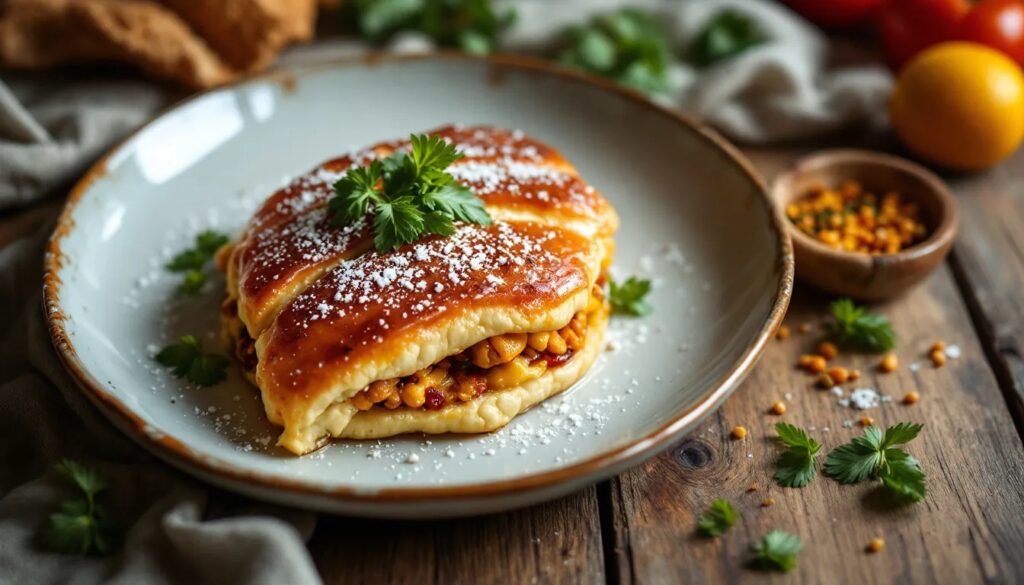
At its core, Brie en Croute is a celebration of Brie, France’s venerable “King of Cheeses,” a title bestowed upon it at the Congress of Vienna in 1815. Hailing from the historic Brie region, just east of Paris, this soft, bloomy-rinded cheese has been a staple of French tables for centuries, its rich, buttery texture and mushroomy aroma making it a culinary treasure. The “en croute” technique, meaning “in a crust,” is equally ancient, dating back to times when food encased in dough served primarily as a method of preservation and transportation rather than a delicate culinary art. Early forms of pasty-like dishes appear in archaeological records from antiquity, with Romans and Greeks employing dough to protect and cook meats and other fillings. Over the centuries, as pastry techniques evolved, particularly in medieval Europe, these humble crusts transformed from mere containers into delectable components, leading to the sophisticated pies and pasties that foreshadow modern “en croute” preparations.
The recipe we examine—featuring Brie, flour, butter, cream cheese, and sesame seeds—is a fascinating snapshot of this evolution, reflecting both its deep French roots and its journey through global culinary landscapes. The flour and butter are the very foundation of classic French pastry, conjuring visions of meticulously crafted puff pastry, a hallmark of haute cuisine. However, the inclusion of cream cheese and sesame seeds offers a distinctive, somewhat more contemporary narrative. Cream cheese, largely popularized in North America, particularly with brands like Philadelphia, suggests an adaptation for texture and accessibility. It might be used to enhance the creaminess, act as a barrier to prevent the Brie from leaking, or simply to add a familiar, pleasing richness to the overall composition. The sesame seeds, with their deep origins in Africa and India, represent an even older, yet simultaneously modern, global migration. Carried across ancient trade routes—from the Silk Road to the maritime spice lanes—sesame found its way into countless cuisines, celebrated for its nutty flavor and textural crunch. Their presence here, often sprinkled atop the pastry, speaks to a widespread appreciation for global ingredients and a desire to add a touch of exoticism or visual appeal to a traditional dish. This particular combination points to a beloved appetizer, likely popularized and refined in North America, where cultural fusion frequently reinterprets European classics.
To perfect your own Brie en Croute, begin with a high-quality Brie, ensuring it’s not overly ripe, which can lead to excessive leakage. A good puff pastry is paramount; while challenging, making it from scratch is rewarding, but store-bought varieties offer convenience without sacrificing much quality. Consider spreading a thin layer of fruit jam—apricot, fig, or raspberry—or a sprinkle of toasted nuts like pecans or walnuts over the Brie before encasing it, adding layers of flavor and texture that complement the cheese beautifully. Score the top of the pastry elegantly before baking to allow steam to escape and create a visually appealing pattern. Serve your golden Brie en Croute immediately, while the cheese is gloriously molten, alongside crisp apple slices, crusty baguette, or artisanal crackers. It’s more than just a dish; it’s an edible testament to history, trade, and the boundless creativity of the human palate.
BRIE EN CROUTE
Embark on a journey of refined indulgence with our Brie en Croûte, a quintessential French-inspired appetizer that promises a symphony of textures and flavors. Envision a rich, exquisitely buttery pastry, meticulously crafted from a delicate blend of cream cheese and high-quality butter, designed to artfully encase a wheel of luscious, creamy Brie. While the full culinary narrative of this recipe awaits its complete unveiling, the anticipation of a warm, molten interior, beautifully contrasted by a golden, perhaps sesame-kissed, flaky crust, is undeniably compelling. This elegant starter, even in its foundational state, guarantees a memorable prelude to any gathering, a testament to timeless sophistication.
Ingredients
-
1
3-oz. Package
cream cheese
room temperature -
1/4
cup
butter
room temperature -
1/2
Teaspoon
sesame seeds -
3/4
cup
flour -
1
4 1/2 oz. package
Brie cheese
Instructions
-
In a spacious mixing bowl, meticulously incorporate the cubed cream cheese and butter using a pastry blender or your fingertips, working the fats into the flour until the mixture achieves a uniform, coarse, mealy texture reminiscent of small peas.
-
Gently gather the nascent dough, pressing it firmly but with care, to coalesce into a cohesive, smooth sphere.
-
Envelop the dough ball tightly in plastic wrap and transfer it to the refrigerator to chill thoroughly for a minimum of one hour, allowing the fats to firm and the gluten to relax for optimal workability.
-
Once adequately chilled, retrieve the dough and divide it precisely into two equal portions.
-
On a pristine work surface lightly dusted with flour, meticulously roll out each individual dough portion. Employ a rolling pin to achieve a uniform thickness of approximately one-eighth of an inch.
-
Using a circular cutter or a sharp knife, fashion each rolled-out piece into a perfect six-inch disc, carefully reserving any excess dough trimmings for potential decorative embellishments.
-
Delicately place one of the prepared dough circles onto an un-
Recipe Notes
Please note: The comprehensive preparation guidance for this recipe concludes prematurely at this juncture. We anticipate future updates to unveil the complete orchestration of this culinary masterpiece.
Global Heritage Archive
Anthropological & Spice Migration Record
“A culinary culture renowned for its artisanal cheese production and sophisticated pastry techniques, which has been embraced and adapted worldwide.”
🌿 Spice & Botanical Migration
Sesame seeds (Sesamum indicum) are native to sub-Saharan Africa and the Indian subcontinent, having been cultivated for over 5,000 years. They traveled globally via ancient trade routes, including those connecting Mesopotamia, the Mediterranean, and the Spice Routes, establishing themselves across the Middle East and Asia. Their presence in this dish signifies a modern cross-cultural influence, appreciated for their nutty flavor and textural crunch, rather than a traditional French component.
🏺 Historical & Archaeological Record
The earliest forms of dough-encased foods, the conceptual predecessors to ‘en croute’ dishes, can be traced back to ancient Egypt, with tomb paintings depicting bakers. More concrete evidence for pastry-encased foods appears in ancient Greek and Roman texts, such as Apicius’s ‘De re coquinaria’ (4th-5th century CE), which describes various meat and savory pies, demonstrating the technique of wrapping ingredients in dough for cooking.
💡 Little Known Facts
- Brie cheese was crowned the ‘Roi des Fromages’ (King of Cheeses) at the Congress of Vienna in 1815, triumphing over 60 other European cheeses.
- The ‘en croute’ technique originated as a practical method of cooking and preserving food, with the pastry crust serving as a protective casing that kept contents moist and extended their shelf life, long before it became a delicate culinary art.
📸 Made This Heritage Recipe?
We would love to see how your dish turned out! Send a photo of your culinary creation to [email protected] to be featured in our community gallery.
Leave a review and rate this recipe below!
Curated Literature & Washington DC Downtown Calendar
The Culinary Alchemist: Modern Gastronomy & Flavor Pairing
By LDN Gastronomy Series
Artisanal technique, seasonal sourcing, and kitchen mastery.
Upcoming Downtown Happenings
Live acoustic sessions, gallery receptions, literary salons, and independent trade shows across Washington DC.
