
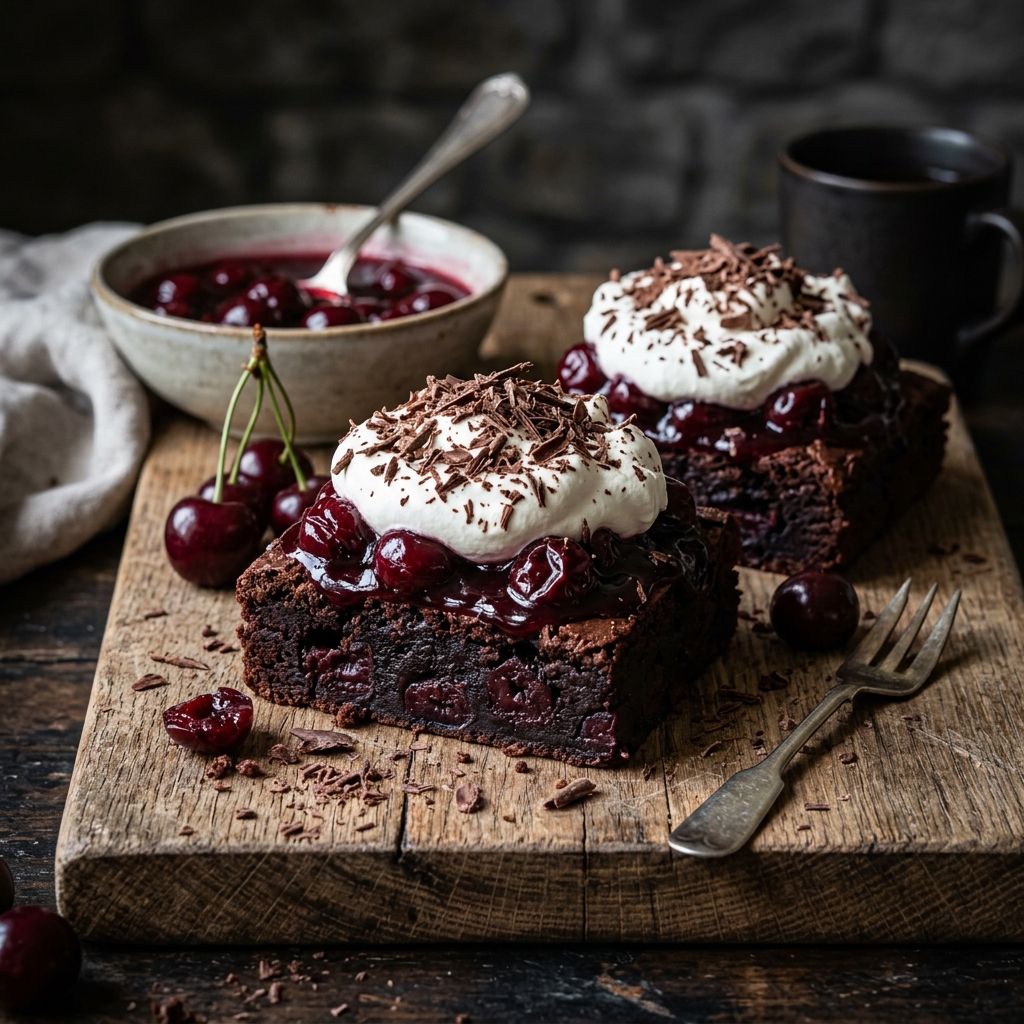
The brownie itself is a quintessentially American invention, a testament to practical ingenuity and a penchant for portable, satisfying sweets. Born sometime in the late 19th or early 20th century, its exact origins are shrouded in delightful apocrypha – from a Chicago hotel chef creating a dessert for a women’s exposition to a happy accident of a forgotten leavening agent. What’s certain is that by the 1900s, this flat, chocolatey bar had captured the American palate, evolving from a simple bar cookie to a national obsession, celebrated in countless variations for its chewy edges and gooey center.
Across the Atlantic, nestled deep within Germany’s Black Forest region, lies the inspiration for the ‘Black Forest’ moniker: the magnificent Schwarzwälder Kirschtorte. This layered masterpiece, consisting of rich chocolate sponge cake, fresh whipped cream, sour cherries, and a generous splash of Kirschwasser (cherry brandy), is a symphony of textures and flavors, a true icon of German patisserie with roots tracing back to the early 20th century. It’s a dessert of precision and tradition, deeply tied to its geographical origin.
The ‘Black Forest Brownie’ emerges from the beautiful collision of these two distinct culinary worlds. It’s an American interpretation, a respectful nod to the German classic, yet reimagined through the lens of convenience and accessibility. The complex layers of the torte are condensed into the familiar, fudgy bite of the brownie. Crucially, the traditional Kirschwasser, a potent cherry brandy, often gives way to the more readily available, brightly hued maraschino cherries and the subtle warmth of almond extract – a clever substitution that maintains the cherry-almond-chocolate trinity without requiring specialized ingredients. This act of adaptation speaks volumes about culinary migration; how flavors travel, are embraced, and ultimately transformed to fit local palates and pantry staples.
Consider the journey of its key ingredients: cocoa, once the sacred beverage of Mesoamerican civilizations, embarked on a transatlantic voyage with the Columbian Exchange, forever changing European confectionery. Vanilla, another gift from the Americas, followed a similar path, becoming a global spice. Even sugar, originally from New Guinea, spread worldwide through complex trade networks and colonial enterprises, becoming a fundamental building block of modern desserts. These ingredients, once exotic treasures, are now commonplace, enabling creations like our Black Forest Brownie, symbolizing global interconnectedness on a delectable plate.
When crafting these brownies, remember the essence of their dual heritage. For a truly fudgy brownie, avoid overmixing the batter once the dry ingredients are added – this prevents gluten development that can lead to a cakey texture. The quality of your cocoa powder matters; a good unsweetened Dutch-process cocoa will yield a richer chocolate flavor. Don’t be shy with the cherries; their tart-sweet bursts are key to balancing the deep chocolate. And for a touch of authenticity, if you have access to Kirschwasser, a splash in the batter or brushed over the warm brownies before frosting can elevate them to another level. Allow them to cool completely before cutting for clean slices and optimal fudginess. The Black Forest Brownie is more than just a dessert; it’s a palatable history lesson, a testament to culinary evolution, and a deeply satisfying treat that brings together continents in every bite.
BLACK FOREST BROWNIES
Embark on a decadent culinary journey with these extraordinary Black Forest Brownies, an exquisite confection that masterfully unites the profound depths of dark chocolate with the vibrant, spirited burst of macerated cherries and the elegant textural contrast of toasted nuts. Far from a mere treat, these brownies offer a sophisticated indulgence, transforming any occasion into a celebration of elevated flavors and artisanal craftsmanship.
Ingredients
- 1-1/3 cups all purpose flour None
- 1 tsp baking powder None
- 1 cup butter or margarine None
- 1 cup cocoa powder (Hershey's)
- 1 tsp almond extract None
- 1 cup (or more) maraschino cherries drained
- 1/2 teas salt None
- 2 cups sugar None
- 4 eggs beaten
- 1½ tsp vanilla None
- 1/2 cup chopped nuts for brownies
- 1/4 cup butter or margarine softened, for icing
- 2 cups confectioners sugar for icing
- 1/4 cup milk for icing
- 1 tsp vanilla for icing
- 6 tbsp baking cocoa for icing
- 1/4 cup chopped nuts for icing
Instructions
-
Whisk together the flour, baking powder, and salt in a medium bowl; reserve for later incorporation.
-
In a spacious saucepan over gentle heat, liquefy the butter. Withdraw from the stovetop, then thoroughly incorporate the cocoa powder until the mixture achieves a silken consistency.
-
Carefully integrate the eggs, granulated sugar, and chosen extracts into the chocolate base, ensuring a well-homogenized blend.
-
Gently fold in the dry flour blend, followed by the macerated cherries and chopped nuts, mixing just until combined.
-
Transfer the prepared batter uniformly into a pre-greased 13 x 9 x 2-inch baking pan.
-
Bake in a preheated oven at 350°F (175°C) for approximately 35 minutes, or until a wooden skewer inserted into the center emerges with moist crumbs attached.
-
To prepare the luscious ganache-style frosting: In a separate bowl, combine the softened butter or margarine, vanilla extract, confectioners' sugar, baking cocoa, and milk. Whisk vigorously until the mixture is exceptionally smooth and creamy.
-
Artfully spread the warm frosting across the surface of the freshly baked brownies.
-
Crown the finished brownies with a final scattering of additional nuts.
Recipe Notes
This recipe yields an abundant three dozen brownies, ideal for sharing or indulging over several days. For optimal freshness, store these delectable treats in an airtight container at room temperature.
Global Heritage Archive
Anthropological & Spice Migration Record
“A culinary fusion where the rich, complex flavors of a traditional German Black Forest Gateau are reinterpreted through the comforting, accessible form of a quintessential American brownie, embodying cross-cultural adaptation.”
🌿 Spice & Botanical Migration
Cocoa, the primary flavor in this dish, originated in Mesoamerica and was brought to Europe via the Columbian Exchange in the 16th century, fundamentally transforming European desserts. Vanilla, another Mesoamerican native, followed a similar path, becoming a global flavoring agent. Almonds, while not a ‘spice,’ are crucial for the almond extract; they are indigenous to Central Asia and the Middle East, spreading to Europe along ancient trade routes, allowing for their widespread use in Western baking.
🏺 Historical & Archaeological Record
The concept of the brownie, a dense, fudgy, chocolate bar cookie, is a distinctly American invention, with the first widely recognized recipes appearing in American cookbooks in the early 20th century (e.g., Fanny Farmer’s 1906 Boston Cooking-School Cook Book). However, its foundational ingredients like sweetened chocolate (derived from Mesoamerican cacao, developed in Europe in the 17th century) and leavened cakes (with roots in ancient civilizations, but refined with modern leavening in the 19th century) have much deeper and global historical lineages.
💡 Little Known Facts
- The modern brownie is widely believed to have originated in the United States around the late 19th or early 20th century, with one popular theory attributing its creation to a chef at Chicago’s Palmer House Hotel in 1893.
- Traditional German Black Forest Gateau (Schwarzwälder Kirschtorte) almost invariably features Kirschwasser, a clear cherry brandy distilled from Morello cherries, a critical flavor component often replaced by almond extract or omitted in Americanized versions.
📸 Made This Heritage Recipe?
We would love to see how your dish turned out! Send a photo of your culinary creation to [email protected] to be featured in our community gallery.
Leave a review and rate this recipe below!
Curated Literature & Washington DC Downtown Calendar
The Culinary Alchemist: Modern Gastronomy & Flavor Pairing
By LDN Gastronomy Series
Artisanal technique, seasonal sourcing, and kitchen mastery.
Upcoming Downtown Happenings
Live acoustic sessions, gallery receptions, literary salons, and independent trade shows across Washington DC.
