
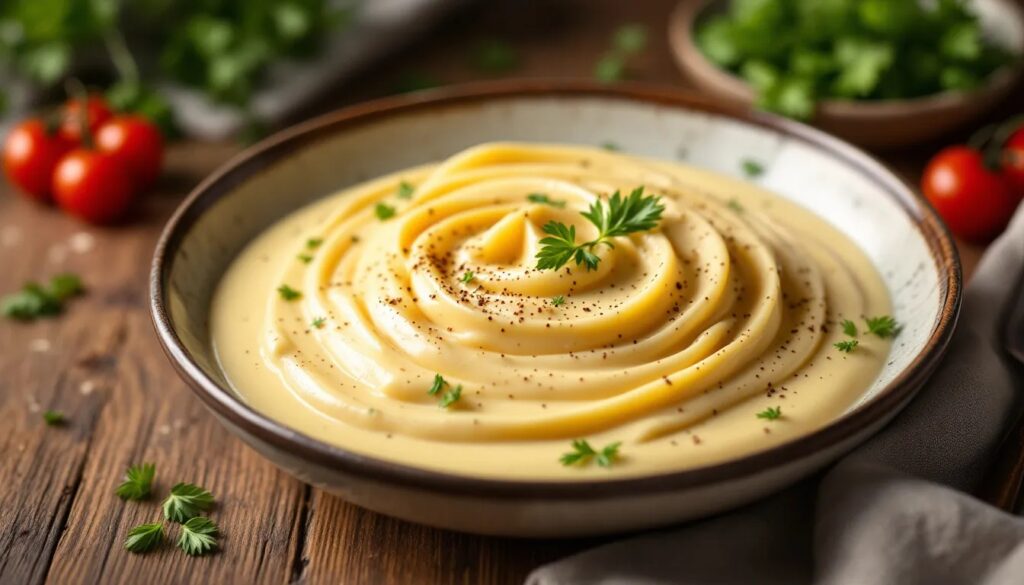
The true genesis of Béchamel is shrouded in the delicious mists of history, a tale often retold with varying protagonists. One popular narrative attributes its creation to Louis de Béchameil, the marquis de Nointel, steward to Louis XIV. While the marquis was indeed a prominent figure in the court and a reputed gourmand, many culinary historians, including the formidable Marie-Antoine Carême, posited that Béchameil merely lent his name to an already existing “white sauce” that he enjoyed and perhaps helped popularize. Another theory, equally compelling, posits an Italian origin, suggesting that the technique arrived in France with Catherine de’ Medici in the 16th century, part of the sophisticated Florentine culinary traditions she introduced to the French court. Regardless of its exact birth certificate, Béchamel flourished on French soil, becoming one of Escoffier’s five foundational “mother sauces,” a testament to its unparalleled versatility and enduring appeal.
The ingredients themselves tell a story of agricultural prowess and global exchange. Butter and milk are pillars of European dairy farming, deeply embedded in the continent’s culinary identity for millennia. Flour, the universal thickener, speaks to the ancient human ingenuity of harnessing grains. But it is the black pepper, a seemingly minor accent, that truly unveils the sauce’s silent witness to vast historical migrations. Originating on the Malabar Coast of India, black pepper traversed continents and oceans via the ancient Spice Routes. It was a luxury in Roman times, a currency in medieval Europe, and a prized commodity that fueled empires and exploration. Its presence in a basic French sauce underscores centuries of global trade, connecting the kitchens of Western Europe to the distant shores of Asia.
Mastering Béchamel is less about complex techniques and more about patient attention. Begin with a perfectly crafted roux: melt the butter gently, then whisk in the flour, cooking it slowly over medium heat until the raw flour taste disappears, typically 2-3 minutes. This crucial step prevents a gritty texture. Next, gradually incorporate warm milk, whisking continuously to prevent lumps. A common tip is to warm the milk beforehand, as cold milk can shock the roux and make lumps more likely. Simmer gently until the sauce thickens to your desired consistency, coating the back of a spoon. Season generously with salt and a touch of white pepper, often complemented by a grate of fresh nutmeg – a secret ingredient that elevates the sauce from good to sublime. From enveloping gratins to binding croquettes, Béchamel is a blank canvas, inviting endless culinary interpretations. It’s a quiet testament to the power of simple ingredients, expertly combined, to create something truly extraordinary.
Basic Bechamel Sauce:
Distinguished as one of the venerable mother sauces of French gastronomy, Bechamel is an exquisite testament to culinary foundational elegance. This ethereal, ivory-hued emulsion serves as the sophisticated backbone for an astonishing repertoire of classic and contemporary dishes. Our refined methodology demystifies the creation of this inherently smooth and opulent base, transforming a trio of staple ingredients – rich butter, finely milled flour, and fresh milk – into a creamy perfection, seasoned with judicious precision. Acquiring proficiency in this fundamental technique is a hallmark of the discerning home chef.
Ingredients
-
2
Tablespoons
butter
None -
1
cup
milk
None -
2
Tablespoons
flour
None -
None
None
Salt and pepper
to taste
Instructions
-
In a robust saucepan or a heavy-bottomed pot, gently warm the butter over medium-low heat until it has fully liquefied and appears shimmering.
-
Introduce the flour to the melted butter, whisking continuously to form a smooth paste, known as a ‘roux.’ Allow this mixture to cook gently for approximately one to two minutes, ensuring it remains pale and refraining from any browning; its purpose is solely to cook out the raw flour taste.
-
Temporarily withdraw the saucepan from the direct heat source to prevent scorching and to prepare for the incorporation of the liquid.
-
Gradually pour in the pre-warmed milk, initially a small amount to loosen the roux, then steadily adding the remainder while vigorously whisking. Maintain constant stirring as the mixture returns to the heat, allowing it to gently simmer and transform into a luxuriously thick, impeccably smooth sauce, free of any lumps.
-
Refine the flavor profile by incorporating a measured pinch of fine sea salt and freshly ground white pepper to taste, stirring until fully integrated.
Recipe Notes
The pursuit of a truly impeccable Bechamel hinges on vigilance: maintain a keen eye on your roux to prevent any discoloration, as this would compromise the sauce’s pristine white hue. For an elevated aromatic dimension, consider infusing your milk beforehand with a clovestudded onion and a bay leaf, warming it gently, then straining before use. Should any unwelcome lumps emerge, a swift pass through a fine-mesh sieve will restore its silken perfection. This foundational sauce is not merely a component but an alchemical starting point, gracefully transforming into magnificent Mornay, enriching soufflés, binding exquisite gratins, and forming the soul of an authentic lasagna. Its mastery unlocks a universe of culinary possibilities.
Global Heritage Archive
Anthropological & Spice Migration Record
“A foundational pillar of classical French cuisine, Béchamel epitomizes elegance and versatility, serving as a base for countless dishes.”
🌿 Spice & Botanical Migration
Black pepper (Piper nigrum) originated on the Malabar Coast of India. It traveled westward via ancient maritime and overland Spice Routes, becoming a prized commodity in Europe by Roman times and a staple in French cuisine by the medieval period, long before the sauce’s codification.
🏺 Historical & Archaeological Record
The earliest known written recipes for flour-thickened white sauces, precursors to Béchamel, appear in 17th-century French cookbooks, most notably in François Pierre de la Varenne’s ‘Le Cuisinier François’ (1651), where a ‘sauce blanche’ is described.
💡 Little Known Facts
- The sauce’s name is often attributed to Louis de Béchameil, but renowned chef Marie-Antoine Carême suggested it was an older, refined sauce he simply popularized.
- Though primarily associated with France, similar white sauces thickened with flour and fat existed in Italy prior to its widespread French adoption, with some theories linking its introduction to France through Catherine de’ Medici.
📸 Made This Heritage Recipe?
We would love to see how your dish turned out! Send a photo of your culinary creation to [email protected] to be featured in our community gallery.
Leave a review and rate this recipe below!
Curated Literature & Washington DC Downtown Calendar
The Culinary Alchemist: Modern Gastronomy & Flavor Pairing
By LDN Gastronomy Series
Artisanal technique, seasonal sourcing, and kitchen mastery.
Upcoming Downtown Happenings
Live acoustic sessions, gallery receptions, literary salons, and independent trade shows across Washington DC.
