
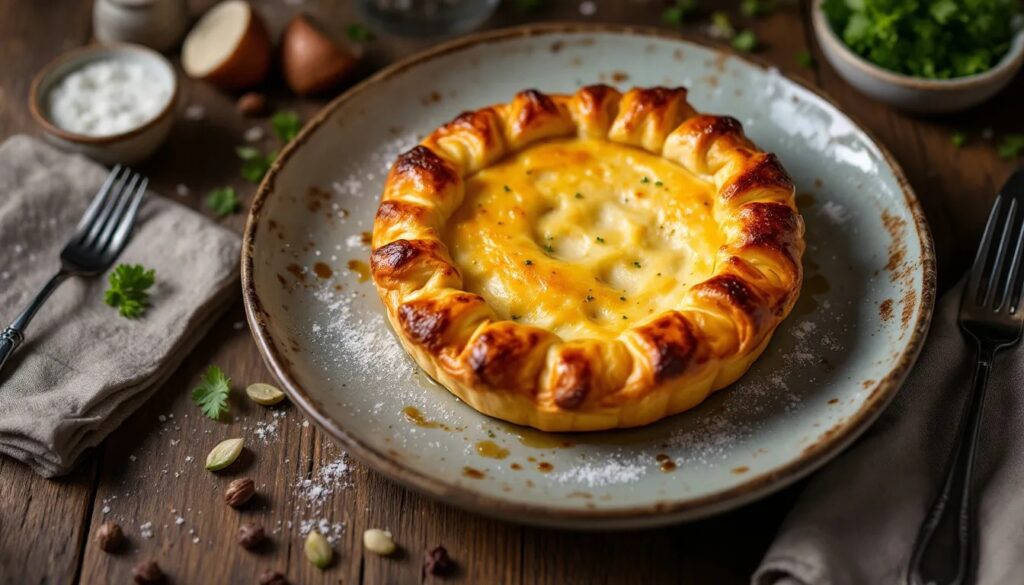
At its core lies Brie, a cheese steeped in centuries of French heritage. Originating from the region of Brie, just east of Paris, this soft, rind-ripened cheese boasts a lineage that stretches back to at least the 8th century. Legend has it that Charlemagne himself, in 774 AD, tasted Brie and declared it “one of the most delicious things I have ever eaten.” Over the centuries, Brie cemented its status, eventually being crowned “Le Roi des Fromages” (The King of Cheeses) at the Congress of Vienna in 1815. It was a cheese fit for royalty, yet its subtle mushroomy notes and creamy texture made it beloved by all strata of French society.
The vehicle for this royal cheese, the pastry dough, has an even more sprawling ancestry. The practice of encasing fillings in dough for preservation and flavor dates to ancient Egypt, where rich breads were a staple. The Greeks and Romans refined early forms of pastry, but it was in the medieval kitchens of Europe that the art truly began to flourish with savory meat pies. The specific flaky pastry we often associate with Baked Brie—puff pastry—is a testament to culinary evolution, its creation often attributed to a 17th-century French painter’s apprentice, Claude Gelée, who made a rich dough for his ailing father and incorporated butter to roll it out repeatedly. This technique, further refined by culinary giants like Marie-Antoine Carême, transformed simple dough into ethereal layers.
The marriage of Brie and pastry, while perhaps not ancient, is a stroke of genius. While baked cheeses have been enjoyed for centuries, the specific presentation of a whole wheel of Brie encased in puff pastry became a celebrated appetizer in the latter half of the 20th century, particularly popular in North America as a chic, yet effortless, entertaining solution. It embodies the French concept of *l’art de vivre* – the art of living – by transforming simple, high-quality ingredients into a memorable experience.
And then there are the sesame seeds, those tiny, unassuming jewels sprinkled atop the golden crust. Far from being indigenous to France, sesame (Sesamum indicum) is one of the world’s oldest cultivated oilseed crops, originating in Africa and India over 3,000 years ago. Its journey across continents, facilitated by the ancient Spice Route and Silk Road, brought it to the Mediterranean and Middle East, where it became a culinary cornerstone. In this dish, sesame seeds serve as a graceful nod to global interconnectedness, adding a delightful crunch and nutty counterpoint to the rich, creamy cheese—a subtle reminder that culinary boundaries are fluid, continually enriched by the flow of ingredients and ideas across the world.
Preparing Baked Brie Pastry is a rewarding experience. Choose a ripe Brie; avoid overly firm or runny ones. Ensure your pastry dough is thoroughly chilled, making it easier to handle. A simple egg wash provides that irresistible golden sheen. Serve it warm, straight from the oven, with crusty bread, crisp apple slices, or a dollop of fig jam or honey. It’s more than just a dish; it’s an invitation to gather, to share, and to savor the rich tapestry of human history and culinary innovation, all wrapped up in a warm, flaky embrace.
Baked Brie Pastry
Imagine a culinary jewel, born from the marriage of creamy, indulgent Brie and a crisp, golden pastry embrace. This exquisite appetizer transforms any occasion into a celebration of refined taste and effortless elegance. A whole wheel of delectable Brie, enveloped in a rich, flaky pastry shell, bakes to a luminous finish, its surface adorned with artful dough cut-outs and a delicate whisper of sesame seeds. The result is a warm, sumptuous delight—a savory masterpiece that promises to captivate palates and elevate your entertaining repertoire with its sophisticated charm and timeless appeal.
Ingredients
-
1
whole
Brie cheese -
approx. 1
pastry dough
sufficient for a large circle to enclose the Brie, plus additional for decorative cut-outs -
to taste
sesame seeds
for sprinkling
Instructions
-
Prepare a baking sheet by lightly coating it with a non-stick cooking spray or a thin layer of butter.
-
Carefully position the entire Brie wheel in the center of the largest pastry round. Drape the remaining smaller pastry circles elegantly over the Brie.
-
Gently but firmly, crimp and seal the edges of the pastry dough all around, ensuring the cheese is completely enclosed within its golden casing.
-
Preheat your oven to 400°F (200°C) in anticipation of baking.
-
On a lightly floured surface, roll out any leftover pastry dough. Using a large cookie cutter, create one prominent decorative design. With a smaller hors d’oeuvre cutter, fashion approximately ten smaller, intricate shapes. Arrange the smaller cut-outs gracefully around the sides of the wrapped Brie, positioning the single large design prominently on top.
-
Sprinkle the entire surface of the pastry with a generous, even layer of sesame seeds.
-
Transfer the prepared Brie pastry to the preheated oven and bake for 15 to 17 minutes, or until the crust achieves a beautiful, golden-brown hue and appears perfectly puffed.
-
Allow the baked delight to rest for several minutes before carefully slicing into elegant wedges for serving.
Recipe Notes
For the most refined presentation and to prevent the delightfully molten Brie from oozing too rapidly, permit the pastry to stand and cool for a few minutes post-baking. This brief resting period allows the cheese to set slightly, ensuring clean, perfect wedges for your guests.
Global Heritage Archive
Anthropological & Spice Migration Record
“A celebratory dish often served as a sophisticated appetizer or communal centerpiece at social gatherings, embodying an accessible yet elegant French culinary tradition.”
🌿 Spice & Botanical Migration
Sesame seeds (Sesamum indicum) are one of the oldest cultivated oilseed crops, originating in Africa and parts of India over 3,000 years ago. Their migration across the globe was facilitated by ancient trade routes, reaching the Middle East and Mediterranean via the Spice Route, where they became a staple. While not historically central to French cuisine itself, their decorative and nutty qualities made them a popular garnish, signifying a globalized pantry where ingredients from distant lands are incorporated into European dishes for textural contrast and aesthetic appeal.
🏺 Historical & Archaeological Record
The concept of wrapping ingredients in dough and baking them dates back to ancient civilizations. Archaeological evidence from ancient Egypt (circa 1500 BCE) shows depictions of pastry-like breads, and the Greeks and Romans developed various rich doughs for both sweet and savory applications. While a “Baked Brie Pastry” as we know it is a more recent invention, the fundamental technique of encasing a filling in dough and baking it can be traced to these ancient Mediterranean and Middle Eastern traditions, with specific puff pastry techniques emerging in 17th-century France and Austria.
💡 Little Known Facts
- Brie is one of France’s oldest cheeses, with mentions dating back to the 8th century AD; Charlemagne himself is said to have tasted and loved Brie in 774 AD.
- While the specific dish “Baked Brie in Pastry” gained widespread popularity in the latter half of the 20th century, particularly in North America, as a chic appetizer, the concept of encasing savory fillings in dough dates back to medieval European meat pies (pâtés en croûte).
📸 Made This Heritage Recipe?
We would love to see how your dish turned out! Send a photo of your culinary creation to [email protected] to be featured in our community gallery.
Leave a review and rate this recipe below!
Curated Literature & Washington DC Downtown Calendar
The Culinary Alchemist: Modern Gastronomy & Flavor Pairing
By LDN Gastronomy Series
Artisanal technique, seasonal sourcing, and kitchen mastery.
Upcoming Downtown Happenings
Live acoustic sessions, gallery receptions, literary salons, and independent trade shows across Washington DC.
