
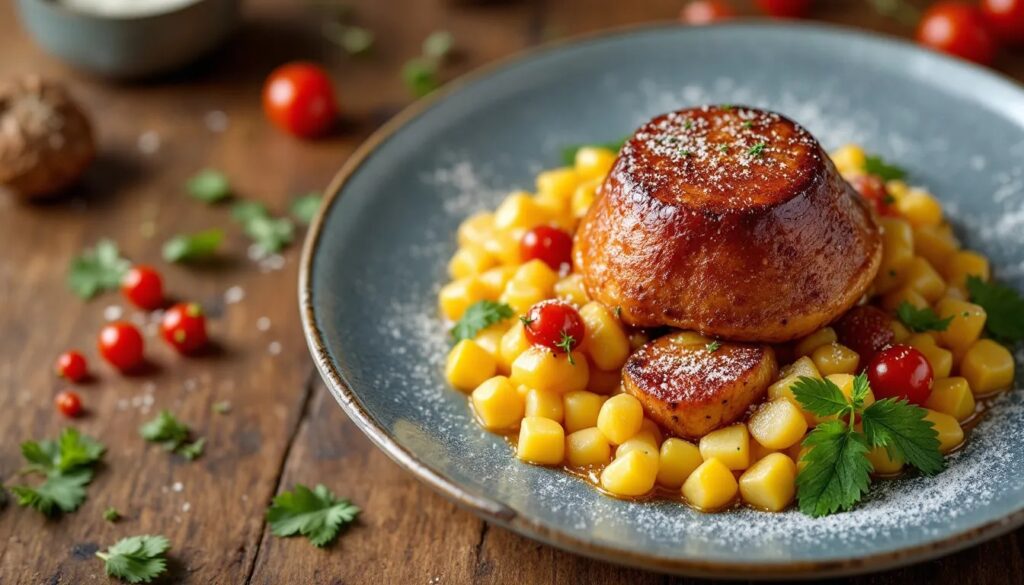
Our story begins not in a Parisian patisserie, but in the court of Stanislas Leszczynski, the dethroned King of Poland who found himself Duke of Lorraine in the early 18th century. Legend has it that the King, a man of refined tastes but perhaps a touch too much impatience, found his morning brioche too dry for his liking. A culinary epiphany struck: why not moisten it? Initially, it was said he used a splash of Tokay wine. But the true magic occurred when his chefs, perhaps one of them a certain Nicolas Stohrer, began to douse the brioche in a syrup infused with West Indies rum. The transformation was complete, and a star was born. Stanislas, a connoisseur of *One Thousand and One Nights*, is often credited with naming his new creation ‘Ali-Baba,’ later simply shortened to ‘Baba,’ a Polish endearment for an old woman.
From the modest kitchens of Lorraine, the Baba au Rhum migrated to Paris, carried by Stanislas’s daughter, Marie Leszczynska, who became Queen of France by marrying Louis XV. The Stohrer family, who had followed Stanislas to France, opened their eponymous patisserie in Paris in 1730, widely credited with popularizing the Baba au Rhum and forever cementing its place in French haute pâtisserie.
The ingredients themselves tell a remarkable story of global interconnectedness. Flour, the base of our brioche-like cake, represents millennia of agricultural development tracing back to the Fertile Crescent. Sugar, providing both sweetness and structure to the soaking syrup, journeyed from Southeast Asia across continents and oceans, its cultivation in the Caribbean fundamentally shaping colonial economies and human migration. And then there’s the rum, the very soul of the Baba: a potent spirit born from the sugarcane plantations of the New World, a liquid legacy of trade routes and exploitation that linked Europe, Africa, and the Americas. Even baking powder, though a more modern invention, speaks to an evolving understanding of chemistry in the kitchen, simplifying the leavening process for what was once a complex yeast dough.
Traditionally, a Baba au Rhum is a yeast-leavened cake, baked until golden, then meticulously soaked in a warm syrup rich with rum, sugar, and often fragrant with citrus zest or vanilla. The key to its perfection lies in the soaking—the cake must absorb just the right amount to become incredibly moist without disintegrating. To prepare it at home, don’t rush the yeast dough’s proofing; patience yields the lightest crumb. When soaking, ensure the syrup is warm but not boiling, allowing for maximum absorption. And use a good quality rum; its flavor is paramount. Serve it warm or at room temperature, often garnished with Chantilly cream and fresh berries or candied fruit, to complete an experience that is at once regal, historical, and utterly delicious. It’s more than a dessert; it’s a bite of history, a journey through time and across oceans.
BABA AU RHUM
Embark on a culinary journey to a bygone era of sophisticated indulgence with this exquisite Baba au Rhum. This archival gem promises a remarkable lightness and an ethereal, airy crumb, perfectly poised to absorb the rich, aromatic embrace of a rum-infused syrup. A testament to the timeless elegance of French-Caribbean patisserie, this dessert once graced tables as a truly distinguished finale, evoking visions of tropical grandeur and refined taste. While the full narrative for its signature spirited finish remains a tantalizing mystery within these historic pages, the foundation for an unforgettable experience is profoundly laid.
Ingredients
-
4
eggs
separated -
4
Tablespoons
sugar -
4
Tablespoons
flour -
1
teaspoon
baking powder -
rum
unspecified quantity, for soaking (recipe incomplete)
Instructions
-
Commence by vigorously whisking the egg yolks and sugar until the mixture transforms into a pale, thick ribbon, signifying proper aeration and emulsification.
-
Delicately fold in the flour, spoonful by spoonful, alternating with the majestic, stiff-peaked egg whites, ensuring the meringue’s airy structure is preserved through gentle incorporation.
-
Integrate the baking powder with the ultimate addition of flour, ensuring its even distribution for optimal rise and a tender crumb.
-
Gently transfer the ethereal batter into a meticulously prepared (well-greased) baking mold, ready for its metamorphosis.
-
Bake in a preheated oven at 350°F (175°C) for approximately 20 to 30 minutes, or until the cake achieves a golden hue and springs back gently to the touch when lightly pressed.
-
Permit the baba to rest within its mold for 10 minutes to set and firm up, then deftly invert it onto a wire rack to completely unmold and cool.
-
Once fully cooled to room temperature, carefully return the baba to its original mold, poised for the subsequent crucial step of imbibing its signature syrup.
Recipe Notes
This intriguing historical fragment concludes abruptly, tantalizingly omitting the vital methodology for crafting and infusing the baba with its quintessential rum-laced syrup. A true connoisseur might embark on a quest to complete this gastronomic legacy, drawing upon established techniques for rum syrup preparation and application to bestow this magnificent cake with its characteristic spirited drenching. The journey to its iconic boozy finish is left to the discerning chef’s skilled intuition and knowledge of classic patisserie.
Global Heritage Archive
Anthropological & Spice Migration Record
“A sophisticated and indulgent dessert, often found in patisseries and fine dining, embodying a fusion of aristocratic innovation and French culinary refinement.”
🌿 Spice & Botanical Migration
The distinctive flavor of Baba au Rhum comes from rum, a spirit whose botanical origin traces back to sugar cane (*Saccharum officinarum*). Sugar cane originated in Southeast Asia and Melanesia, migrating west through India, the Middle East, and eventually reaching the Mediterranean. Its most significant global journey was with Columbus to the Caribbean, where it became the backbone of colonial plantations, profoundly shaping transatlantic trade routes and bringing this unique alcoholic flavoring agent to European culinary traditions.
🏺 Historical & Archaeological Record
While specific ‘Baba au Rhum’ recipes are more recent, its direct precursor, the ‘babka,’ is deeply rooted in Eastern European baking traditions. Early written recipes for yeast-leavened sweet breads similar to babka can be traced back to 18th-century Polish and Austrian aristocratic cookbooks, indicating a long-standing tradition of enriched doughs. The general concept of soaking cakes in alcohol for preservation or flavor, however, has much older precedents, appearing in various forms in Roman and medieval European texts.
💡 Little Known Facts
- The original ‘babka’ from which Baba au Rhum evolved was a tall, fluted, yeast-leavened cake, sometimes made with raisins, popular in Polish, Ukrainian, and Belarusian cuisines, often baked for Easter.
- The dessert owes its existence to Stanislas Leszczynski, the dethroned King of Poland (and father-in-law to Louis XV of France), who, according to legend, found his brioche too dry and soaked it in Tokay wine, a practice later refined with rum by his chefs.
📸 Made This Heritage Recipe?
We would love to see how your dish turned out! Send a photo of your culinary creation to [email protected] to be featured in our community gallery.
Leave a review and rate this recipe below!
Curated Literature & Washington DC Downtown Calendar
The Culinary Alchemist: Modern Gastronomy & Flavor Pairing
By LDN Gastronomy Series
Artisanal technique, seasonal sourcing, and kitchen mastery.
Upcoming Downtown Happenings
Live acoustic sessions, gallery receptions, literary salons, and independent trade shows across Washington DC.
