
The presence of Moselle wine is the recipe’s definitive geographic anchor. The Mosel Valley, famed for its Riesling grapes, runs through Germany, Luxembourg, and France, immediately situating this dish firmly within the Germanic culinary landscape. This isn’t just a nod to local produce; it speaks to a culture where wine was not merely a beverage but an integral cooking ingredient, lending its acidity, depth, and aromatic complexity to both savory and sweet preparations.
The ingredient list itself is a microcosm of global trade routes. Apples, while now ubiquitous in Europe, trace their botanical lineage back to Central Asia, their migration westward occurring over millennia. They became a staple, especially in cooler climates, prized for their storability and versatility. Red currants, often preserved as jelly, are a testament to European agrarian traditions, ensuring the taste of summer could be enjoyed through the colder months. But it’s the trio of lemon, cinnamon, and ginger that truly illuminates the intricate tapestry of historical migration. Lemons, originally from Southeast Asia, traveled via Arab trade routes to the Mediterranean and then across Europe, prized for their sharp counterpoint to sweetness. Cinnamon, a fragrant bark from Sri Lanka, and ginger, a pungent rhizome from maritime Southeast Asia, were luxury goods that journeyed thousands of miles along the ancient Spice Routes, first arriving in Europe as exotic treasures, symbols of wealth, and eventually integrating into everyday cookery, particularly in festive or comforting dishes. Their inclusion here isn’t just for flavor; it’s a whisper of ancient caravans and bustling ports.
Sugar, too, has a complex history, originating in New Guinea, spreading to India, then the Middle East, and finally Europe, its availability increasing dramatically with the expansion of colonial plantations and the transatlantic slave trade. Here, it balances the tartness of the apples and lemon, creating a harmonious sweet-sour profile characteristic of much older European cookery. And the humble fresh bread crumbs? They are a historical hallmark, an economical and effective thickener, demonstrating an era when frugality and resourcefulness were paramount in the kitchen, turning stale bread into a rich body for soups and stews, long before cornstarch became a pantry staple.
Preparing this apple soup is a journey back in time. It would have been a comforting dish, perhaps served warm as a substantial starter on a cool evening, or even as a light main course during a Lenten fast. The process involves gently simmering the apples with water, lemon, and spices until tender, then incorporating the jelly for color and body, and finally thickening with breadcrumbs to achieve a velvety texture. The Moselle wine is added either during cooking to meld flavors or just before serving for a brighter aromatic punch.
To recreate this dish today is to honor a culinary heritage that skillfully blended the bounty of the local harvest with the exotic allure of distant lands. One might choose a dry or off-dry Moselle Riesling to best complement the apple’s tartness. Serve it warm with a dollop of cream or a sprinkle of toasted almonds for added luxury, or even chilled on a summer’s day for a refreshing twist. This apple soup is not merely food; it is a narrative in a bowl, a testament to the enduring power of food to connect us to history, geography, and the ingenuity of human culture.
APPLE SOUP
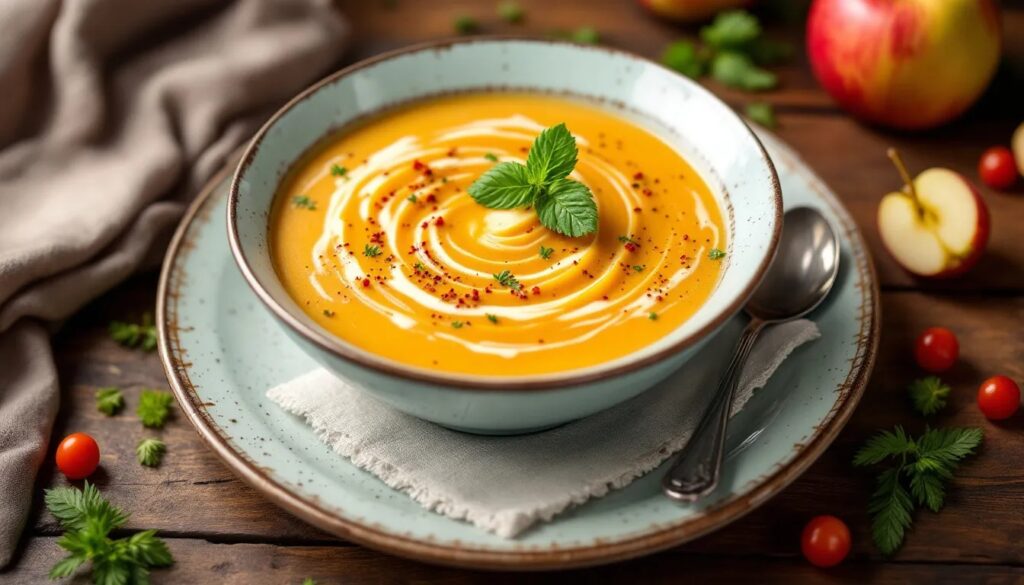
Challenge your perceptions of classic soup with this captivating Apple Elixir. A harmonious ballet of sweet and tart, this unique chilled creation unveils the crisp essence of fresh apples, infused with the warm embrace of aromatic ginger and a whisper of cinnamon. Brightened by the vibrant zest and juice of lemon, and uplifted by the elegant floral notes of Moselle wine, each silken spoonful offers an unexpected journey for the palate. Perfectly pureed to a velvety consistency and served exquisitely cold, it’s a refreshing revelation that promises to intrigue and delight at any culinary occasion.
Ingredients
-
4
large
tart dessert apples -
1
lemon
rind and juice -
2 1/2
cups
water -
2
Tablespoons
red currant jelly -
1/2
teaspoon
cinnamon -
2
Tablespoons
sugar -
1
teaspoon
grated ginger root - Salt
-
2
Tablespoons
fresh bread crumbs -
1 2/3
cups
Moselle wine
Instructions
-
Commence by meticulously preparing the apples: carefully pare away the skin, extract the core, and then finely slice the fruit. Transfer these pristine apple segments to a robust, heavy-bottomed saucepan alongside the fresh water.
-
Next, introduce the array of aromatic elements to the saucepan: the fragrant cinnamon stick, a carefully selected piece of fresh ginger root, the light bread crumbs, and the finely grated zest of the lemon.
-
Gently bring the contents of the saucepan to a vigorous boil over medium-high heat. Once boiling, immediately reduce the heat to a low simmer and allow the mixture to cook, uncovered, for approximately ten minutes, permitting the flavors to beautifully meld.
-
Incorporate the vibrant lemon juice, the glistening red currant jelly, and the granulated sugar into the simmering mixture. Stir diligently until every sugar crystal has completely dissolved, ensuring a smooth, sweet foundation.
-
Remove the saucepan from the heat and allow the prepared soup base to cool completely to room temperature.
-
Carefully transfer the cooled apple mixture into a high-speed blender and process until it achieves an exquisitely smooth and velvety consistency, free from any lumps.
-
Season the luscious puree with a delicate pinch of salt, adjusting to your discerning taste, then gently fold in the crisp, aromatic Moselle wine, stirring to fully incorporate.
-
For optimal enjoyment, ensure the soup is thoroughly chilled before serving. Just before presentation, adorn each bowl with delicate, thin slivers of fresh lemon zest and a light dusting of additional ground cinnamon.
Recipe Notes
This enchanting elixir truly shines when served impeccably chilled, allowing its nuanced flavors to fully develop. The final garnishes of delicate lemon slivers and a whisper of cinnamon are not merely decorative; they provide a crucial aromatic flourish and textural counterpoint that elevates each spoonful to a truly memorable culinary experience. Consider preparing this dish ahead of time, as the flavors deepen beautifully with a few hours of refrigeration.
Global Heritage Archive
Anthropological & Spice Migration Record
“A culinary culture that masterfully balances the sweet and tart notes of seasonal fruits with the warmth of imported spices and the richness of local wine, often thickening with humble breadcrumbs for a comforting, substantial dish.”
🌿 Spice & Botanical Migration
Cinnamon, originating from Sri Lanka, and ginger, from maritime Southeast Asia, traversed the ancient Spice Routes for millennia, reaching Europe via the Middle East and Mediterranean trade. Lemon, indigenous to Southeast Asia, also journeyed westward along similar routes, becoming integral to European cuisine for its bright acidity. Sugar, initially cultivated in New Guinea, spread to India and the Arab world before making its way to Europe through trade, later becoming more widely available with the advent of the transatlantic sugar trade.
🏺 Historical & Archaeological Record
The concept of fruit-based pottages or thickened sweet dishes can be traced back to antiquity. Specific written recipes for fruit soups, often incorporating wine and spices, begin to appear in European medieval cookbooks, such as those from 14th-century Germany (e.g., *Das Kochbuch Meister Eberhards*) or Italy (*Liber de Coquina*), indicating a long-standing tradition of such preparations.
💡 Little Known Facts
- Historically, many European fruit soups were served not just as desserts, but often as hearty starters or even light main courses, especially during fasting periods or warm months.
- The inclusion of Moselle wine and red currant jelly points to a tradition of utilizing regional specialties and preserved ingredients to extend the culinary calendar, emphasizing local terroir and seasonality.
📸 Made This Heritage Recipe?
We would love to see how your dish turned out! Send a photo of your culinary creation to [email protected] to be featured in our community gallery.
Leave a review and rate this recipe below!
Curated Literature & Washington DC Downtown Calendar
The Culinary Alchemist: Modern Gastronomy & Flavor Pairing
By LDN Gastronomy Series
Artisanal technique, seasonal sourcing, and kitchen mastery.
Upcoming Downtown Happenings
Live acoustic sessions, gallery receptions, literary salons, and independent trade shows across Washington DC.
