
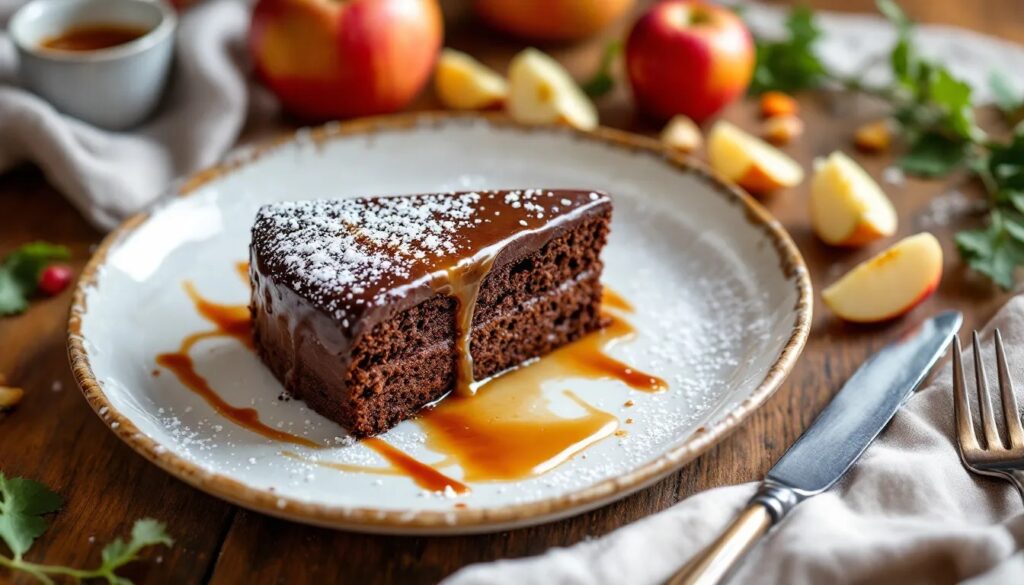
At its heart, this cake is a testament to the transformative power of a single ingredient: applesauce. While apples themselves have graced human palates for millennia, originating in the wild forests of Central Asia and spreading across continents, their puréed form took on a new significance in early 20th-century American kitchens. During challenging times like the Great Depression and World War II, when butter, eggs, and other fats were either scarce or rationed, resourceful home bakers turned to applesauce. Its pectin content and natural moisture allowed it to seamlessly replace more expensive fats and even eggs, yielding a cake that was remarkably moist, tender, and flavorful without breaking the bank. It was a culinary chrysalis, transforming humble ingredients into comforting sustenance.
Alongside applesauce, the presence of chocolate chips and cocoa powder grounds this cake in another rich history. Chocolate, once the sacred drink of Mesoamerican royalty and later the prized luxury of European aristocrats, democratized into a beloved baking ingredient by the late 19th and early 20th centuries. Its journey from the humid forests of modern-day Mexico to American cake tins is a sprawling narrative of exploration, trade, and cultural exchange. Here, the deep, bittersweet notes of cocoa complement the subtle tang of applesauce, creating a symphony of flavors that is both familiar and surprising.
Cinnamon, with its warm, aromatic embrace, joins the ensemble, tracing its lineage back to ancient trade routes connecting the Spice Islands of Southeast Asia to the Mediterranean. It speaks of galleons laden with treasures and caravans traversing deserts, a testament to humanity’s age-old quest for flavor. Walnuts, too, offer a textural counterpoint and a whisper of ancient history, their origins in Central Asia making them a global culinary citizen.
The inclusion of margarine and baking soda further cements this cake’s place in modern culinary history. Margarine, an industrial innovation of the 19th century, became a household staple, particularly when butter was unaffordable or unavailable. Baking soda, a chemical leavening agent that became widely accessible in the mid-19th century, freed bakers from the vagaries of yeast, making light, fluffy cakes an achievable dream for every home cook. Together, these ingredients paint a picture of an evolving kitchen, embracing new technologies and ingredients to create enduring comforts.
For the modern baker, this recipe is more than just instructions; it’s an invitation to connect with a culinary heritage built on frugality, creativity, and the enduring power of a good slice of cake. When preparing your Applesauce Chocolate Cake, remember not to overmix the batter – the chemical leaveners and the applesauce will do most of the work to create a tender crumb. Feel free to toast your walnuts for an intensified nutty flavor. And as you savor each bite, allow yourself to taste not just the chocolate and cinnamon, but the echoes of ingenuity and the sweet spirit of adaptation that define this remarkable dessert.
APPLE SAUCE CHOCOLATE CAKE
Embark on a culinary journey with this exceptional rendition of a cherished classic, where the inherent moisture of applesauce transforms deep, aromatic cocoa into a cake of unparalleled tenderness. Each decadent bite is graced with a subtle whisper of cinnamon, culminating in a lavish crown of molten chocolate chips. This exquisite creation promises a remarkably yielding texture and a heartwarming flavor profile, making it an ideal centerpiece for cherished gatherings or a moment of sophisticated self-indulgence.
Ingredients
-
1/2
cup
margarine -
2
eggs -
2
Tablespoons
cocoa -
1/2
cup
chopped walnuts -
1/2
teaspoon
baking soda -
2
cups
apple sauce -
1 1/2
cups
sugar -
1/2
teaspoon
cinnamon -
1/2
teaspoon
salt -
2
cups
flour -
6
ounces
chocolate chips
Instructions
-
Begin by harmonizing the creamy texture of margarine with the fine crystals of sugar, beating them together vigorously until the mixture achieves a light, airy, and fluffy consistency.
-
Introduce the eggs one at a time, ensuring each addition is thoroughly incorporated into the batter before proceeding, creating a smooth and cohesive emulsion.
-
Sift in the decadent cocoa powder, alongside the earthy crunch of finely chopped walnuts, the leavening power of baking soda, aromatic cinnamon, a delicate pinch of salt, and the all-purpose flour. Gently fold and blend these dry ingredients into the wet mixture until just combined, taking care not to overmix.
-
Delicately fold in the applesauce until it is uniformly distributed throughout the batter, preserving the cake’s nascent, delicate structure.
-
Gracefully transfer the prepared batter into a thoroughly greased 8×12 inch baking pan, spreading it evenly to reach all corners.
-
Adorn the surface generously with a scattering of premium chocolate chips, promising delightful pockets of melted bliss in every slice.
-
Place the pan into a preheated oven at 350°F (175°C) and bake for approximately 40 minutes, or until a skewer inserted into the center emerges impeccably clean.
-
Allow the cake to cool slightly within the pan before artfully slicing it into elegant squares, preparing it for a delightful presentation.
Recipe Notes
This remarkable cake truly shines, offering a sublime balance of flavors and an incredibly tender crumb that delights with every forkful. For an elevated experience, consider serving a slice gently warmed, perhaps alongside a dollop of exquisite crème fraîche or a scoop of premium vanilla bean ice cream. Curiously, the flavors also mature beautifully overnight, deepening in complexity, should you possess the extraordinary willpower to resist immediate gratification.
Global Heritage Archive
Anthropological & Spice Migration Record
“A resourceful and comfort-driven home baking culture, often adapting traditional recipes to economic constraints or nutritional awareness, while cherishing flavors like chocolate, cinnamon, and walnuts.”
🌿 Spice & Botanical Migration
Cinnamon, originating from Sri Lanka (Ceylon cinnamon) and Southeast Asia (Cassia cinnamon), traveled along ancient Spice Routes for millennia, reaching Europe via Arab traders and the Roman Empire before arriving in the Americas with European colonization. Cocoa, the base for chocolate, hails from Mesoamerica, cultivated by the Olmec, Maya, and Aztec civilizations for thousands of years before its introduction to Europe by Spanish explorers in the 16th century, eventually transforming into a global baking staple.
🏺 Historical & Archaeological Record
The concept of a leavened cake emerged much earlier, with ancient Egyptians creating honey cakes around 2600 BCE and Romans perfecting savory ‘placenta cakes’. However, the specific archetype of a chemically leavened chocolate cake using fruit purée as a fat or moisture substitute, as seen in this recipe, first appears in written records and community cookbooks in the United States around the early to mid-20th century (roughly 1920s-1940s), reflecting periods of ingenuity during economic hardship and resource scarcity.
💡 Little Known Facts
- The use of applesauce in cakes gained significant popularity in the United States during the Great Depression and World War II, serving as an ingenious substitute for scarce or rationed fats and eggs while adding moisture and tenderness.
- Margarine, a key ingredient, was originally developed in France in the mid-19th century as a butter substitute, but it became widely adopted in American home baking during the 20th century due to its lower cost and longer shelf life, particularly during times of economic hardship.
📸 Made This Heritage Recipe?
We would love to see how your dish turned out! Send a photo of your culinary creation to [email protected] to be featured in our community gallery.
Leave a review and rate this recipe below!
Curated Literature & Washington DC Downtown Calendar
The Culinary Alchemist: Modern Gastronomy & Flavor Pairing
By LDN Gastronomy Series
Artisanal technique, seasonal sourcing, and kitchen mastery.
Upcoming Downtown Happenings
Live acoustic sessions, gallery receptions, literary salons, and independent trade shows across Washington DC.
