
In the sprawling, vibrant tapestry of culinary history, some dishes emerge as more than mere sustenance; they become cultural artifacts, encapsulating the aspirations, technologies, and social mores of their time. The “Savory Shrimp Mold” is precisely such a dish, a shimmering, quivering testament to mid-20th century American ingenuity and a particular brand of sophisticated home entertaining. It evokes images of suburban bridge parties, holiday buffets, and church potlucks, standing as a proud, if somewhat bewildering, centerpiece.
To truly understand the Savory Shrimp Mold, one must first appreciate the transformative power of gelatin. Before the late 19th century, creating a clear, shimmering aspic was an arduous, multi-day affair. It required boiling calves’ feet or fish heads for hours to extract collagen, then painstakingly clarifying the resulting stock through sieves and egg whites. It was a task for dedicated kitchen staff, a mark of aristocratic kitchens. However, with the advent of commercially processed, granulated gelatin – famously popularized by brands like Jell-O in the United States – this once formidable culinary feat was democratized. Suddenly, any home cook could produce elegant, molded dishes with relative ease, elevating everyday ingredients into something spectacular.
The combination of shrimp, capers, tarragon, and a creamy, tangy base speaks volumes about the dish’s lineage and the migratory paths of its constituent parts. Shrimp, a ubiquitous seafood, finds its way into countless cuisines, but here it is elevated from casual fare to a centerpiece. The mayonnaise, a cornerstone of French haute cuisine, became an American pantry staple, providing the rich, emulsified backbone for the mold. Its journey from delicate sauce to binding agent in countless salads and dishes mirrors the broader adoption and adaptation of European culinary traditions in the New World.
Capers, those briny flower buds, hail from the Mediterranean, their distinctive piquant flavor having traveled trade routes for millennia, offering a sharp counterpoint to the richness of the cream and shrimp. Tarragon, with its delicate anise-like notes, is a beloved herb in French cooking, reflecting a subtle, sophisticated European influence. And the hot pepper sauce? That’s pure American ingenuity, an echo of the Columbian Exchange that brought chili peppers from the Americas to the world, now bottled into a condiment that adds a lively kick, a dash of the unexpected, typical of the era’s culinary experimentation.
Traditional preparation involved carefully layering ingredients, ensuring even distribution, and chilling until firm – a delicate dance of patience and precision. The final flourish, the unmolding, was the moment of truth, revealing a glistening, sculptural creation. For modern kitchens, the process is largely unchanged, though a few tips can ensure success: for a truly clear mold, opt for unflavored gelatin and use a rich, homemade stock, though canned broth works perfectly for a more accessible approach. When unmolding, a quick dip of the mold in warm water can help release it cleanly onto a serving platter. And don’t be shy with the fresh tarragon; its aroma and flavor are essential to lifting the dish beyond mere nostalgia.
The Savory Shrimp Mold, therefore, is more than a retro curiosity. It’s a snapshot of a particular time in American culinary history, a period when convenience and presentation reigned supreme, when global flavors were beginning to coalesce on the home dining table, and when a simple packet of gelatin could transform a meal into a conversation piece. It reminds us that even the most seemingly anachronistic dishes have a rich narrative woven into their very fibers, waiting to be savored and understood.
Savory Shrimp Mold
Step into an era of graceful entertaining with this exquisite shrimp mold, a true culinary gem from the mid-century. This artful presentation marries succulent, finely minced shrimp with a luxurious, velvety emulsion of cultured butter, rich mayonnaise, and air-whipped cream. Bright capers, piquant onion, and aromatic fresh tarragon infuse the blend with vibrant herbaceous notes, while a whisper of hot pepper sauce introduces a tantalizing warmth. Elegantly set within a classic gelatin form, this savory creation is destined to become the sophisticated centerpiece of any spread, perfect for adorning artisanal crackers or, as tradition suggests, toasted brioche points.
Ingredients
-
not specified
gelatin
to soften with water & juice -
not specified
water & juice
for softening gelatin -
1
pound
shrimp
chopped very fine -
1
Tablespoon
capers -
1/3
small onion -
1/3
cup
butter
softened -
3
Tablespoons
whipping cream
whipped -
2
Tablespoons
mayonnaise -
A dash
hot pepper sauce -
1
teaspoon
salt -
1
teaspoon
fresh tarragon
Instructions
-
Gently sprinkle the unflavored gelatin powder over the specified cold water and juice in a small bowl. Allow it to bloom undisturbed for several minutes, until fully softened and hydrated.
-
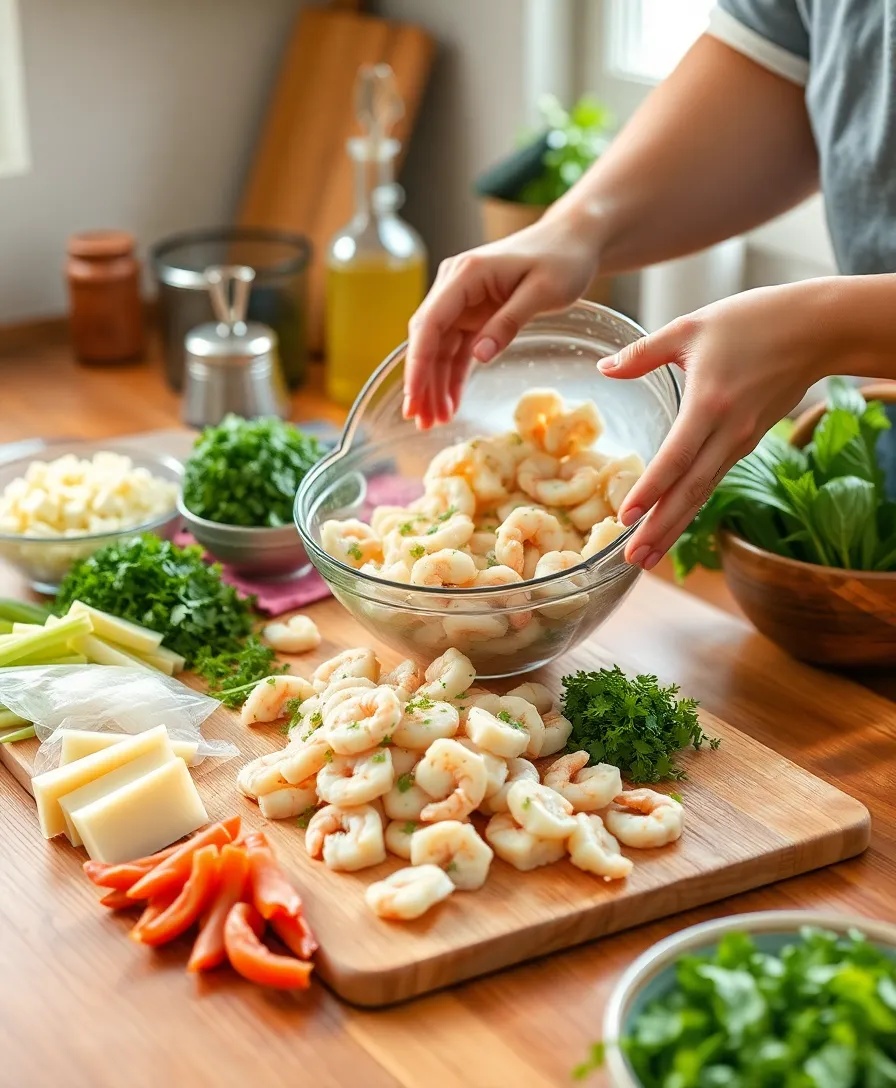
In a generously sized mixing bowl, artfully combine the meticulously chopped shrimp, briny capers, and finely minced onion, ensuring an even distribution of these foundational elements.
-
Introduce the softened, high-quality butter, the ethereal whipped cream, and the creamy mayonnaise to the shrimp mixture. Incorporate a delicate dash of hot pepper sauce, a pinch of fine sea salt, and the aromatic fresh tarragon. Fold all ingredients together thoroughly until seamlessly blended and uniform.
-
Carefully warm the bloomed gelatin mixture over low to medium heat, stirring continuously, until the granules are completely dissolved and the liquid is clear. Avoid boiling.
-
Gently pour the warm, dissolved gelatin into the prepared shrimp and cream base. Stir conscientiously to ensure complete integration of the gelatin throughout the entire mixture, creating a cohesive blend.
-
Transfer the meticulously prepared mixture into your chosen gelatin mold, which has been lightly rinsed with cold water to facilitate easier unmolding. Gently tap the mold on your counter to release any trapped air bubbles and ensure an even surface.
-
Chill the mold in the refrigerator for a minimum of 3 to 4 hours, or ideally overnight, allowing ample time for the mold to firm completely and achieve its desired structural integrity.
-
To serve, delicately unmold the chilled creation onto your preferred serving platter. Adorn with fresh garnishes as desired, perhaps delicate herbs or citrus zests, to enhance its visual appeal.
-
For an intriguing sweet-savory counterpoint, consider enrobing the mold with a whisper-thin layer of lightly sweetened whipped cream just prior to presentation.
Recipe Notes
The foundational recipe from which this exquisite dish is derived did not specify precise measurements for the gelatin, water, and juice. As a professional recommendation, one standard packet (approximately 0.25 oz or 7g) of unflavored gelatin, bloomed in 1/4 cup of cold liquid, typically yields a desirable setting consistency for a mold of this nature. Feel free to subtly adjust the liquid volume to achieve your preferred firmness. Furthermore, the suggestion of an optional, delicate mantle of whipped cream introduces an unexpected yet harmonious sweet-savory complexity, elevating the traditional presentation to a truly memorable experience.
Global Heritage Archive
Anthropological & Spice Migration Record
“A culinary culture emphasizing convenience, presentation, and often a touch of novelty for mid-20th century American home entertaining and social gatherings.”
🌿 Spice & Botanical Migration
Tarragon, a key herb in this recipe, originated in Eurasia and became a foundational element of classical French cuisine before its culinary influence spread globally. Capers, providing a briny counterpoint, are native to the Mediterranean region, their distinctive flavor carried along ancient trade routes for millennia. The hot pepper sauce, though a modern American condiment, owes its existence to the chili pepper, a New World ingredient introduced to the rest of the world via the Columbian Exchange, rapidly becoming a global staple.
🏺 Historical & Archaeological Record
The earliest forms of jellied meats or aspics, which are conceptual precursors to the savory mold, can be traced back to medieval Europe. Written records, such as those found in ‘Le Viandier de Taillevent’ (a 14th-century French cookbook), describe methods for preparing meat jellies, indicating that the technique of gelling foods for preservation and presentation has roots at least as far back as the late Middle Ages, long before the advent of commercial gelatin powder.
💡 Little Known Facts
- Before commercially available powdered gelatin (like Jell-O, introduced in 1897), making aspics was an arduous, multi-day process involving boiling calves’ feet or fish bones for hours to extract collagen, then laboriously clarifying the stock.
- Savory molds like this were often considered a hallmark of a sophisticated hostess in mid-20th century America, despite the relatively simple preparation afforded by packaged gelatin, showcasing a blend of aspiration and accessibility.
📸 Made This Heritage Recipe?
We would love to see how your dish turned out! Send a photo of your culinary creation to [email protected] to be featured in our community gallery.
Leave a review and rate this recipe below!
Curated Literature & Washington DC Downtown Calendar
The Culinary Alchemist: Modern Gastronomy & Flavor Pairing
By LDN Gastronomy Series
Artisanal technique, seasonal sourcing, and kitchen mastery.
Upcoming Downtown Happenings
Live acoustic sessions, gallery receptions, literary salons, and independent trade shows across Washington DC.
