
Then comes sugar, the great migrant. Its journey began on the distant shores of New Guinea, where sugarcane was first cultivated thousands of years ago. From there, it traveled eastward to India, then westward across the Persian Empire and into the Arab world. With the Crusades, sugar made its way to Europe, initially a luxury reserved for the elite and pharmacies. Its escalating demand subsequently fueled the transatlantic slave trade and the establishment of vast plantations in the New World, forever altering global demographics and economies. The inclusion of refined sugar in this sauce, therefore, speaks volumes about a period when sweetness became widely accessible, albeit at a profound human cost.
Finally, the intriguing kirsch. This clear, colorless fruit brandy, or *Kirschwasser* (cherry water), is a quintessentially Central European spirit, originating in the Black Forest region of Germany and neighboring Switzerland and Alsace, France. Made by distilling fermented sour cherries, including their pits which impart a subtle almond bitterness, kirsch represents a centuries-old tradition of capturing the essence of local fruit through the art of distillation. The very technique of distillation, while perfected in Europe, traces its roots back to ancient Mesopotamian and Islamic alchemical practices, highlighting a profound cross-cultural exchange of scientific knowledge that eventually yielded spirits like kirsch.
When these three elements converge – the cultivated raspberry, the globally traded sugar, and the locally distilled kirsch – they create a sauce that epitomizes post-Renaissance European, particularly French, culinary artistry. It reflects a period when cooking evolved from sustenance to an art form, demanding precision, balance, and the thoughtful integration of ingredients both native and exotic. Traditional preparation involves gently simmering the raspberries with sugar until they soften, then straining or pureeing them to achieve a smooth consistency, and finally, enhancing the vibrant fruit notes with a judicious splash of kirsch. The alcohol burns off, leaving behind a fragrant depth that elevates the berries’ natural tartness and sweetness.
For the home cook, making raspberry sauce is a delightful endeavor. Always start with fresh, ripe raspberries if possible, though frozen berries work beautifully when fresh are out of season; simply thaw them first. Adjust sugar to your taste and the sweetness of the berries. A fine-mesh sieve is your best friend for achieving a perfectly smooth, seedless sauce. And while kirsch is traditional, a touch of raspberry liqueur or even a high-quality brandy can be substituted if kirsch is unavailable. Serve it warm over ice cream, chilled with a rich chocolate cake, or as a vibrant counterpoint to creamy desserts. This sauce isn’t just a recipe; it’s a journey through history, a culinary postcard from a world connected by flavor.
Raspberry Sauce
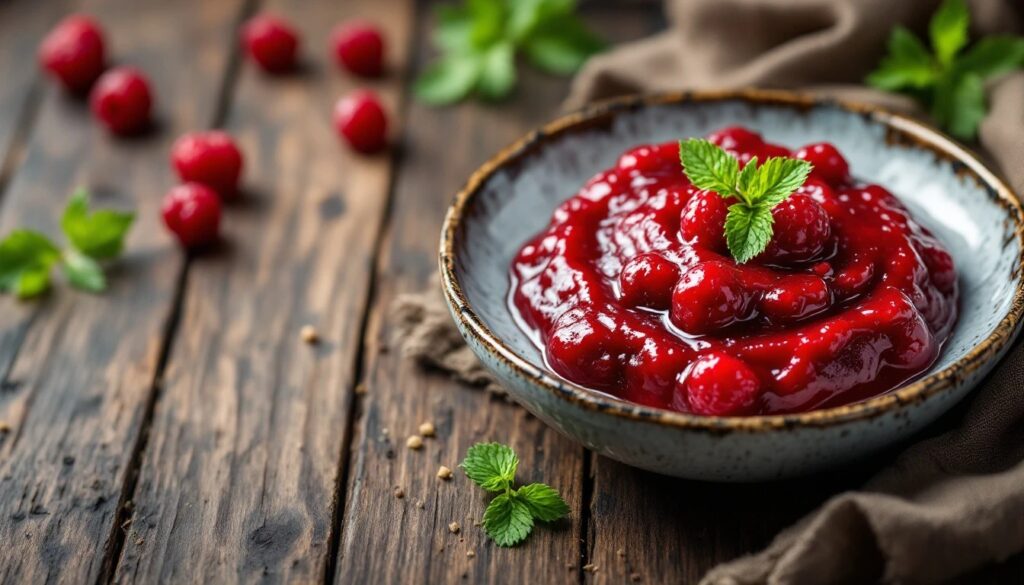
Imagine a culinary journey, a vivid crimson elixir capturing the very essence of summer's bounty. This exquisite Raspberry Coulis, a testament to unadorned elegance, unveils a symphony of sun-ripened berry notes, delicately lifted by a whisper of fine kirsch and perfectly balanced sweetness. Its effortless preparation belies its profound impact, rendering it an indispensable companion in your kitchen repertoire. From gracing delicate patisseries and morning griddle cakes with its jewel-toned allure to introducing a surprising, sophisticated counterpoint to savory main courses like a fragrant pilaf, this sauce transcends mere accompaniment, embodying a timeless charm that speaks to both heritage and innovation.
Ingredients
- 1 1/2 pints fresh or frozen raspberries
- 3 Tablespoons kirsch
- 4 oz sugar
Instructions
-
Carefully transfer the fresh raspberries, granulated sugar, and kirsch into the carafe of a high-speed blender.
-
Process the mixture on its highest setting for precisely ten seconds, until a smooth, fluid consistency is achieved.
-
Pass the vibrant liquid through a fine-mesh sieve or chinois into a clean bowl, discarding any remaining seeds or solids to ensure a silky-smooth finish.
-
Cover the strained coulis and chill thoroughly in the refrigerator until ready for use, allowing the flavors to meld beautifully.
-
Prior to presentation, artfully drizzle a portion of the chilled sauce around your chosen savory dish, such as a fragrant rice pilaf, and offer the remaining exquisite coulis in a separate elegant serving vessel.
Recipe Notes
This remarkable coulis possesses a delightful dual nature, equally at home enhancing the delicate sweetness of pastries, ice creams, and crepes, or providing a surprising, bright counterpoint when elegantly swirled alongside savory preparations, particularly those featuring grains or poultry.
Global Heritage Archive
Anthropological & Spice Migration Record
“A sophisticated culinary culture valuing fruit-based desserts, refined sauces, and the integration of local distilled spirits for flavor and preservation.”
🌿 Spice & Botanical Migration
The primary migrant ingredient is sugar, originating botanically in New Guinea and spreading via ancient trade routes through India, Persia, and the Arab world before arriving in Europe. European demand for sugar fueled the establishment of New World plantations via the Columbian Exchange. While raspberries are native to Eurasia and kirsch’s cherries are European, the sophisticated distillation process for spirits like kirsch has roots in ancient Mesopotamian and later Islamic alchemical practices, demonstrating a cross-cultural exchange of knowledge.
🏺 Historical & Archaeological Record
Evidence of sweetened fruit purees and sauces can be traced back to Roman antiquity, where fruits like figs and grapes were often cooked down with honey or *defrutum* (reduced grape must). The earliest confirmed written recipes for refined sugar-sweetened fruit preparations appear in medieval Arab cookbooks and later in European culinary texts from the late Middle Ages and Renaissance periods. Distillation techniques, crucial for kirsch, first emerged in Mesopotamia (ca. 3500 BCE for perfumes) and were significantly refined in the Islamic Golden Age (8th-13th centuries CE) for medicinal and eventually alcoholic purposes.
💡 Little Known Facts
- Kirsch, or Kirschwasser, literally means ‘cherry water’ in German and is traditionally made from morello cherries, including their pits, which impart an almond-like note to the spirit.
- Raspberries (Rubus idaeus) were highly prized in ancient Greece and Rome for their perceived medicinal properties before their culinary appeal became widespread, with extensive cultivation gaining momentum in the European Middle Ages.

Historical Locality Cartographic Map — Mestizo Media Archive
📸 Made This Heritage Recipe?
We would love to see how your dish turned out! Send a photo of your culinary creation to [email protected] to be featured in our community gallery.
Leave a review and rate this recipe below!
Curated Literature & Washington DC Downtown Calendar
The Culinary Alchemist: Modern Gastronomy & Flavor Pairing
By LDN Gastronomy Series
Artisanal technique, seasonal sourcing, and kitchen mastery.
Upcoming Downtown Happenings
Live acoustic sessions, gallery receptions, literary salons, and independent trade shows across Washington DC.
