
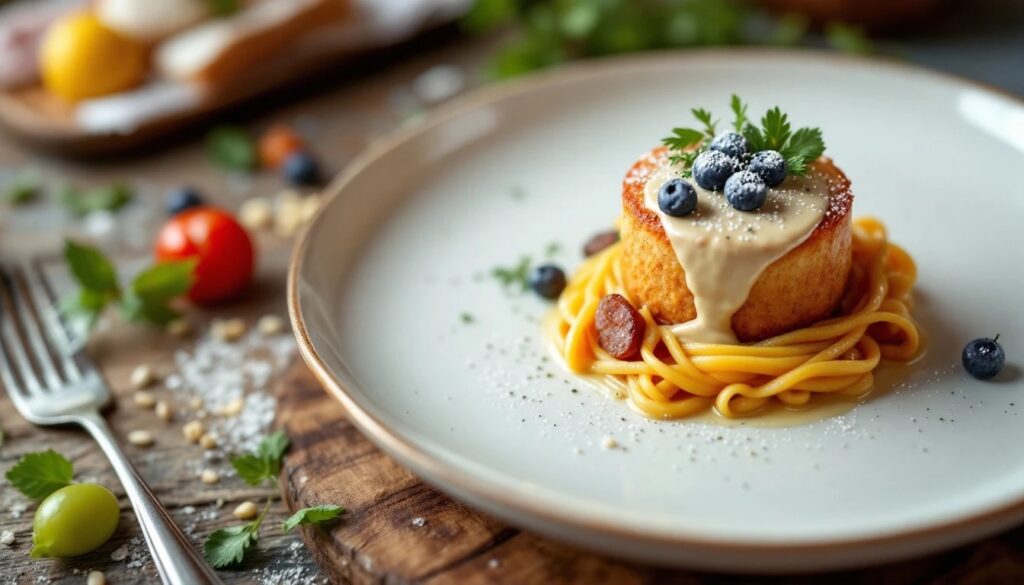
Our journey into its origins transports us to the bustling boulevards of mid-19th century Paris, a golden age for gastronomy. It was amidst this ferment of culinary innovation that Auguste Jullien, a visionary pastry chef at the Chiboust patisserie on Rue Saint-Honoré, is credited with crafting this eponymous dessert around 1840-1850. The Gâteau Saint-Honoré quickly captivated the Parisian elite, its name a clever double entendre, honoring both its street of birth and Saint Honoré, the venerable patron saint of bakers and pastry chefs. It emerged during a period of burgeoning wealth and industrialization, where the availability of refined ingredients allowed for increasingly elaborate and technical confections.
At its heart, the Gâteau Saint-Honoré is an architectural marvel. It begins with a delicate pâte brisée base, providing a sturdy yet tender foundation. Upon this, a ring of pâte à choux is piped and baked, creating a golden border. Small, individual choux puffs, often filled with a lightened crème pâtissière (or the original crème Chiboust, a marriage of custard and meringue), are then dipped in molten caramel—a perilous but essential step—and carefully affixed to the choux ring. The center is finally crowned with a generous swirl of unsweetened whipped cream, offering a sublime contrast to the richness below and the crisp, sweet caramel.
Anthropologically, this dessert speaks volumes about the migration of ingredients and the evolution of taste. The sheer abundance of sugar, crucial for the caramel and creams, reflects the expansive reach of colonial trade routes, which brought sugarcane from its origins in New Guinea to the Caribbean plantations, making it accessible to European kitchens. Flour, the backbone of the pastries, signifies millennia of agricultural development. Even the presence of dairy and eggs points to established European farming practices and the refinement of their use in sweet preparations. The recipe, devoid of exotic spices, highlights a period where sweetness, texture, and technical artistry were the primary drivers of dessert innovation, rather than imported aromatics.
For the home baker, recreating this icon is a rewarding challenge. Mastering pâte à choux, ensuring it’s properly dried out in the oven for that perfect hollow shell, is key. Patience is paramount when working with caramel; a sugar thermometer is your best friend, and safety, your constant companion. Chilling components at various stages is crucial for stability, preventing a beautiful structure from collapsing. While the recipe may seem daunting, each component, when mastered, builds towards a breathtaking whole.
To savor a slice of Gâteau Saint-Honoré is to taste history, to appreciate the ingenuity of a pastry chef, and to partake in a legacy of culinary excellence that continues to inspire. It is more than just ingredients; it is a narrative, baked into every exquisite layer.
GATEAU SAINT-HONORE
Behold the Gâteau Saint-Honoré, a majestic edifice of French confectionery that captivates with its intricate design and harmonious textures. This legendary creation marries the delicate crispness of a pâte brisée foundation with the ethereal lightness of pâte à choux, all embracing a sumptuous crème pâtissière. Crowned with an array of shimmering, caramel-glazed choux puffs, it stands as a testament to classic pastry artistry. A true showstopper, this gâteau promises to elevate any special occasion, inviting the ambitious baker to embark on a rewarding journey into the heart of patisserie.
Ingredients
- amount not specified crème patissière ingredients not specified, assumed to be a base recipe
- 1 envelope unflavored gelatin
- amount not specified sugar from crème patissière recipe
- 2½ cups unsweetened heavy cream whipped firm
- amount not specified pâte brisée (pie crust), ingredients not specified, assumed to be a base recipe
- amount not specified pâte a choux ingredients not specified, assumed to be a base recipe
- amount not specified caramel ingredients not specified, assumed to be made or purchased
Instructions
-
**Crème Pâtissière:**
-
1. Initiate the creation of your silken crème pâtissière, ensuring that the unflavored gelatin is meticulously whisked into the sugar as prescribed in the recipe to achieve optimal setting consistency.
-
2. Once the crème pâtissière has cooled entirely, delicately fold in the firmly whipped, unsweetened heavy cream until the mixture is uniformly lightened and ethereal.
-
**The Gâteau Assembly:**
-
1. From your prepared pâte brisée, meticulously shape a flawless 10-inch circular base, ensuring an even thickness to underpin the grandeur of your dessert.
-
2. Load a pastry bag, fitted with a small, plain tip, with your pâte à choux. Pipe a continuous, elegant border of choux paste around the very edge of the pâte brisée base. With any remaining pâte à choux, pipe individual, evenly sized puffs onto a separate parchment-lined baking sheet; these will be destined for dipping.
-
3. Delicately prick the central area of the pâte brisée foundation within its choux border. Transfer the assembly to a preheated 400°F (200°C) oven and bake for approximately 30 minutes, or until the base is thoroughly cooked and boasts a rich, golden-brown hue. Concurrently, bake the individual choux puffs on their separate sheet until golden and fully puffed. Allow both components to cool completely.
-
4. Once cooled, meticulously fill each of the separately baked individual choux puffs with a small portion of crème pâtissière. Prepare your shimmering caramel glaze. One by one, carefully dip the filled puffs into the warm caramel, allowing any excess to drip away, then artfully arrange them along the perimeter of your baked pâte brisée base, setting them atop the choux border.
-
5. Carefully spoon the remaining gelatinized crème pâtissière, now lightened with whipped cream, into the central cavity of the baked pâte brisée base, creating a generous, luscious mound.
-
6. Transfer a portion of this delightful cream into a clean pastry bag, fitted with a decorative tip of your choice, and elegantly pipe intricate patterns or swirls atop the central cream filling.
-
7. Crown your magnificent creation by delicately positioning the final caramel-dipped choux puff as a distinguished central flourish.
-
8. Allow the assembled gâteau to set gently in a cool, rather than cold, environment until it is time for its grand presentation.
Recipe Notes
This sophisticated recipe presumes a foundational mastery of classic French pastry techniques, including the meticulous preparation of pâte brisée, pâte à choux, crème pâtissière, and glistening liquid caramel. The enduring allure of the Gâteau Saint-Honoré lies in the precise execution of each component, particularly the dynamic interplay between its choux pastry elements. Our refined instructions clarify the nuanced process of crafting both the structural choux border upon the base and the separately baked, filled, and caramel-glazed individual puffs, ensuring a visually stunning and texturally rich outcome worthy of its celebrated heritage.
Global Heritage Archive
Anthropological & Spice Migration Record
“A highly refined and complex pastry tradition emphasizing precise techniques, luxurious textures, and elegant presentation, often associated with celebrations and skilled craftsmanship.”
🌿 Spice & Botanical Migration
While this recipe does not feature pungent exotic spices, its very sweetness hinges on ingredients whose journeys are epic. Sugar, originally from New Guinea, was brought to Europe via Arab trade routes, becoming widely accessible for elaborate confections due to colonial plantations in the Americas. Vanilla, though not explicitly listed but a standard in crème pâtissière, originated in Mesoamerica and became a coveted European flavoring after its complex cultivation was mastered in the 19th century.
🏺 Historical & Archaeological Record
The foundational elements of the Gâteau Saint-Honoré trace back through centuries. Pâte à choux, or ‘hot paste,’ is often linked to Catherine de’ Medici’s chefs in 16th-century France. Early forms of shortcrust pastry (pâte brisée) existed in antiquity, while formalized crème pâtissière evolved in French cookbooks from the 17th century. However, the precise assemblage of these elements into a distinct, named architectural dessert like the Gâteau Saint-Honoré emerged in mid-19th century Parisian patisseries, specifically credited to Auguste Jullien around 1840-1850.
💡 Little Known Facts
- The original Gâteau Saint-Honoré is said to have featured ‘crème Chiboust,’ a custard lightened with Italian meringue, rather than just crème pâtissière.
- The pastry was named after Rue Saint-Honoré in Paris, where the patisserie of its inventor, Auguste Jullien, was located, and subsequently after Saint Honoré, the patron saint of bakers.
📸 Made This Heritage Recipe?
We would love to see how your dish turned out! Send a photo of your culinary creation to [email protected] to be featured in our community gallery.
Leave a review and rate this recipe below!
Curated Literature & Washington DC Downtown Calendar
The Culinary Alchemist: Modern Gastronomy & Flavor Pairing
By LDN Gastronomy Series
Artisanal technique, seasonal sourcing, and kitchen mastery.
Upcoming Downtown Happenings
Live acoustic sessions, gallery receptions, literary salons, and independent trade shows across Washington DC.
