
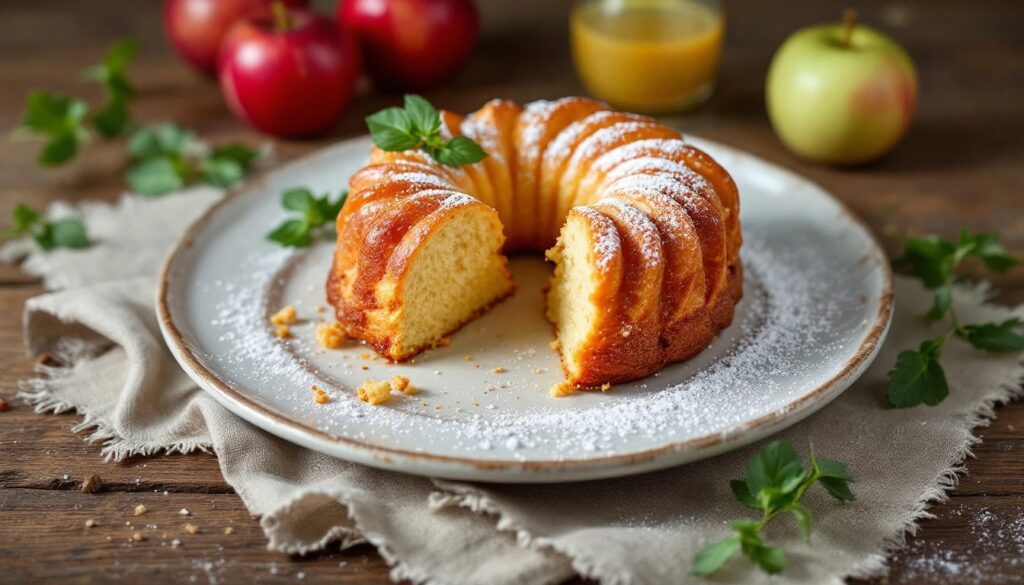
Imagine a golden-crusted brioche, its buttery crumb a testament to centuries of French baking artistry. This opulent bread, often dubbed the ‘queen of pastries,’ boasts a lineage stretching back to the 15th century, evolving from simpler enriched breads into the tender, melt-in-your-mouth delicacy we know today. Its name, ‘brioche,’ is believed by some to derive from the Norman verb ‘brier,’ meaning to knead, or possibly from ‘broye,’ referring to the wooden tools used to work the dough. While Marie Antoinette’s infamous (and likely apocryphal) quip about ‘eating brioche’ when starved of bread has become a cultural touchstone, it nonetheless underscores the brioche’s historical status as a luxury. In our gateau, slices of this buttery bread are transformed, soaking up the sweet, spirited essence of its companions.
Then, there are the apples – crisp, tart green jewels, plucked from the very orchards that carpet Normandy. Apples, far from being solely European, embarked on an epic journey from the Tien Shan mountains of Central Asia millennia ago, migrating west along the Silk Road. They arrived in Europe, were cultivated by the Romans, and found their ultimate terroir in the temperate climes of Normandy, where their abundance led to the celebrated production of cider and, most famously, Calvados. This golden apple brandy, with its protected ‘Appellation d’Origine Contrôlée,’ is a liquid poem, embodying the very spirit of the region. A splash of Calvados in this cake is not merely an addition; it’s a declaration, an infusion of concentrated apple warmth that elevates every bite.
And let’s not forget the silent travelers: sugar and vanilla. Sugar, originating as sugarcane in New Guinea, journeyed through India and the Arab world before sweetening European tables, later fueled by the Columbian Exchange and global plantations. Vanilla, that intoxicating fragrance, hails from the rainforests of Mesoamerica, brought to European palates by Spanish conquistadors, and painstakingly cultivated globally after the secrets of its pollination were unlocked. These global ingredients, seemingly disparate, converge here to form a distinctly French narrative.
To recreate this masterpiece in your own kitchen, select a brioche that’s a day or two old; its slight dryness will allow it to absorb the custardy apple juices without becoming soggy. Choose firm, tart green apples like Granny Smiths or Braeburns, which will hold their shape and provide a delightful counterpoint to the richness. Don’t be shy with the Calvados; it’s the soul of the dish, its fruity warmth permeating every layer. Serve this exquisite gateau warm, perhaps with a generous dollop of rich vanilla ice cream or a cloud of freshly whipped cream, allowing its myriad historical layers and comforting flavors to unfold with each luxurious spoonful. It is, truly, a taste of history, a slice of Normandy, and an invitation to savor the enduring magic of the French culinary arts.
GATEAU BRIOCHE AUX POMMES ET CALVADOS (Brioche Apple Calvados Cake)
Transport your senses to the heart of French patisserie with this magnificent Gâteau Brioche aux Pommes et Calvados. This sophisticated dessert promises an opulent brioche foundation, a golden embrace of butter and yeast, imbued with the spirited essence of fine Calvados. Layered within are delicate ribbons of succulent, thinly fanned green apples, their crisp tartness providing a perfect counterpoint to the brioche's richness. While the intricate dance of preparation remains a mystery on this page, the ingredients alone whisper of a truly lavish yet soul-satisfying creation, destined to become the crowning jewel of any elevated occasion.
Ingredients
- 2½ cups sugar
- 4 cups milk
- 6 None eggs
- 2/3 cup sugar
- 1 pound brioche cut into 1-inch-thick slices (see below)
- 1 cup butter 2 sticks
- 4 pounds green apples peeled and thinly sliced
- 1 pound tart green apples peeled and thinly sliced
- 3 Tablespoons Calvados
- 1 cup sugar
- None None rich vanilla ice cream or whipped cream for serving
Recipe Notes
While the precise culinary roadmap for assembling this exquisite gâteau is not explicitly delineated here, the curated ingredient list offers intriguing insights into its potential grandeur. Notably, a meticulous deployment of three distinct quantities of sugar—2½ cups, 2/3 cup, and 1 cup—suggests a nuanced approach to sweetness, perhaps for enriching the brioche, caramelizing the apples, or crafting a delicate glaze. Furthermore, the inclusion of two specified quantities of green apples (4 pounds and 1 pound tart green apples) hints at a thoughtful curation of pomaceous varieties, likely intended to contribute varied textural dimensions and tart profiles within the finished cake. The 'brioche (see below)' annotation signals a foundational component whose intricate preparation is paramount and, by implication, is detailed in a separate or accompanying guide, rather than being included within these current parameters.
Global Heritage Archive
Anthropological & Spice Migration Record
“A celebration of Normandy’s orchard bounty, refined into a comforting yet elegant French dessert, embodying the region’s culinary philosophy of showcasing local ingredients with rich patisserie techniques.”
🌿 Spice & Botanical Migration
The core ingredients, though seemingly local, have global journeys. Sugar, originally from sugarcane in New Guinea, traveled through India, Persia, and the Arab world before becoming a European staple via trade routes and colonial plantations. Apples, specifically *Malus domestica*, trace their genetic origin to the Tien Shan mountains of Central Asia (modern-day Kazakhstan) before spreading west along the Silk Road. Vanilla, subtly present in the ‘rich vanilla ice cream,’ is native to Mesoamerica, brought to Europe by Spanish conquistadors and later cultivated globally after methods for artificial pollination were discovered.
🏺 Historical & Archaeological Record
The oldest archaeological evidence of enriched bread-making (precursors to brioche) can be traced to ancient Egypt and Rome, where various forms of leavened and sometimes enriched breads were consumed as early as 3000 BCE. The specific term ‘brioche’ first appeared in French texts in 1404. Distillation, a key process for Calvados, evolved from alchemical practices in the ancient Near East and was perfected for alcohol production in Europe during the 12th-13th centuries, drawing heavily on Arab scientific advancements. The cultivation of apples dates back to Neolithic times in Europe, with evidence found in Swiss lake dwellings from 2500 BCE, and their systematic cultivation by Romans and Greeks.
💡 Little Known Facts
- Calvados, the apple brandy central to this recipe, holds an ‘Appellation d’Origine Contrôlée’ (AOC) status, similar to Champagne, ensuring its production adheres to strict geographical and traditional methods within Normandy, France.
- While often misattributed to Marie Antoinette, the phrase ‘Qu’ils mangent de la brioche’ (‘Let them eat brioche’) refers to the rich, butter-laden bread, highlighting its status as a luxury item in French society even before the revolution.
📸 Made This Heritage Recipe?
We would love to see how your dish turned out! Send a photo of your culinary creation to [email protected] to be featured in our community gallery.
Leave a review and rate this recipe below!
Curated Literature & Washington DC Downtown Calendar
The Culinary Alchemist: Modern Gastronomy & Flavor Pairing
By LDN Gastronomy Series
Artisanal technique, seasonal sourcing, and kitchen mastery.
Upcoming Downtown Happenings
Live acoustic sessions, gallery receptions, literary salons, and independent trade shows across Washington DC.
