
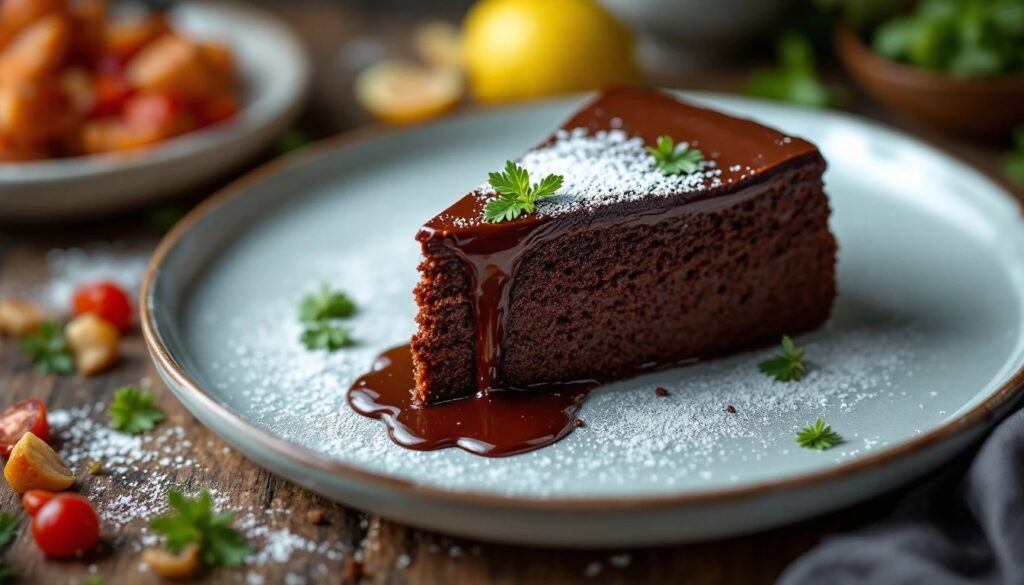
Imagine the cloisters of an ancient French abbey, perhaps in the 17th or 18th century. While the prior might have been a man of spiritual devotion, he was also likely a figure of considerable worldly influence, hosting dignitaries and requiring meals that reflected the abbey’s standing. The very notion of a “chocolate cake” at this time was a statement of immense luxury. Chocolate, vanilla, and even coffee were recent, precious imports from the New World and distant empires, far removed from the everyday staples of European tables.
The history of this cake is a delicious narrative of global migration. Cacao, the source of chocolate, originated in the rainforests of Mesoamerica, where it was revered by the Maya and Aztecs. Vanilla, too, was a Mesoamerican secret, its intoxicating fragrance initially bound to the Totonac people of Mexico. Rum, derived from sugarcane, tells a story spanning from Southeast Asia to the Caribbean plantations, fueled by the complex history of colonialism and trade. These ingredients, once unknown in Europe, arrived through the Columbian Exchange and intricate spice routes, transforming European culinary landscapes forever. Monasteries, with their wealth, scholarly connections, and often sprawling gardens, were uniquely positioned to experiment with these novelties, turning raw materials into culinary masterpieces.
The preparation of such a gâteau would have been a labor of love and precision. Clarified butter, a hallmark of traditional European baking, ensures a delicate crumb and rich flavor, free from the solids that can burn. The meticulous creation of a custard and a vanilla-laced whipped cream speaks to the French emphasis on layered textures and harmonious flavors. While modern kitchens have electric mixers and precise temperature controls, the spirit of slow, deliberate craftsmanship remains essential. A prior’s kitchen would have relied on experienced hands, careful measurements, and perhaps even a wood-fired oven for a perfect, even bake.
For today’s baker, recreating “The Prior’s Chocolate Cake” is an invitation to connect with this rich heritage. Use high-quality sweet chocolate – the kind that melts silkily and truly sings with the vanilla and rum. Don’t skimp on the clarified butter; it makes a noticeable difference. When preparing the custard, a gentle hand and consistent stirring are key to avoiding lumps. The addition of rum and coffee isn’t just for flavor; they enhance the chocolate’s depth, adding an intriguing complexity that elevates the cake from merely sweet to truly profound. Serve it at room temperature to allow the full spectrum of its flavors to blossom, perhaps with an extra dollop of the vanilla-scented Chantilly. This cake isn’t just a dessert; it’s a portal to a time when food was art, history, and luxury, all rolled into one exquisite bite.
GATEAU AU CHOCOLAT DU PRIEUR (The Prior's Chocolate Cake)
Inspired by time-honored traditions, this exquisite "Gateau au Chocolat du Prieur" invites a journey into luxurious indulgence. It masterfully marries the delicate aeration technique akin to a classic Genoise with the profound depth of a rich chocolate mousse. Gently coaxed to perfection in a water bath, this cake achieves an unparalleled silken, yielding texture that promises to melt upon the palate, embodying a sophisticated heritage dessert perfect for life's most cherished celebrations.
Ingredients
- 7 eggs
- 1 teaspoon vanilla
- 1½ cups all-purpose flour sifted
- 1 cup sugar
- ½ cup clarified butter
- 4 ounces sweet chocolate melted with 3 Tablespoons water and cooled
- quantity not specified heavy cream for whipping
- quantity not specified rum
- quantity not specified coffee for melting chocolate
- enough hot water for water bath and melting chocolate
- as needed confectioners' sugar for sprinkling (optional)
- as needed custard for serving (optional)
- as needed sweetened and vanilla-flavored whipped cream for serving (optional)
Instructions
-
Into a medium-sized saucepan, introduce the specified amounts of coffee and hot water. Incorporate the rum, then add the 4 ounces of sweet chocolate, breaking it into smaller pieces to facilitate melting.
-
Establish a gentle bain-marie by bringing approximately 2 inches of water to a boil in a larger vessel. Remove this larger pan from the heat, then carefully nest the saucepan containing the chocolate mixture within it. Cover and allow the chocolate to liquefy completely. Once molten, remove the smaller pan and vigorously whisk the chocolate until it achieves a lustrous, velvety consistency. Set aside to cool to room temperature.
-
In a heatproof mixing bowl, combine the 7 eggs with the 1 cup of granulated sugar. Suspend this bowl over a pan of gently simmering water (ensuring the bowl does not touch the water). Continuously whisk the mixture for several minutes until it feels perceptibly warm to the touch.
-
Transfer the warmed egg and sugar mixture to a stand mixer fitted with a whisk attachment (or use a hand mixer). Beat on high speed for at least 5 minutes, or until the mixture has dramatically increased in volume (at least threefold) and, when lifted, falls back into a thick ribbon that holds its shape momentarily on the surface, akin to a softly whipped créme.
-
Pour the heavy cream into a chilled metal mixing bowl. Prepare an ice bath by placing this bowl into a larger basin filled with a tray of ice cubes and a small amount of water. Using a hand-held mixer, beat the cream with energetic, broad strokes to incorporate ample air. Continue whipping until the cream has doubled in volume and forms soft peaks that gently hold their form. Finally, gently fold in the 1 teaspoon of vanilla extract.
-
Carefully introduce the cooled, smooth chocolate mixture into the aerated egg base, swiftly yet tenderly incorporating it with a flexible spatula until partially blended. Subsequently, with utmost care, gently fold in the prepared whipped cream. Execute these final blending steps with a light hand to preserve as much of the delicate volume in both the eggs and cream as possible.
-
Pour the meticulously prepared batter into your chosen cake pan (a springform pan is recommended for easy release). Position this cake pan within a larger roasting pan. Thoughtfully pour hot water into the larger pan, ensuring the water level reaches approximately halfway up the exterior sides of the cake pan, creating a protective water bath.
-
Immediately transfer the assembled water bath and cake to the preheated oven. Bake for approximately 1 hour, or until a thin skewer or toothpick inserted into the cake's center emerges clean, indicating it is fully set.
-
Upon completion of baking, switch off the oven and prop the door slightly ajar. Allow the cake to rest undisturbed within its pan and water bath for 30 minutes; this gradual cooling aids in an even settling. Following this, carefully extract the cake (still in its pan and water bath) from the oven and permit it to cool further at room temperature for an additional 30 minutes to firm up before attempting to unmold.
-
This gateau truly shines when served slightly warm. For advance preparation, the cake can be made 1 to 2 days ahead; once completely cool, cover it while still in its pan and refrigerate. To gently rewarm, place the cake (uncovered) in a 200°F (93°C) oven for 20 minutes. Before serving, carefully unmold and elegantly garnish with a dusting of confectioners' sugar or a dollop of freshly whipped cream. For an enhanced experience, consider serving alongside a classic crème anglaise or a generous swirl of sweetened, vanilla-infused whipped cream.
Recipe Notes
Upon careful review, it is noted that the provided ingredient list specifies 1½ cups of sifted flour and ½ cup of clarified butter. However, the subsequent preparation instructions do not include any steps for incorporating these ingredients into the cake batter. The described method, with its emphasis on aerated eggs, melted chocolate, and whipped cream, is characteristic of a sophisticated baked chocolate mousse or a flourless chocolate cake. To ensure the integrity of this recipe, it is recommended to either omit the flour and clarified butter from the ingredient list or to provide explicit instructions for their integration, should they be essential to the intended final product. Additionally, for precision and replicability, specific quantities for the coffee, rum, and heavy cream would greatly benefit the culinary process.
Global Heritage Archive
Anthropological & Spice Migration Record
“A refined culinary tradition, often associated with monastic innovation, aristocratic patronage, and later, the bourgeois kitchen, characterized by precise techniques, rich ingredients, and the elegant incorporation of global flavors.”
🌿 Spice & Botanical Migration
Vanilla, native to Mesoamerica, was introduced to Europe by Spanish conquistadors after the Columbian Exchange; its labor-intensive cultivation outside its native habitat made it an exclusive luxury for centuries. Cacao (chocolate) also originated in Mesoamerica, arriving in Europe via Spain where it transformed from a bitter drink into sweetened confections. Coffee, originating in Ethiopia, spread via the Arab world to Europe, initially as a beverage before becoming a popular flavoring in patisserie. Rum, distilled from sugarcane, traces its roots to sugarcane’s origin in Southeast Asia, brought by Columbus to the Caribbean, where its production became integral to colonial trade with Europe.
🏺 Historical & Archaeological Record
The oldest archaeological evidence of cacao use dates back to 3900 BC in southeastern Ecuador, consumed as a beverage. The concept of sweetened, baked goods (precursors to modern cake) dates to ancient Egypt, Greece, and Rome. However, refined cakes (‘gâteaux’) as we know them, incorporating butter, sugar, and specific leavening, began to truly develop in European culinary traditions from the late Middle Ages, with detailed written recipes for chocolate cakes emerging more commonly in the 17th-19th centuries.
💡 Little Known Facts
- Monasteries in Europe were historically significant centers for culinary development, particularly in baking and confectionery, using their resources and knowledge to create elaborate dishes for feast days or high-ranking guests.
- Chocolate, vanilla, and rum were once extremely expensive luxury ingredients; their prominent inclusion in a ‘Prior’s’ cake indicates a dish of considerable status and expense, likely reserved for special occasions or influential individuals.
📸 Made This Heritage Recipe?
We would love to see how your dish turned out! Send a photo of your culinary creation to [email protected] to be featured in our community gallery.
Leave a review and rate this recipe below!
Curated Literature & Washington DC Downtown Calendar
The Culinary Alchemist: Modern Gastronomy & Flavor Pairing
By LDN Gastronomy Series
Artisanal technique, seasonal sourcing, and kitchen mastery.
Upcoming Downtown Happenings
Live acoustic sessions, gallery receptions, literary salons, and independent trade shows across Washington DC.
